L5 News ·
Top 10 Coins of Auction 3
With L5 Auction 3 on 12/12/25 fast drawing nigh, it is time to share what is becoming a cherished tradition of mine: the top 10 coin list of the auction! From a deaccessioned dekadrachm to the recontextualization of a Carthage argenteus in light of vibrant Roman North Africa, these write ups and coins will surely have something for each and everyone!
Before we begin with the list, the L5 team wishes to express our thanksgiving to each and every one of you for your incredible support throughout this process! Here are our updated numbers for both L5 Auction 1 and Auction 2:
- $435,764 in sales across both auctions, more than double the combined estimate of $202,447.
- $135,127 in fees that L5 has saved collectors across two auctions!
- 4,300+ registered bidders on L5 competing for coins.
- Tens of thousands of additional bidders reached through syndication to NumisBids.
The above numbers highlight that L5 is a veritable success, and the number one destination to both sell and buy ancient, medieval, and even modern coins! Thanks to you, the wonderful sellers and buyers of L5, we are able to present the following list of incredible specimens, each with rich and varied history. Without further ado, here begins the top 10 coin list for L5 Auction 3:
The Top 10 Coins of L5 Auction 3
1. Sicily, Syracuse. Euainetos Decadrachm, circa 400 BC.

Boston Museum of Fine Arts Duplicate (MFA inventory no. 1984.807), by the bequest of Cornelius C. Vermeule III.
Syracusean Dekadrachma form the most illustrious series of coinage from all of antiquity, and undoubtedly the laurels for best engraver wreathe Euainetos’ head. Hailed by every generation since the Renaissance as the classical engraver most sublime, the magic and dynamism of Euainetos has caught the attention of even the medieval man. Reliquaries and museum cabinets alike have held the work of Euainetos, a claim that only the smallest handful of celators might be able to make – most certainly not Kimon. For further reading on the history of dekadrachma including medieval misattributions and a curious reliquary, I invite you to read my numismatic article hosted on L5 News, ‘The Dekadrachma of Euainetos: Medieval and Modern Misattributions of Beauty Recognized in Every Age’.
If the medieval man could see the divine in the dekadrachma of Euainetos, then a remarkable man too perhaps noticed a spark of lofty heights in the magnificent artistry in the above coin. Such a piece, such toning, such vivid iconography from so wonderful an engraver surely draws attention from every generation as noteworthy. Admiration for the above dekadrachm traces back to the illustrious Museum of Fine Arts (MFA), Boston, and to the donor of this coin to that institution, Cornelius C. Vermeule III. A World War Two veteran, Harvard graduate, classicist, and director of the MFA, Cornelius was a leading academic and helped to purchase key pieces for the MFA during his tenure. Generous as he was adventurous, Cornelius donated the above dekadrachm to the MFA in 1984. Later sold as a duplicate of the museum, this piece ranks among the most beautiful of the entire dekadrachm series.
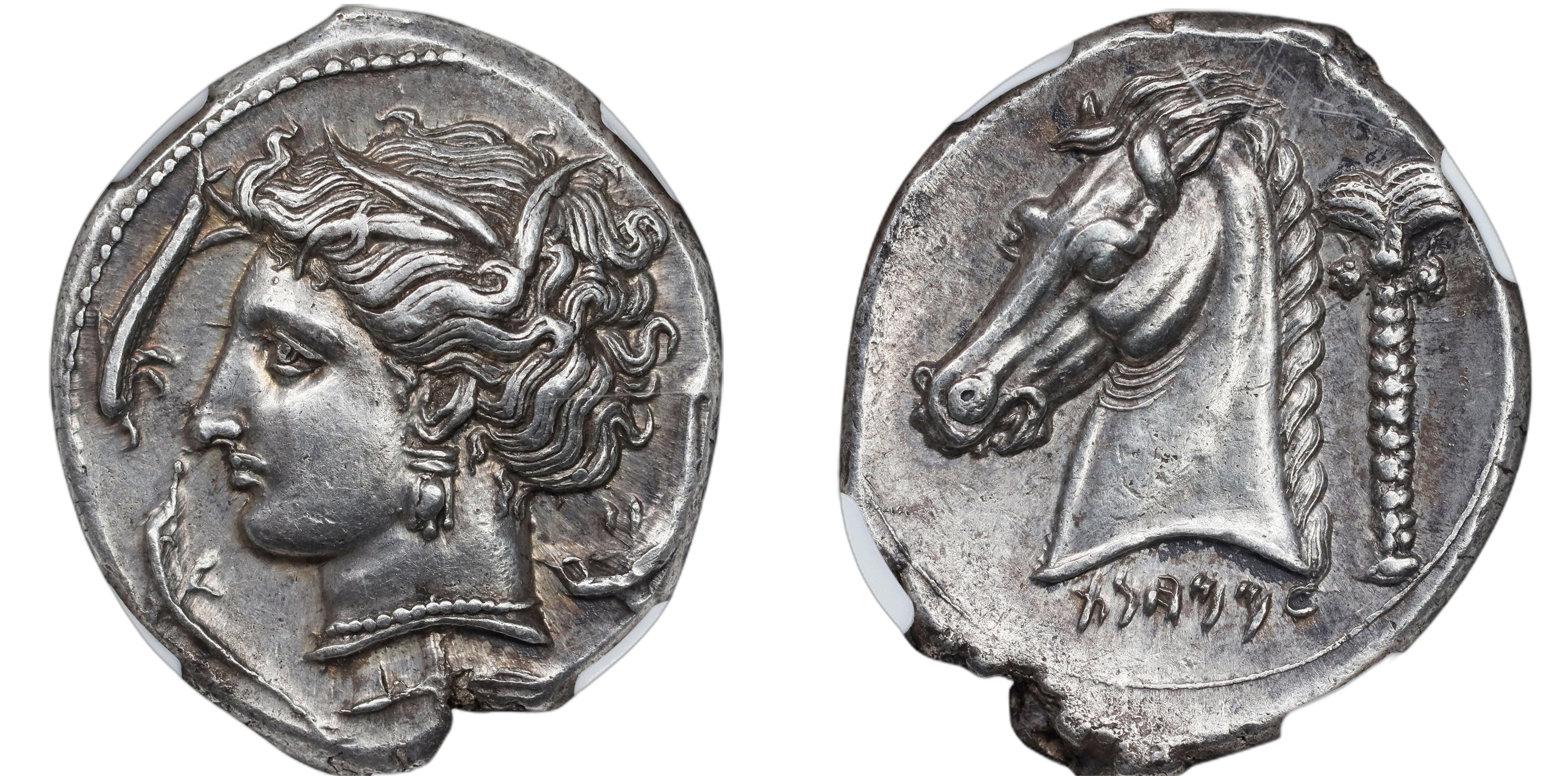
2. Entella, Sicily. AR Tetradrachm, circa 320/15–300 BC.
‘This violence of [the sicilian] landscape, this cruelty of climate, this continual tension in everything, and even these monuments of the past, magnificent yet incomprehensible because not built by us and yet standing round us like lovely mute ghosts; all those rulers who landed by main force from every direction who were at once obeyed, soon detested, and always misunderstood, their only expressions works of art we couldn’t understand and taxes which we understood only too well and which they spent elsewhere: all these things have formed our character, which is thus conditioned by events outside our control as well as by a terrifying insularity of mind’
So writes Giuseppe Tomasi di Lampedusa speaking of the Sicilian outlook in his novel the Leopard. The Jewel of the Mediterranean is a prize oft contested, snatched from the ravaging hands of one power into another. First colonized by Phoenician traders, then came the Greeks, then the Carthaginians, then the Romans, then the Vandals, then the Ostrogoths, then the Byzantines, then the Arabs, then the Normans, then the Swabians, then the Angevins, then the Aragonese, then the Savoys, then the Habsburgs, then the Bourbons, then finally unification and permanent cultural and economic subjugation of Sicily to the north.
As in every age of Sicilian history, the 4th century BC was no different for its natives, facing subjugation by foreign peoples and powers. For those natives living in or near Entella, their new overlord were the Carthaginians. Whether they fared better or worse under the new regime than they would have under differing occupations is unknown and to a degree irrelevant. The fate described by di Lampedusa is applicable in that century as ever, ‘[the invaders] only expressions [were] works of art we couldn’t understand and taxes which we understood only too well and which they spent elsewhere’. Taxes imposed on the natives were spent on the mercenaries hired to crush them, and a work of art the above tetradrachm indeed is.
The Carthaginian invaders, profiting off of conquest and taxation, using local and imported resources dared to make bold on the natives and rival occupiers. The tetradrachm, minted to the Attic weight standard, was intended to be a pleasing payment for the Greek mercenaries who fought for Carthage. The designs echo the great power of that metropolis, with the horse recalling the mother city who sent the expedition to Sicily and the palm tree Phoenicia of old, the progenitors of the Carthaginian people. With a near perfect strike and little to no wear, the shared tetradrachm represents the numismatic emission of a mighty state who invested resources to appease Greek artistic and economic sensibilities while projecting their own power unabashedly. Above all, the coin captures the stunning dialogue and fusion of Punic and Greek art occurring in Sicily at the end of the fourth century BC. One only asks, where are the influences of the native Sicilians and their culture to be found?
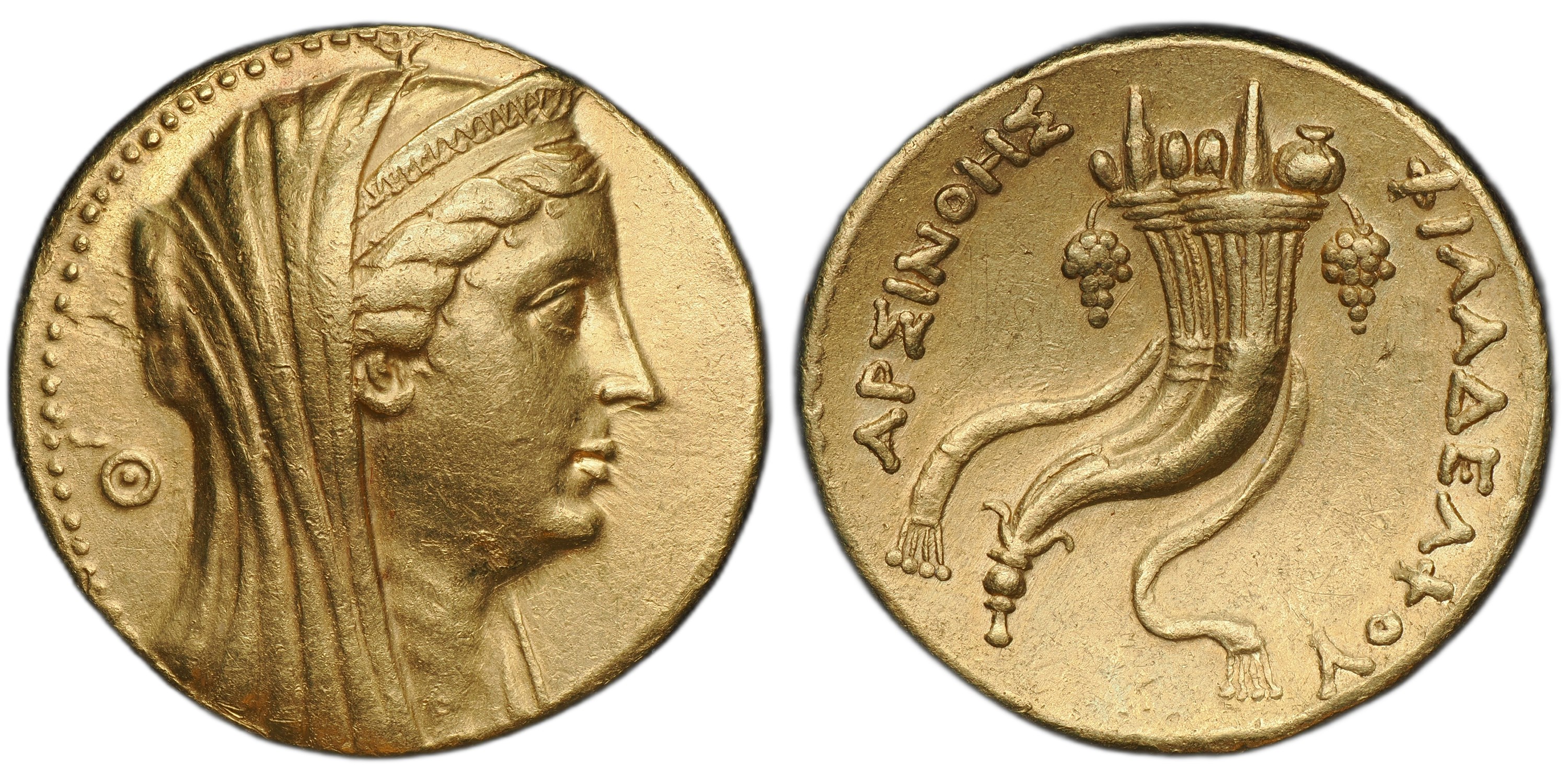
3. Ptolemy II Philadelphos in the name of Arsinoe II, Alexandria. AV Octodrachm, circa 252–249 BC.
Ptolemaic Egypt represents one of the most efficiently run and culturally sophisticated kingdoms of antiquity. For while Egypt was as ancient as the oldest of civilizations, and while her fame stretched back to the dawn of recorded history, the civilization built around the Nile did not reach ripe maturity until the loam rich river beds carrying gold from Kush and Nubia blended with the refinement of the Hellenistic world to elevate Alexandria as entrepôt and develop the kingdom beyond. The superstitious, static nature of Egyptian civilization proved conducive to the elegant vivacity of Hellas, and the melding of both sides of the Mediterranean found a receptive harbor in the city built by the greatest conqueror of all.
If Ptolemy I had the martial valour and audacious foresight to select Egypt as his bequest from the collapsing Macedonian empire, Ptolemy II forged his patrimony from the functional into the prosperous. Jew and Gentile, Greek and barbarian mingled and mixed in the busy causeways of his capital city. The bureaucratic oversight of Ptolemy II overhauled the taxation system and new administrators tended to the detailed governing of a populous domain. While Ptolemy II laid the foundation for the great library of Alexandria, he likewise encouraged two and seventy Hebrews to translate their canon of scriptures into the Greek, an action with profound consequences for the dissemination of Christianity into the Greek east but a few generations later.
Thanks to the capable stewardship and steady reforms of Ptolemy II, the kingdom of Egypt reached new heights of wealth never before seen. The above octodrachm represents a new coin type introduced by Ptolemy II, the largest standard emission gold denomination in antiquity, indicating both the incredible amounts of wealth in the Ptolemaic kingdom and the need for smooth facilitation of its exchange. On one side depicted is the monarch’s deceased sister wife, elevated to the divine pantheon. On the other are two cornucopiae, the symbolized abundance of the kingdom. Warrior, scholar, capable, incestuous – Ptolemy II paints a portrait of a man adept and fierce, able and willing to execute the means to obtain whatever he found enticing.
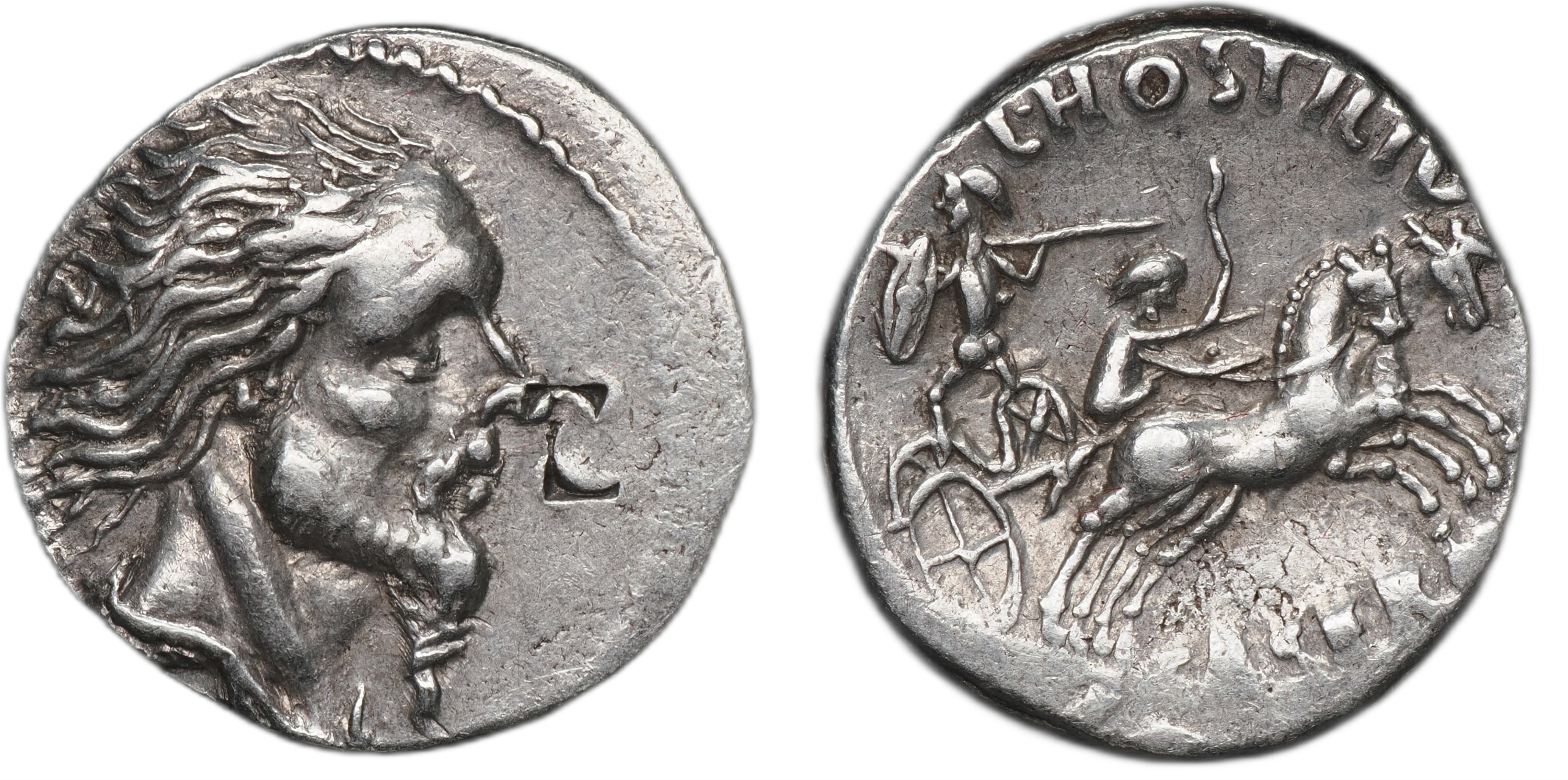
4. L. Hostilius Saserna, Rome. AR Denarius, 48 BC.
Disparate warriors, a fractured people – the strength of Brennus and the Senonii alone was enough to sack and devastate the eternal city before it had yet to fully earn that lofty title. The people of Romulus, Brutus, Cincinatus, and Camillus vanquished before a roaming hoard of brutes. The rectitudinous Romans of ancient stock with nerve and patriotism could not stop even one tribe, yet the reprobate Romans of the late Republic drunk on the blood of citizen, provincial, and empire alike shattered a unified confederacy and forever snuffed out Gallic liberty.
Vercengetorix, gallant Gallic prince and tactician, with cunning and skill wove together a coalition of diverse tribes under the appellation of freedom. To battle for one’s independence, to thwart the invader, to protect the home is ever the good. Yet bravery does not match training, and internecine discord a unified front. Even with the Gauls having practiced dark religion and frequent, barbaric human sacrifices, one still cannot help but sympathize with the plight of such peoples facing the total destruction of their way of life by the irresistible might of the most powerful empire in the world, bent on their destruction. Soon would come the imperial edicts banning the druids and sacrificing of people, even if such practices still continued illicitly alongside whispers and wind in ancient groves and shadowy forests. The last gasp of a dying civilization breathed upon the mirror of her foes, Gaul who had no written records suffered her fate to be told from the Roman mouth. Nor is her material culture spared, for while the quaint, Gallic, zoomorphic archeological remains exist, indelibly they are encroached upon when juxtaposed in the museums of Europe with the finer, gleaming marbles of Rome and Greece.
With cruel irony, Gaul is perhaps best visualized by the art commissioned by the empire that vanquished her. The Dying Gaul statue is seared into the memory of the collective consciousness, and the only lifelike depictions of these ancient Gauls from antiquity come from the presentation of their effigy through propaganda of the victorious Romans, promoting themselves and their glory as seen on the above coin. Serving as the foil to the Romans for contemporary, moralizing historians, the Gauls are perhaps today best remembered for the atrocities committed against them, and the victories won over them at the hands of the Romans. If the Gauls were eventually avenged by the migrating Germanic tribes that the Western Roman Empire succumbed to, the descendants of the Gauls suffered alongside the Romans under the German invasions the same.
5. Julius Caesar (L. Munatius Plancus as praefectus urbi), Rome. AV Aureus, autumn 45 BC.
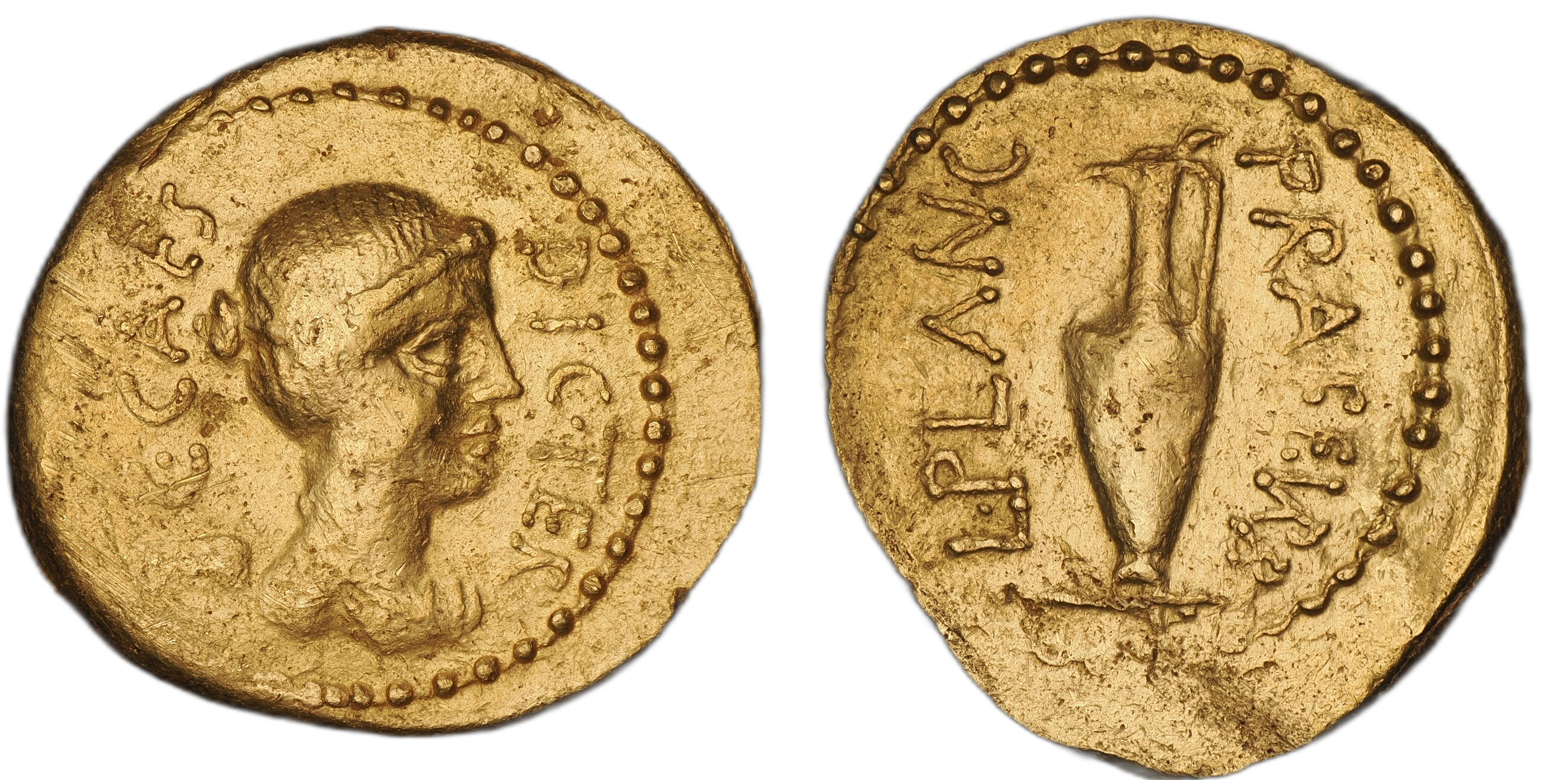
At the height of his power and authority, Julius Caesar issued the above aureus to commemorate his victories in the Roman civil wars. The goddess on the obverse symbolizes Caesar’s victory either in the Spanish or African campaign against fellow Romans. In the very act of celebrating the vanquished being trampled, against good taste Caesar no longer displayed victories over foreign enemies but victories over his own countrymen. Burgeoning with the arrogance that can only come with the accumulation of power, Caesar unnecessarily flaunted the trappings of his authority whereby discreetly exercising the means thereof would have achieved his aims better.
In this Caesar can be proud, for when he wept at the grave of Alexander as a young man lamenting how little he achieved in comparison to the exploits of that king, Caesar in his middle age had now at least matched his declared rival if not in military reputation (for Caesar suffered battlefield losses, Alexander none), and if not in military conquests (for Caesar had conquered but one nation, Alexander innumerable), then at least Caesar now matched Alexander in one regard: self aggrandizement and a total corruption of self in the reins of power.
No longer the reserved statesman and great diplomat, Caesar was blinded by his own success and unable or unwilling to care about the consequences thereof. The niceties of respecting traditions and laws going back centuries he ignored. As his might increased, the relentless tides of Caesar’s ambition and greed knew neither slake nor stop. Augustus with sagacity limited his own appetite to the exercise of power and not its display. Caesar had no time to protect delicate sensibilities, and he met his end under a statue of his rival slain by his friends as a result. As in before Caesar’s lifetime, during it, and after, the numberless multitude of wretched citizenry were given the chance to escape destitution for the price of their limb or life. Such is the fate of a nation beset by great men competing for greater prizes still.
‘Caesar, let us quit this madness
of civil war. Through land and sea you seek
more enemies to pierce us, ready to spill our
lives unvalued at the hand of any foe. Some
of us slain in Gaul, others in the hard fighting
in Spain; others lie behind in Italy; throughout
the world your victories mean soldiers perish.
What use to have shed our blood in the north,
victorious beside the Rhone and Rhine? Your
reward to us for such campaigns is civil war.
- Lucan, Pharsalia, Book V
6. Mark Antony with Octavia, Athens. AV Aureus, Summer 38 BC.
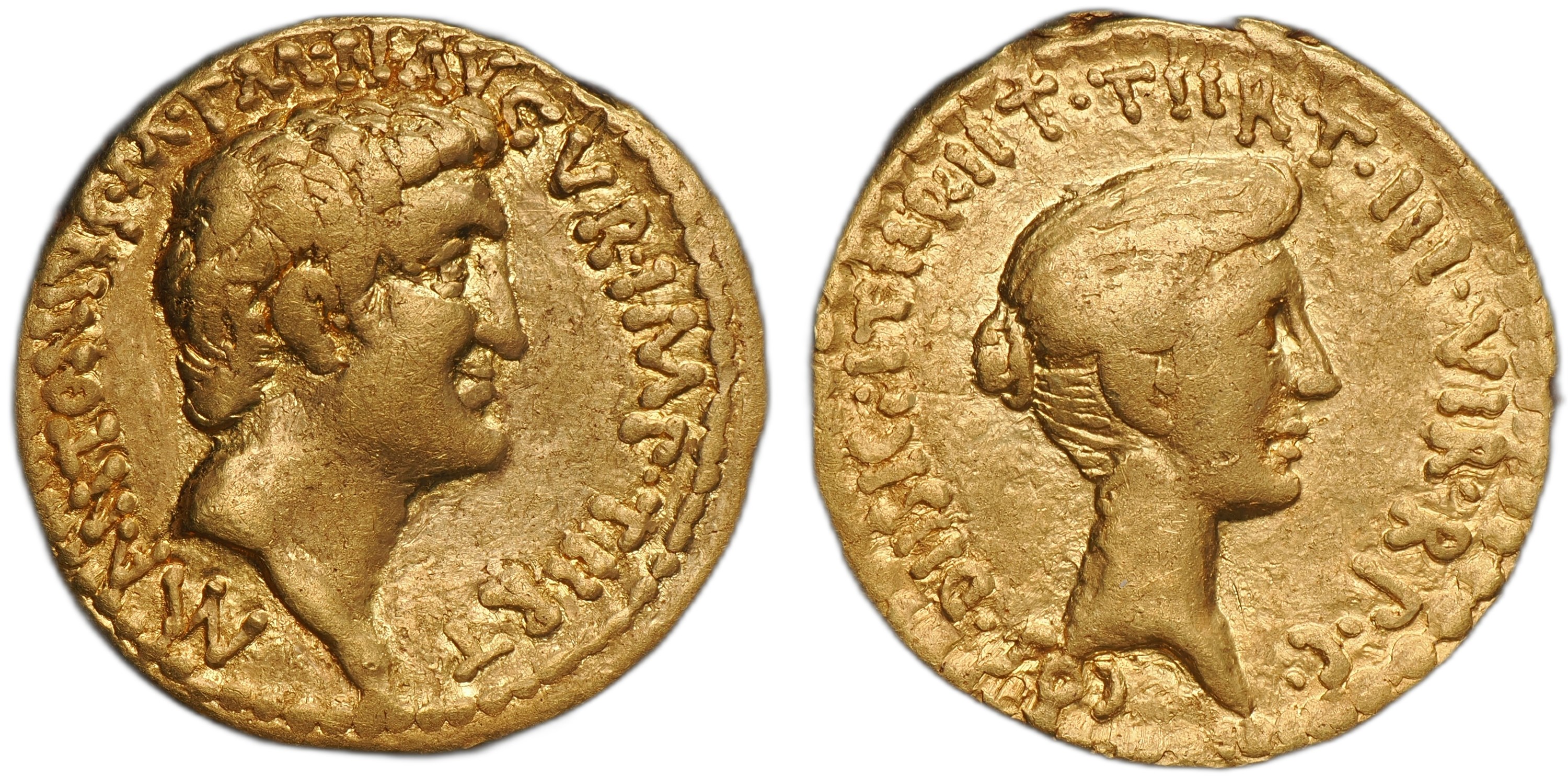
A perilous dynastic arrangement that never lasted, the above aureus represents a rare snapshot at harmony between Octavian and Mark Antony. Still pregnant with the child of her recently deceased first husband, Octavia was quickly married off to Antony by Octavian in the ill-fated hope of cementing their alliance through the union. Octavia faced many injustices, not the least of which was her treatment at the hands of her husband. Antony already being acquainted with Cleopatra (for the pair had a set of twins the previous year), the star crossed lovers so famously depicted by Shakespeare were fated to live and die together. Antony was loyal in many regards but not the marital bed chamber, and when Cleopatra captured his heart so too did she his mind. A man true to his friends, Antony nevertheless was dictated by his passions. Octavia followed the higher precept of virtue.
Scorned from the outset of the marriage, Octavia remained faithful to her estranged husband and continued to support him even after abandonment. Ever tender, she adopted and was guardian of the children Antony had with her, his first wife Fulvia, and his third wife Cleopatra. Respected as the ideal matriarch and granted honor by Octavian, Octavia lived out her final years in widowhood with great prestige and esteem. Only the death of her son Marcellus could shake the firm foundations on which she was grounded.
Marcellus, married to the daughter of (by then) Augustus, was poised to play a prominent role in the Augustan age before illness cut his life short. Both genetically and emotionally close to Augustus and Octavia, Marcellus would frequently feature in contemporary literature after his death, often at steep financial gain to the author. Aelius Donatus in his Vita Vergilii, recounts a story about Octavia, ‘Much later, when [Virgil] had refined his subject-matter, he finally recited three whole books for Augustus: the second, fourth, and sixth–this last out of his well-known affection for Octavia, who being present at the recitation is said to have fainted at the lines about her son’:
At this Aeneas said – for by his side he saw a youth of passing beauty in resplendent arms, but with joyless mien and eyes downcast: “Who, father, is he that thus attends the warrior on his way? Is it his son, or some other of his progeny’s heroic line? What a stir among his entourage! What majesty is his! But death’s dark shadow flickers mournfully about his head.” Then, as his tears well up, Father Anchises begins: “My son, seek not to taste the bitter grief of your people; only a glimpse of him will fate give earth nor suffer him to stay long. Too powerful, O gods above, you deemed the Roman people, had these gifts of yours been lasting. What sobbing of the brave will the famed Field waft to Mars’ mighty city! What a cortege will you behold, Father Tiber, as you glide past the new-build tomb! No youth of Trojan stock will ever raise his Latin ancestry so high in hope nor the land of Romulus ever boast of any son like this. Alas for his goodness, alas for his chivalrous honour and his sword arm unconquerable in the fight! In arms none would have faced him unscathed, marched he on foot against his foe or dug with spurs the flanks of his foaming steed. Child of a nation’s sorrow, could you but shatter the cruel barrier of fate! You are to be Marcellus. Grant me scatter in handfuls lilies of purple blossom, to heap at least these gifts on my descendant’s shade and perform an unavailing duty.”
(Donatus continued) ‘Revived only with difficulty, [Octavia] ordered ten-thousand sesterces to be granted to Virgil for each of the verses’. To touch the tender heart of Octavia was to touch her largess. While the above aureus certainly would not have featured among the gift from Octavia to Virgil, the coin does represent only for the second time in history a woman on a Roman coin (the first with some irony being Fulvia). Intelligent, diplomatic, and above all kind hearted, Octavia stands out as perhaps the most favorable figure in the late Republic and early Empire among a rather motley crew of morally dubious and outright reprehensible characters.
7. Trajan, Rome. AV Aureus, circa AD 108–110.

Ex Glendining, 3 December 1929, lot 159. Illustrated in Calicó, Aurei 996a
Tribunate powers and the consulship aside, officially he is titled Imperator Caesar Nerva Traianus Divi Nervae filius Augustus Parthicus Germanicus Dacicus Optimus Princeps Pontifex Maximus Pater Patriae. Terror of the barbarians, scourge of the East, Trajan stands tall among the Roman emperors. Suffering from the general condition of the office, war and subjugation for the sake of conquest were his modi operandi. Yet the temperament of the man was firm if mellow, with an unrelenting approach to warfare but a collected and humane governance of the empire.
Of his predecessors, Augustus, Claudius, and Vespasian each to a degree might be lauded, the likes of Tiberius, Caligula, Nero, and Domitian eternally condemned, and both Titus and Nerva forgotten. The ignominy of one of the emperors condemned outweighs in indecency the combined dignity of all the emperors lauded. Where Trajan would rank among the more respectable of the emperors is difficult to say, and the paltry list of capable rulers in the early Roman Imperium serves as the greatest advertisement against monarchy and autocracy in the entirety of antiquity.
Provincial if thoroughly romanized, Trajan represents a turning point in the history of Rome, where the imperial throne was more open than ever to those who could only but grasp it. Trajan himself, ascending to the imperial office via back channel negotiation and veiled threats of a coup, was a harbinger for the crises to come wherein every man that could aspire to the throne did. Those days still far off, Trajan’s reign was rather felicitous. If he overextend the reach and boundaries of the empire beyond prudence and good taste, then perhaps his successors are to be blamed for craven attitudes that guaranteed the conquests of Trajan as lost. ‘Felicior Augusto, melior Traiano’, if the first clause raises an eyebrow, with the second the conscript fathers rightly saluted an emperor elect.
8. Marcus Aurelius as Caesar, Rome. AV Aureus, AD 148–149.
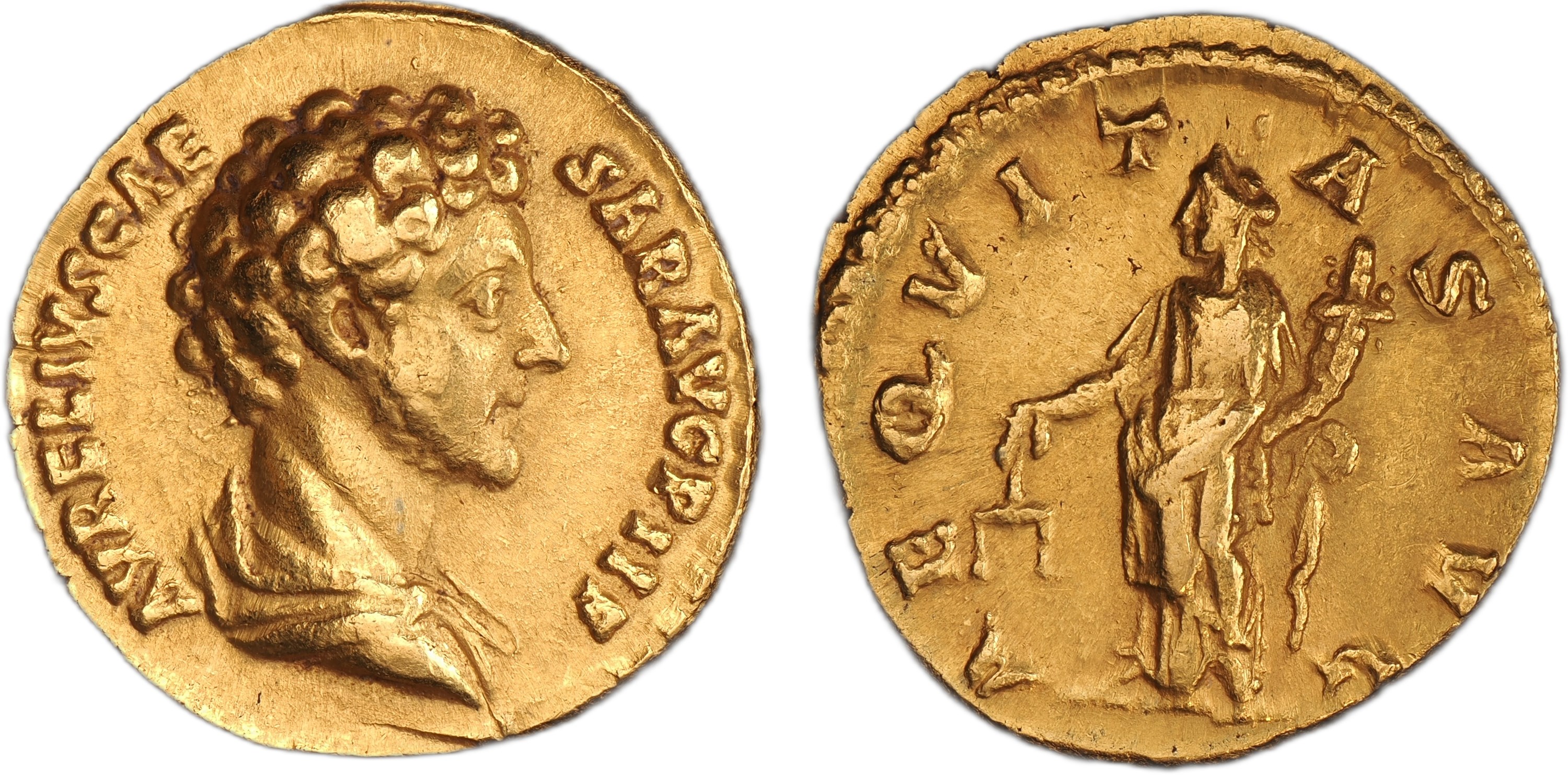
The above aureus represents a wonderful, unpublished specimen for the Marcus Aurelius enthusiast and specialist. Dated most probably to AD 147/148 given the shared obverse die* with Aureus type RIC 445/Calicó 1926, the youthful bust of Aurelius from earlier emissions has begun to show signs of maturity. No longer a youth yet still young, Aurelius at age 27 was already showing promise, the darling of the emperor and empire. At this stage, Aurelius may still enjoy his days as Caesar in tranquility. Eased into the offices of empire, if Aurelius did grumble that his duties took him away from his study of philosophy, he nevertheless had the time to devote to learning. While Lucius Verus cavorted in the streets and theatres, after completing his work young Aurelius stayed buried in his scrolls and codices.
The reverse of this aureus – the presence of which is unique and unpublished for the entirety of the coinage of Aurelius – is intriguing. AEQVITAS AVG promises the justice of the emperor, but Aurelius is of course still Caesar. Most likely, the above aureus is a mule with the Antoninus Pius denarius type RIC 91, likewise dated to the same year. If a mule, then the reverse is fortuitously apt. How indeed would Aurelius upon ascension to the highest office fulfill this promise, the oath of AEQVITAS AVG.
*Ira & Larry Goldberg Coins & Collectibles, Auction 130 lot 1238 (9/27/2022).
9. Gordian III, Rome. AV Aureus, AD 240.
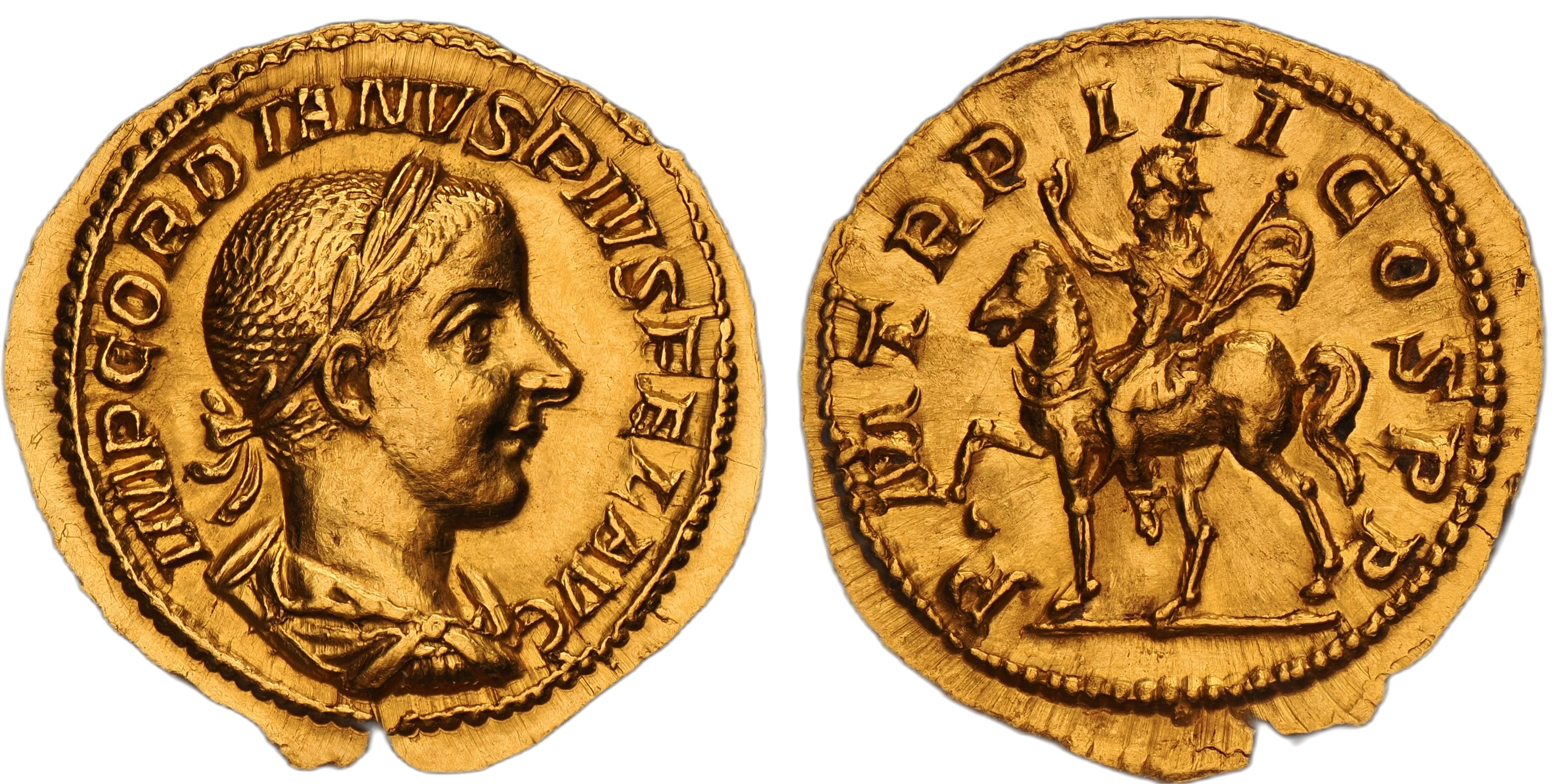
In striking miniature is the emperor astride his charger, paralleling similar Adventus issues. The emperor need brandish no arms, nor declare his prowess. Cloak billowing in the wind while wearing the radiate crown, the simple raising of his right hand and careless carry of the scepter denote the man. Struck in the year 240, the above aureus is a resplendent rarity with shimmering fields and light iridescence. The man in whose likeness the coin was struck is something of an enigma, a powerful symbol of hope and the last cusp of stability before the relentless tides of barbarian invasions and endemic civil strife almost destroyed the empire of the Romans forever. Gibbon writes of his grandfather and uncle, both of whom led a short lived revolt against the tyrant Maximinus Thrax,
“When [Gordian the elder] reluctantly accepted the purple, he was above four-score years old; a last and valuable remains of the happy age of the Antonines, whose virtues he revived in his own conduct and celebrated in an elegant poem of thirty books. With the venerable proconsul, his son [Gordian the younger], who had accompanied him into Africa as his lieutenant, was likewise declared emperor. His manners were less pure, but his character was equally amiable with that of his father. Twenty-two acknowledged concubines, and a library of sixty-two thousand volumes, attested the variety of his inclinations, and from the productions which he left behind him, it appears that the former as well as the latter were designed for use rather than ostentation.”
Of such stock was Gordian III, taking the reluctance of power from his grandfather without the spiritedness of his uncle. Excellently advised, the amiable and gentle Gordian III had a quick and violent descent from the throne after the death of his foremost council. Better suited to a life of otium liberale, perhaps Gordian III should have avoided the imperial dignity and enjoyed a pleasant retirement on his family estates in Rome and North Africa – yet such was not his fate. Only four years after the above aureus was minted, Gordian III met his end in murky circumstances in a far flung region of the empire.
10. Maximian, Carthage. AR Argenteus, AD 297–299.
The blossoming of Roman Africa in Late Antiquity created the most fragrant rose for the crown of the empire yet seen. From the desolate and forgotten interior villages today thronged and thrived multitudes in antiquity. Testimony to the veracity of the flourishing of Roman Africa is Thysdrus. That ancient city boasted of a theatre with a seating capacity of 35,000 strong while the current population of El Djem on the same site is around 21,000. The great difference being of course the many fold increase in population size for the regions across those disparate 1,500 years. Throughout the deserts and craggy landscapes of the north one can hardly believe the poems from antiquity that come down to us describing lush landscapes and vegetation up to hundreds of miles from the coast! The quiet but evidently once prosperous ruins that scatter across the empty seas of sand speak to that truth louder than any literature could.
More important than the cities, the Late Antique population of Roman Africa had the spirit of joy and a culture that produced the greatest minds of the age. Indisputably among the greatest minds of all time and the most significant theologian after St. Paul, the venerable and hallowed St. Augustine grew up in the interior of Roman Africa over 200 miles from the northern coast, in one of many villages situated in a verdant and lively landscape dominated by forests and small-scale agriculture, from where the saint happily recalls childhood memories of interacting with and hunting local fauna. Among St. Augustine we too can credit Roman Africa for Tertullian, Lactantius, and St. Cyprian. If one moves from the famous to the forgotten, the picture becomes even more compelling. Peter Brown, the eminent historian of Late Antiquity, wonderfully recounts the splendor and spirit of these places and times by recounting the epitaph of a certain individual, ‘Here lies Dion, a pious man; he lived 80 years and planted 4000 trees’.
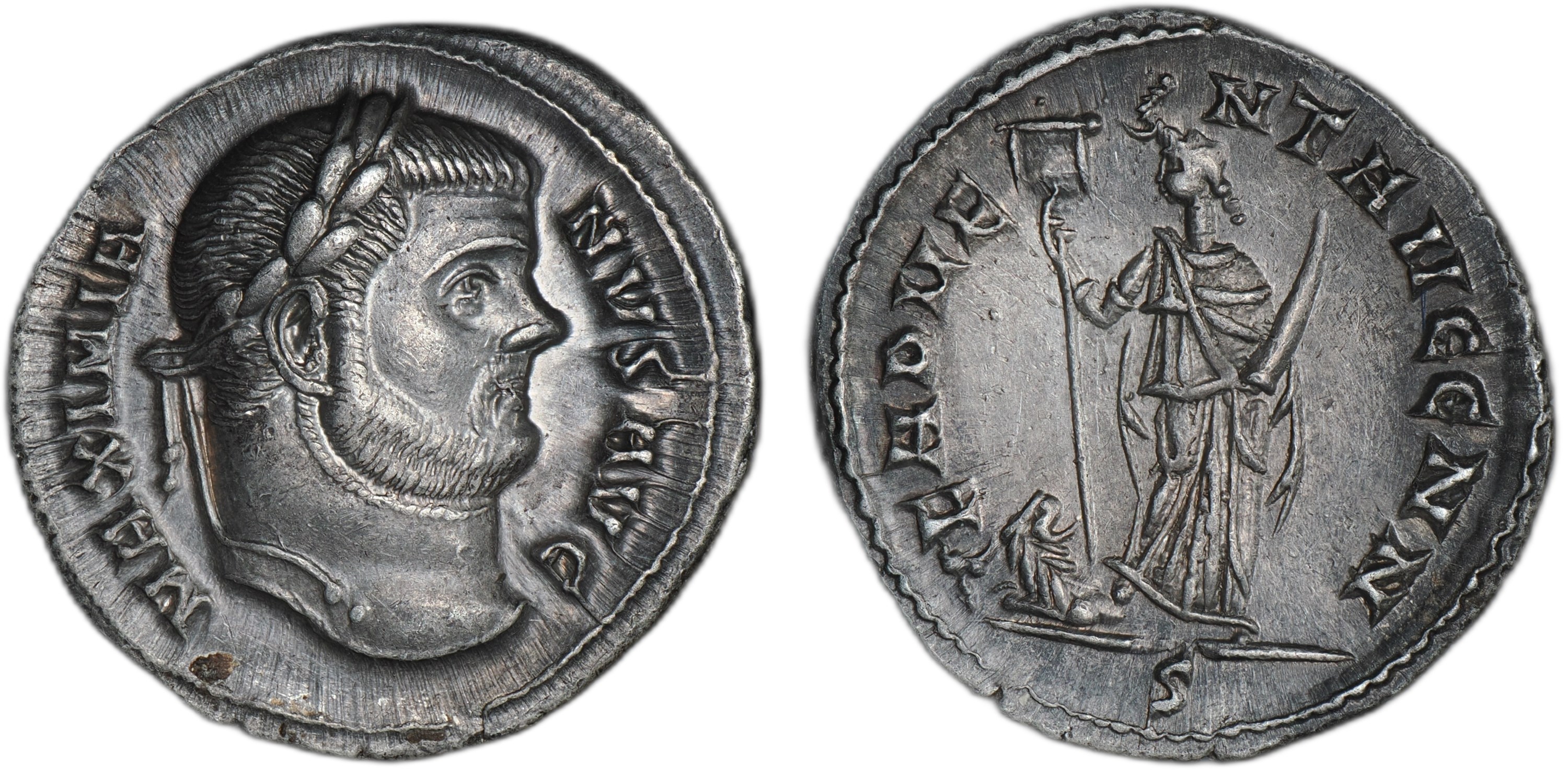
If one can gush endlessly about the countryside and small villages, credit too must be paid to the largest city of all. Carthage, inveterate foe brought to see reason, the melting pot of the entire region and nucleus connecting to the wider world, what splendor and honor you had in Late Antiquity! What names passed through your streets, what power vested within your walls! From the capital of a province to that of a kingdom, even the roving of the Germanic tribes could not suppress your glory. Soon before your ultimate demise, even the saviors of the Romans hailed from you, both Heraclius the elder and the younger! From this city, contextualized in the Late Antique period, was the above argenteus issued. The emperor who minted his coin in your city, Maximian, would have done well to study the lessons of your respectable countrymen.
On the reverse, the personification of Africa herself stands tall, in elephant headdress. Her standard of righteousness is planted over the conquered lion, and the august nature of the province made manifest for all to see.
So ends the top 10 list for L5 Auction 3. If any of these coins should have intrigued you, O’ reader, rest assured that many more treasures are to be found in the full sale. What was shared here is but a small preview. I hope that I have played my part well and to your satisfaction.
Acta est fabula, plaudite!
An Honorable Mention from the L5 Shop

After reviewing L5 Auction 3, don’t forget to view our fixed price page! This exemplary livre turnois of the iron king, Phillip IV, was recently sold there! While you no longer have the chance to acquire this coin minted by the man who shuttered the knights templar, other wonderful examples like it are frequently uploaded to the fixed price section on L5. Make sure to keep tabs on both the L5 auction and the L5 fixed price section!