L5 News ·
As L5 Auction 3 approaches its sale date of December 12th, numerous coins of immense interest have been listed. Certainly not least is a dekadrachmon of Euainetos, with provenance as a deaccessioned duplicate of the Museum of Fine Arts, Boston (MFA). Its donor to that institution was none other than the MFA curator, numismatist, and World War Two veteran Cornelius C. Vermeule III. Such a coin and provenance deserve a deep dive into the world of dekadrachma, including etymology, a curious medieval reliquary, and a syriac apocryphon.
The Absence of the Dekadrachmon
The ancient Syracusan dekadrachma have since their very coining been recognized as forms of the highest artistry. Beyond intrinsic beauty apparent to all, the denomination of dekadrachmon itself poses some questions, for as popular as dekadrachma are in numismatic culture, their cultural significance to the Greeks seems to have minimal at best. Unlike the tetradrachmon or drachmae, the noun δεκάδραχμον defined as a coin worth ten δραχμαί does not actually appear anywhere in our ancient sources. Δεκάδραχμος as an adjective is only attested in Aristotle’s Οἰκονομικά, there as something the price of ten δραχμαί or when substantively used as a citizen assessed at the same value. Comparatively, the smaller τετράδραχμον denomination is rather frequently found in numerous works of ancient literature used as a noun defined as a coin worth four δραχμαί, including but not limited to Plato and Plutarch (the δραχμή needless to say even more so). Thus, no ancient greek source ever specifically used δεκάδραχμον as a noun, and from the adjectival form τετράδραχμος (referring to something the price of four δραχμαί and likewise sourced from the aforementioned work of Aristotle) have numismatists constructed a modern noun for the ancient ten δραχμαί denomination based on the τετράδραχμον.
Coins of value equal to ten δραχμαί do rarely appear in our sources. Diodoros of Sicily mentions a coin worth ten δραχμαί, the famed δαμαρέτειον (XI 26.3, “[Damarete] struck a coin which was called from her a Damareteion. This was worth ten Attic drachmas…”). With use of the verb ἔχω, Diodoros indicates that the δαμαρέτειον is indeed not only equal in value to, but literally comprised of silver equal in weight to ten δραχμαί and so a δεκάδραχμον in the truest sense (“τοῦτο δ´ εἶχε μὲν Ἀττικὰς δραχμὰς δέκα…”). However, in the great encyclopedic compendia like Julius Pollux’s Ὀνομαστικόν that do discuss the δραχμή as a money of account more abstractly and denominations like the τετράδραχμον more specifically, the δεκάδραχμον makes no appearance. Besides the extraordinary appearance in Diodoros, the absence of the δεκάδραχμον in other sources raises questions about the contemporary fiscal and cultural role of the δεκάδραχμον.
Dekadrachma then are surprisingly absent from the plethora of Greek digressions on the drachmae, and the difficulty lies in how this absence is to be understood. Dekadrachma seemingly circulated as normal coinage and were buried alongside smaller denominations in hoards during their own time. Near non-existent in the varied and impressive range of the surviving corpus of classical Greek literature, it is only in periods after the classical age that dekadrachma have reached new heights in both material appreciation and literary topos. These impressive pieces have been reinterpreted and reinvented by subsequent generations as coins with significance beyond that assigned to them by their contemporary culture, or at least beyond what is evidenced by the existing literature. The idea of dekadrachma as something beyond circulating currency, as specially minted commemoratives or presentation pieces, likely stems from an anachronistic viewing of Greek numismatics through later, Roman imperial numismatics practices and most especially Renaissance, early-modern European medallion manufacturing.
A Medieval Discovery
If early modern Europeans misinterpreted dekadrachma through their own enlightenment culture and practices, the high medieval Europeans were no different. Around the year 1300, an individual stumbled across a Euainetos dekadrachmon. Without exaggeration, one imagines that this must have been the most beautiful coin anyone in the period ever laid their eyes upon. Before the Renaissance, the crusty and crude brockage pennies and stiff bezants simply could not compare with the majesty of ancient Hellas. Stunned and mesmerized by the beauty of his dekadrachmon, the finder made the most logical conclusion for attribution of the piece given their own background and knowledge: surely such a splendid coin had a divine background, and was none other than one of the thirty pieces given to Judas to betray Christ.
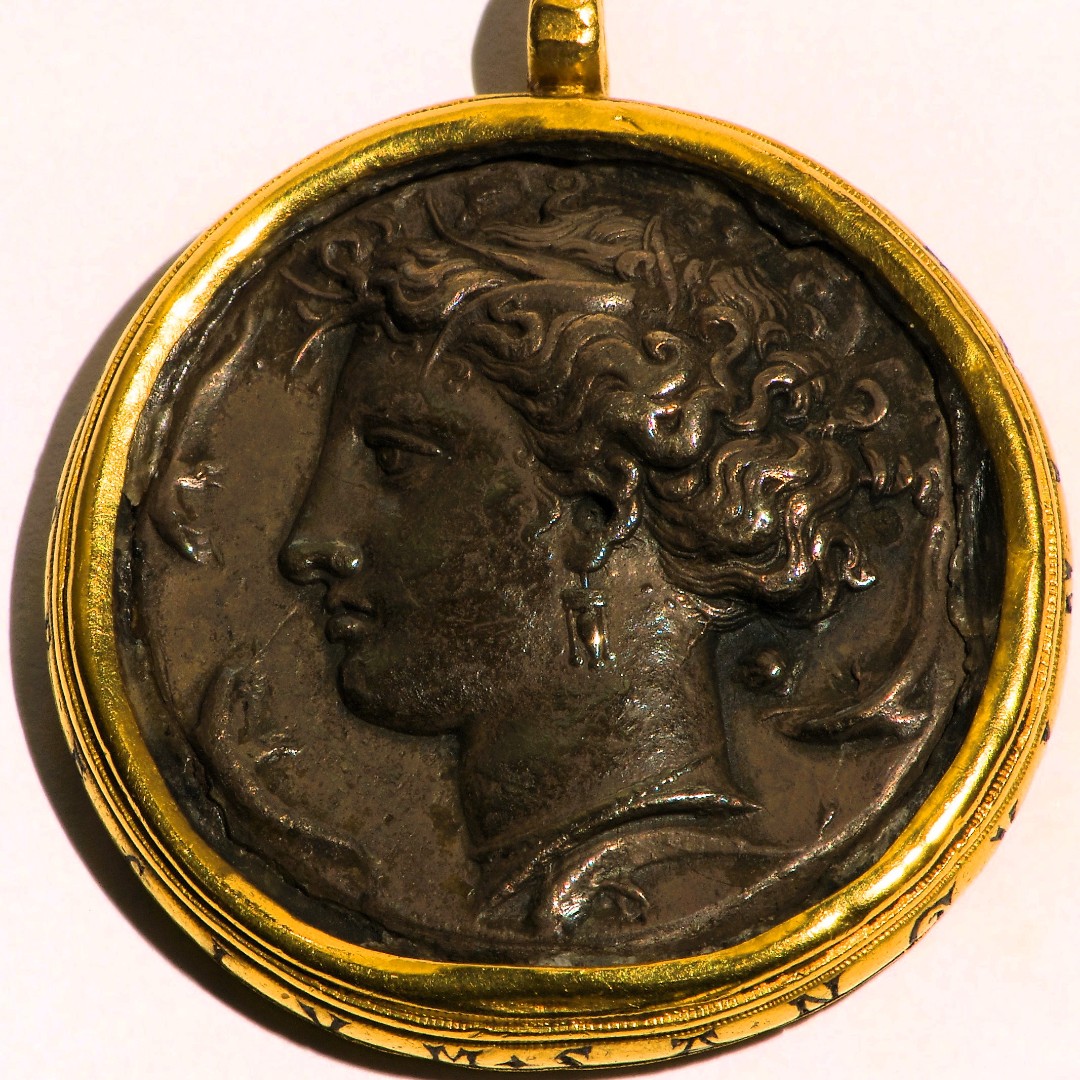
The Hunt Museum, Limerick, Ireland. PD MG 034
Engraved in the reliquary mount around the dekadrachmon reads the legend “QUIA PRECIUM SANGUINIS EST” (trns: because this is the price of blood). The words directly quote from the Matthew 27:16 in the Vulgate, “Principes autem sacerdotum, acceptis argenteis, dixerunt: Non licet mittere eos in corbanan, quia pretium sanguinis est” (trns: And the leaders of the priests, taking the silver, said: this is cannot be put into the temple, because this is the price of blood). Medieval Latin pronunciation was similar for Ci and Ti, thus the slight spelling variation between the reliquary and the more polished Clementine Vulgate. The mount is able to be dated quite precisely thanks to the calligraphic style of the engraved letters.
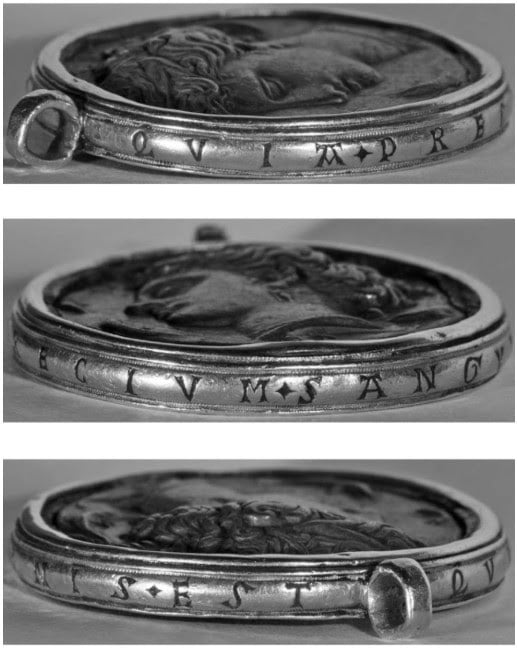
Travaini, The Thirty Pieces of Silver: Coin Relics in Medieval and Modern Europe pg. 106, figures 6.1 c,d,e
While at first glance the medieval attribution of this dekadrachmon as one of thirty pieces might seem absurd, one should remember that serious study of ancient numismatics had not yet come about, and so any inquisitive medieval scholar would not have had a library full of peer reviewed reference works readily accessible to consult. Likewise, they probably would not have had access to many if any other existing ancient coins. Without a numerous collection to study nor existing research, that individual would have worked with the knowledge available to them, namely a society built around a Christian framework with select access to ancient texts.
Rather ingeniously then, the medieval individual was able to reimagine and recontextualize an ancient Greek coin into the wider medieval traditions about history. Among the most prominent of these were apocryphal tales surrounding the fate of the thirty pieces of silver, both before and after they were acquired by Judas Iscariot. In the medieval consciousness, the thirty pieces were not simply part of the transaction between the temple leaders and Judas, but a part of revelation history dating back to the parents of Abraham. Minted by the father of the father of the nations, the thirty pieces uniquely remained together from the bronze age city of Ur of the Chaldeans up to and beyond the purchase of the Potter’s Field in 33 AD. Translated by Tony Burke and Slavomír Céplö, the following syriac apocryphon presents one of many variants on the Medieval understanding of the history of the thirty pieces:
These pieces were made by Terah, the father of Abraham. Abraham gave them to his son Isaac. And Isaac bought a village with them. The master of it brought them to Pharaoh. And Pharaoh sent them to Solomon, the son of David, for the temple he was building. And Solomon took the pieces and placed them round the door of the altar.
When Nebuchadnezzar came and took captive the children of Israel, he entered the temple of Solomon and saw that these pieces were beautiful, and he took and brought them to Babylon with the captive children of Israel.
And there were some Persians there as hostages. When Nebuchadnezzar came from Jerusalem, they sent him everything fit for kings. And when king Nebuchadnezzar saw that all they had sent him was beautiful, he released their sons and gave them many presents. He gave them also those pieces. And the Persians brought them to their fathers.
When Christ was born and they saw the star, they rose and took those pieces and gold and myrrh and frankincense. They took those pieces and set forth on a journey until they reached the vicinity of Edessa. The day grew dark and they fell asleep on the side of the road. And in the morning they arose to continue their journey. They left those pieces where they slept and did not know it. Some merchants came and found the pieces.
And they came to the vicinity of Edessa by a well of water. And on that very day an angel came to the shepherds of that land and he gave them a garment without a seam on the upper end. And he said to them, “Take the garment in which is life to humanity.” The shepherds took the garment and came to a well of water. And they found the merchants who had found the pieces near the well of water. They said to the merchants, “Will you buy this beautiful garment without seam at the upper end?” The merchants said to them, “Bring it here.” And when the merchants saw this garment, they marveled at it very much. The merchants said to the shepherds, “We have beautiful pieces worthy of a kings. Take them and give us this garment.”
When the merchants had taken the garment, they arrived in the city and stopped at an inn. Abgar the king sent for the merchants and said to them, “Have you anything worthy of a king that I could buy from you?” The merchants said to him, “Yes, we have a garment without a seam at the upper end.” When king Abgar saw that garment of which there was no equal, he said to them, “Where did you get this garment?” They said to him, “We came to a certain well by the gate of your city. And some shepherds said to us, ‘We have a garment without a seam at the upper end. Will you buy it?’ And we looked at the garment and saw that there was no other like it in the world. We had with us thirty pieces with images of kings which we gave to the shepherds and received the garment. And these pieces are worthy of kings such as yourself.”
When Abgar heard this, he sent for the shepherds and took the pieces from them. And Abgar sent the pieces and the garment to Christ for the good that he had done him with regard to Abgar’s disease from which he had cured him. When Christ saw the garment and the pieces, he took the garment and sent the pieces to the Jewish treasury. Our Lord knew their secrets. That is why he sent these pieces with which he would be bought.
And when the Jews came to Judas Iscariot they said to him, “Deliver to us Jesus, son of Joseph!” He said to them: “What will you give me if I deliver him to you?” And they rose (and) got those thirty pieces and gave them to Judas Iscariot. And Iscariot returned them to the Jews. They bought with them a burial-place for strangers. And then they brought the pieces to Solomon’s temple and threw them into a fountain inside the temple—the pieces and the staff of Moses the prophet—and thus hid them.
Thus, the thirty pieces of silver did not just represent the most ignominious and infamous transaction in all history, but played an important role in the history of the Messiah. Within this context, the understanding of a dekadrachmon as a piece of the thirty is more understandable. The medieval scholar who did not have centuries worth of numismatic scholarship to consult could not have read that the minting of coinage postdated the father of Abraham by some two millennium, and nor could he have browsed through ready made catalogues. Rather, with ingenious intellect, a foreign and impossible to accurately identity piece was reinvented by sound scholarship built on flawed assumptions to place a dekadrachmon of Euainetos among the thirty pieces of silver. If the medieval scholar was further off from the true attribution of the dekadrachmon, he certainly was not more inventive in his thought process than the early modern scholars who assigned fanciful attributions and events as the impetus of the striking of these coins in the absence of solid evidence.
Of course, the medieval understanding of the rich history of the thirty pieces, of their beauty, and of the cultural infatuation with the story and its apocrypha could only be awakened by a dekadrachmon of Euainetos. It is hard to imagine that the medieval individual upon finding a Kimon dekadrachmon, recognized as inferior by every generation, could have assigned such a coin to the thirty. Euainetos, and Euainetos alone, could excite their imagination and drive home the connection to the blood silver…the poorer cousins made by Kimon must as in every generation play second fiddle, and here again it is no surprise that a Euainetos made it to the status of venerated, religious relic while Kimon laid buried and forgotten, whether in the ground or in a cabinet.
A Modern Treasure
If L5 cannot claim to present a Euainetos dekadrachmon in a reliquary with provenance a millennium old, then we shall attempt to do the next best thing. Perhaps our example was not recognized as divine by the medieval, but it was recognized as beautiful by the expert curator. Hailing from the Boston Museum of Fine Arts (MFA inventory no. 1984.807), the below dekadrachmon was donated to that illustrious institution by the equally illustrious Cornelius C. Vermeule III.
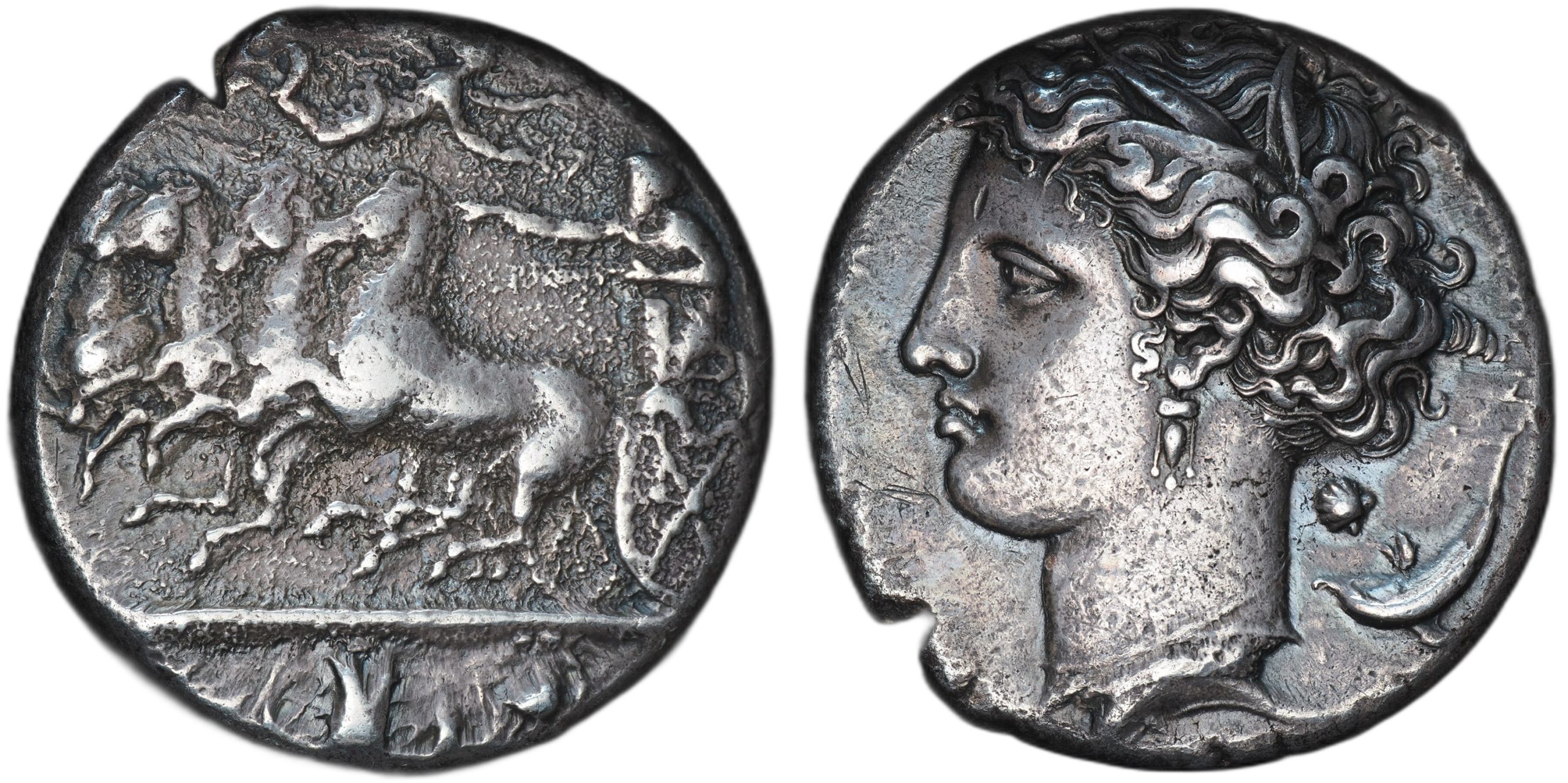
Euainetos Dekadrachmon – Ex MFA Boston (1984.807)
A World War Two veteran, Harvard graduate, and director of the MFA, Cornelius was a leading academic and helped to purchase key pieces for the MFA during his tenure. Generous as he was adventurous, Cornelius donated the above dekadrachmon to the MFA in 1984. Later sold as a duplicate of the museum, this piece ranks among the most beautiful of the entire dekadrachmon series.
Sam Cowell serves as director of Numismatics for L5. Sam will begin his doctorate studying 13th century Balkan and Anatolian coinage at the Universität Wien in the upcoming semester under supervisors Dr. Nikolaus Schindel and Dr. Johannes Preiser-Kapeller, in conjunction with the Österreichische Akademie der Wissenschaften. Sam has numerous publications including the ‘The Fourrée Hyperpyra of John V Palaeologus’. He has presented lectures at institutions including the Oxford Centre for Byzantine Research. Sam obtained his bachelor’s at the University of Tennessee and his master’s at the Wirtschaftsuniversität Wien with the thesis titled ‘Thirteenth Century Byzantine Economic Activity: Analyzing Logistical Networks through Geographic Information Systems’. Forthcoming publications of his include a chapter in the Moving Byzantium series titled ‘Reevaluating the Arta Mint and Epirote Coinage of Michael I and II Ducas: Numismatic Evidence for the Imperial Pretensions of Alexius III in ‘Exile’’.