L5 News ·
Rates of Graffiti on 7th Century Solidi in the Private Trade
The following is the second article in the ‘Graffiti on 7th Century Solidi: Provincial Economic Practices at the Imperial Periphery’ series. Find part one here.
The tens of thousands of solidi bought and sold on the private market provide a dataset with unique insights and impediments as it pertains to the study of graffiti on solidi. In the general absence of geolocated find reporting, privately owned solidi can not provide evidence for questions relating to geographic distribution. Graffiti on solidi offered in the private trade likewise suffer from the same issue of visibility as discussed in the previous article. A seemingly significant percentage of solidi with graffiti are published or sold with no mention as being such. To search and find these unlabeled graffito incised solidi would involve an endeavor of monumental proportions, namely the manual examination of tens of thousands of solidi. With these limitations in mind, there are important insights possible to be gleaned from solidi in private trade without independently examining many thousands of coins. By using the sales archive AcSearch.com with some 35,000 solidi of the 7th century recorded, privately owned solidi can be used to demonstrate the relative percentage of solidi in the 7th century that were incised with graffiti.
The author has opted for a solution to provide relative graffiti rates found on solidi between emperors without tens of thousands of manhours of research. Custom and extensive searches have been set for each emperor to specifically pull only the solidi from their reign on AcSearch.com. These searches have then been repeated to include only solidi from the same emperors described as having graffiti, and the two numbers have been compared. Bias in reporting graffiti – whatever they may be – are likely to be equally borne across the entries of the same auction houses in the same sales archive. The figures below provide the proportional rate of graffiti between 7th century emperors, if not the actual rate itself – something bound to be higher. The figures in the table should not be taken as representative of the true rate of graffiti found on the solidi of each emperor. Rather, these figures represent an approximation of said proportional rate of graffiti found on the solidi of each emperor relative to others in the 7th century.
Solidi and Graffiti Population Figures for 7th Century Emperors According to AcSearch.com
| Emperor | Number of Solidi on AcSearch.com | Number of Solidi with Graffiti Reported on AcSearch.com | Percentage of AcSearch.com Solidus Population Reporting Graffiti |
| Maurice TiberiusAD 582-602 | 2,714 | 137 | 5.0% |
| PhocasAD 602-610 | 4,701 | 375 | 8.0% |
| HeracliusAD 610-641 | 9,100 | 1,054 | 11.6% |
| Constans IIAD 641-668 | 6,904 | 744 | 10.8% |
| Constantine IVAD 668-685 | 2,028 | 190 | 9.4% |
| Justinian II AD 685-695(First Reign) | 1,074 | 26 | 2.4% |
| LeontiusAD 695-698 | 327 | 9 | 2.8% |
| Tiberius III ApsimarAD 698-705 | 641 | 18 | 2.8% |
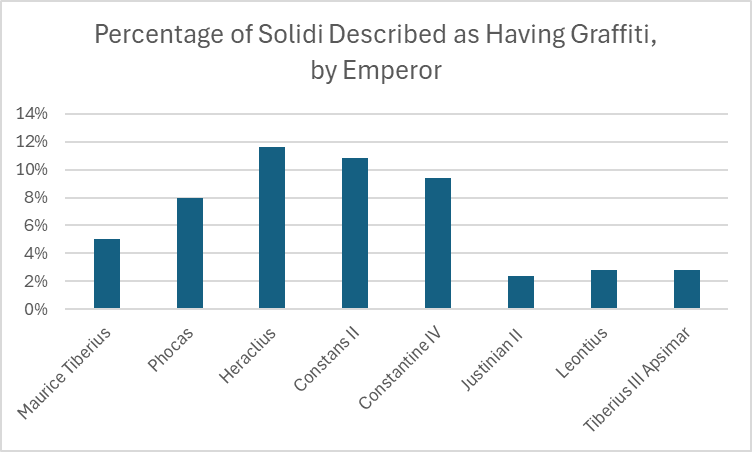
Data gathered on 1/13/2026.
From these figures, it is clear that the pattern first suggested by Bijovsky is represented in the private trade. The proportion of solidi with graffiti to the general solidus population of each emperor follows a chronologically bell-shaped curve, with the solidi of Heraclius, Constans II, and Constantine IV comprising the zenith of graffito incising for 7th century specie. The fact of a solidus from a certain emperor having graffiti indicates a post terminus quem to the assigned chronological window for minting, with the possibility of circulation and graffito incising occurring up to a few decades after. With hoard evidence indicating circulation of Levantine hoards with significant levels of graffiti up to the late 7th century, the general population figures from AcSearch conform to the aforementioned hoard analysis from part one (Hurvat Kub Hoard, AD 662-665; Ben She’an Hoard, AD 680s; Rehob hoard, terminus post quem AD 686). These numbers in conjunction evidence a specific uptake in graffito incisions during the middle and late 7th century, with a steep fall off after the reign of Constantine IV.
The reason why graffito use declined in the late 7th century and beyond is intriguing. Tentatively, the decline in graffito incising could be connected with the events surrounding Justinian II’s numismatic enterprises. With the introduction of Christ on the solidus, the subsequent fallout and reactionary economic reforms of the Umayyads and Abd al-Malik are well known. If 7th century graffito incising is indeed predominantly Levantine in nature, as the dinar replaced Byzantine solidi, the ever decreasing rates of solidi circulating in the Levant led to a parallel decrease in graffito incisions. Likewise, as Byzantine power waned in the face of the Arab onslaught, the rates of circulating solidi in the Levant are comparatively diminished near the end of the 7th century. The picture is a difficult one to capture thanks to a dearth of information dedicated to graffito incising, but the Umayyads conquests and later economic reforms appear more than tangentially related to 7th century graffiti on Byzantine solidi.
Part three in this series will investigate the potential uses for graffiti on 7th century solidi! Keep an eye out in the coming weeks for the next addition to this fascinating series of coinage that L5 is proud to present.
Catalogue
Suggested interpretations of graffiti have been shared below.
Lot 404: Maurice Tiberius, 582-602. AV Solidus, Constantinople.
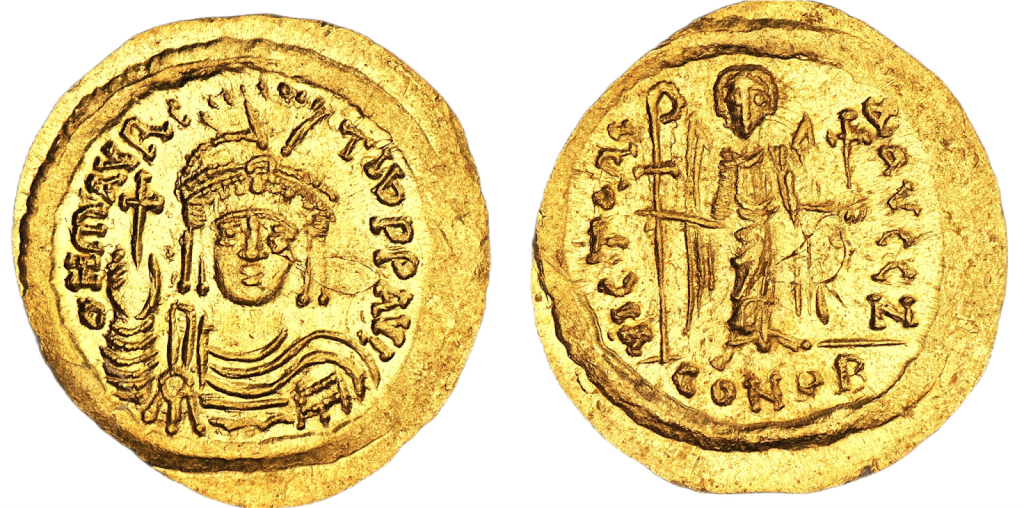
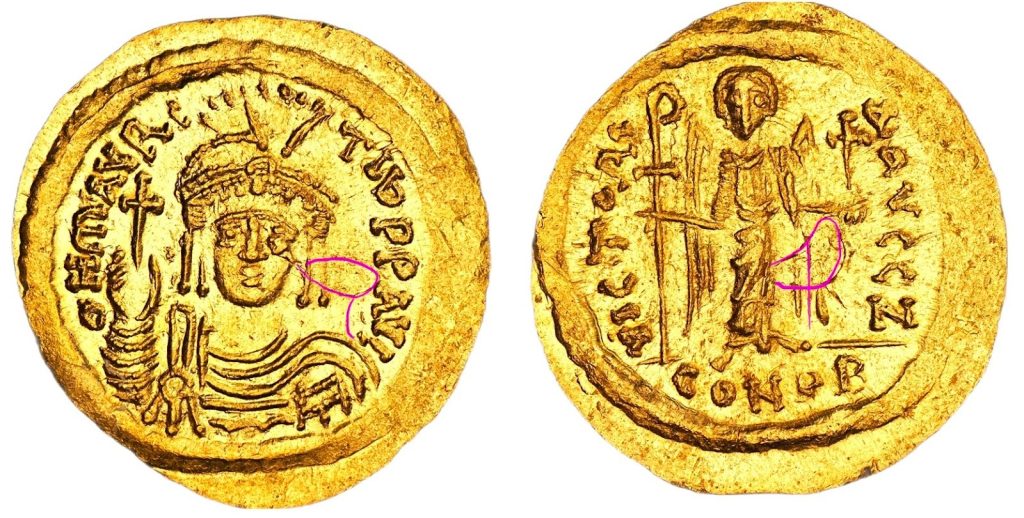
Obverse: α?
Reverse: Φ
Lot 410: Phocas, 602-610. AV Solidus, Constantinople.
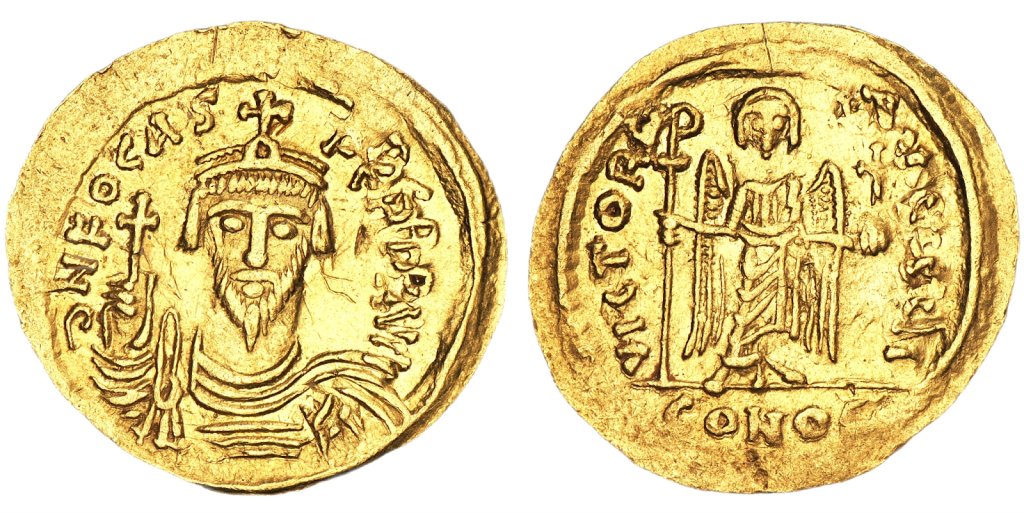
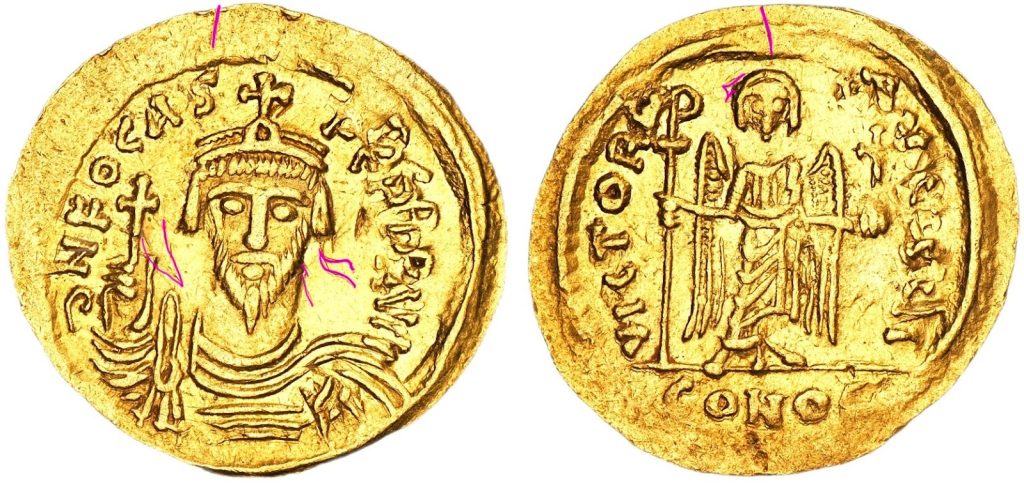
Obverse: [various markings]
Reverse: [various markings]
Lot 411: Heraclius with Heraclius Constantine, 610-641 (616-625). AV Solidus, Constantinople.
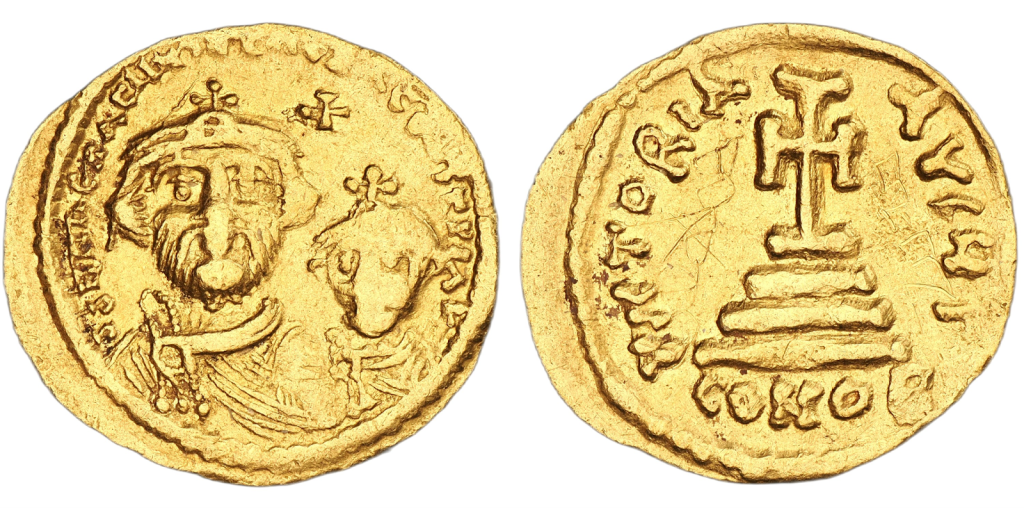
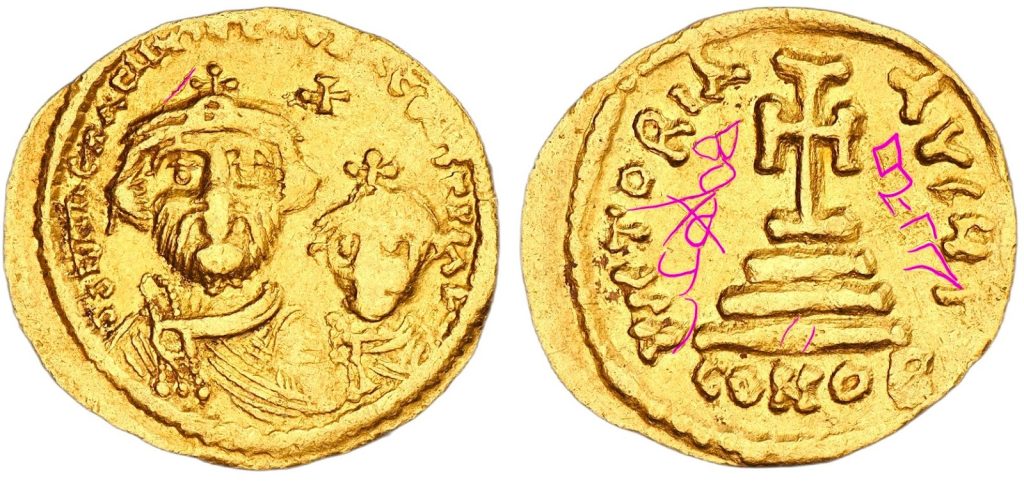
Obverse: [various markings]
Reverse: [uncertain script, partly Arabic? / various markings]
Lot 414: Heraclius with Heraclius Constantine, 610-641 (616-625). AV Solidus, Constantinople.
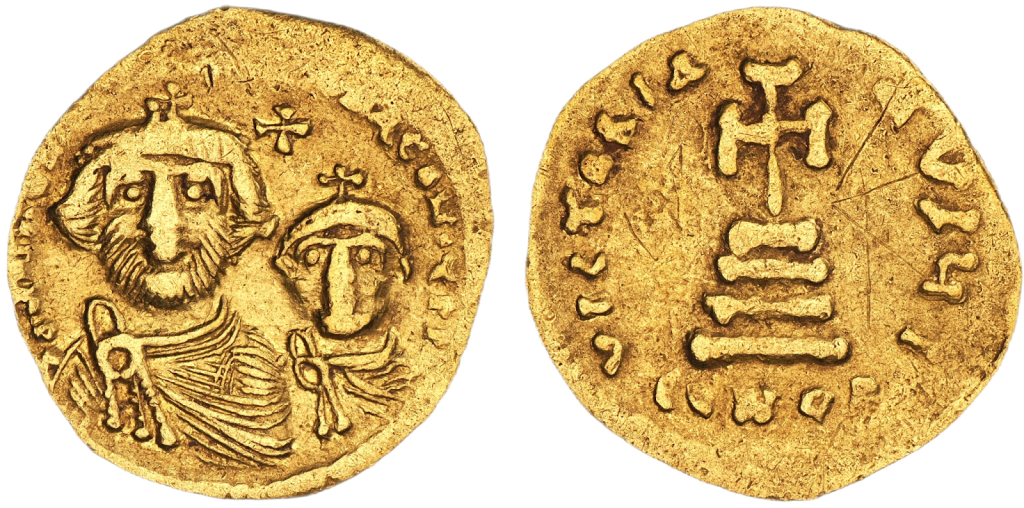
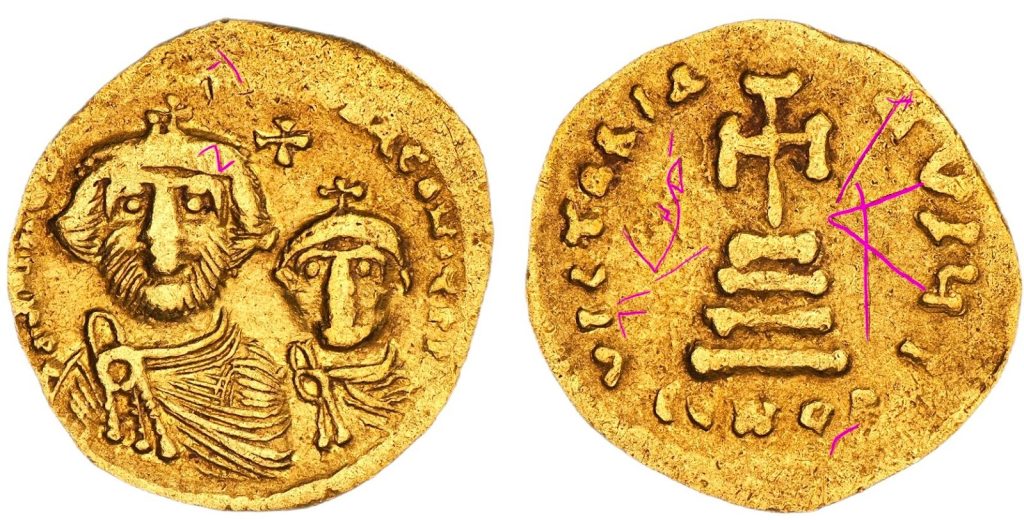
Obverse: ΛN
Reverse: [various markings] K
Lot 415: Heraclius with Heraclius Constantine, 610-641 (616-625). AV Solidus, Constantinople.
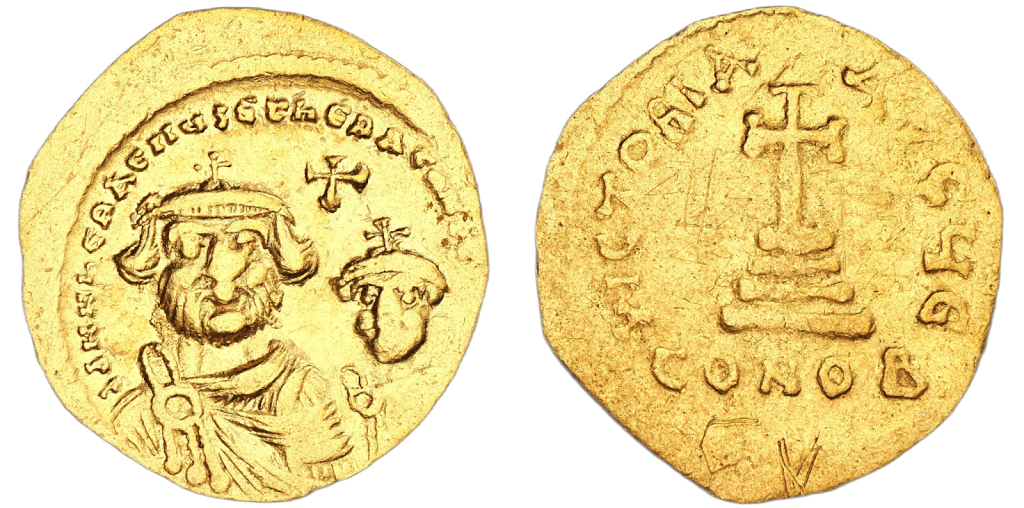
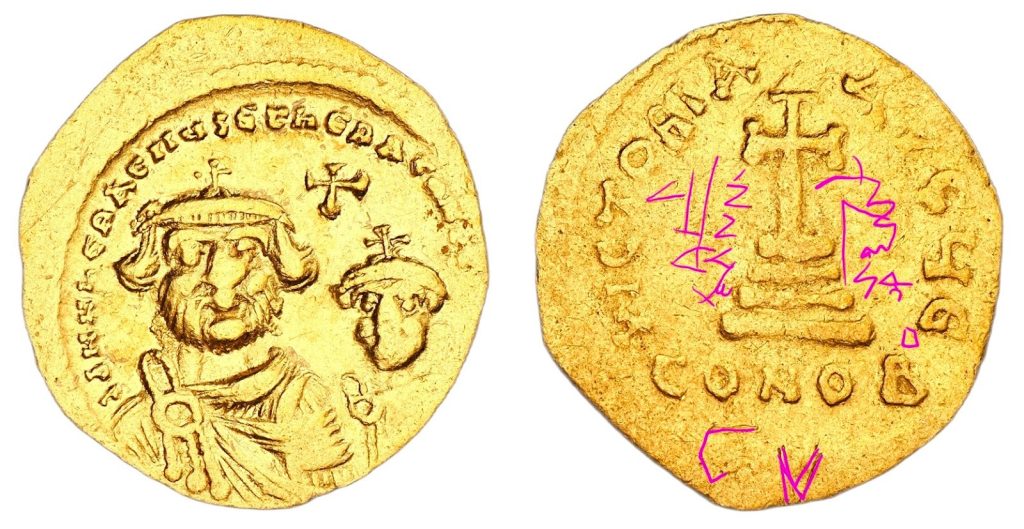
Obverse: [N/A]
Reverse: [various markings] CV
Lot 416: Heraclius, Heraclius Constantine, and Heraclonas, 639. AV Solidus, Constantinople
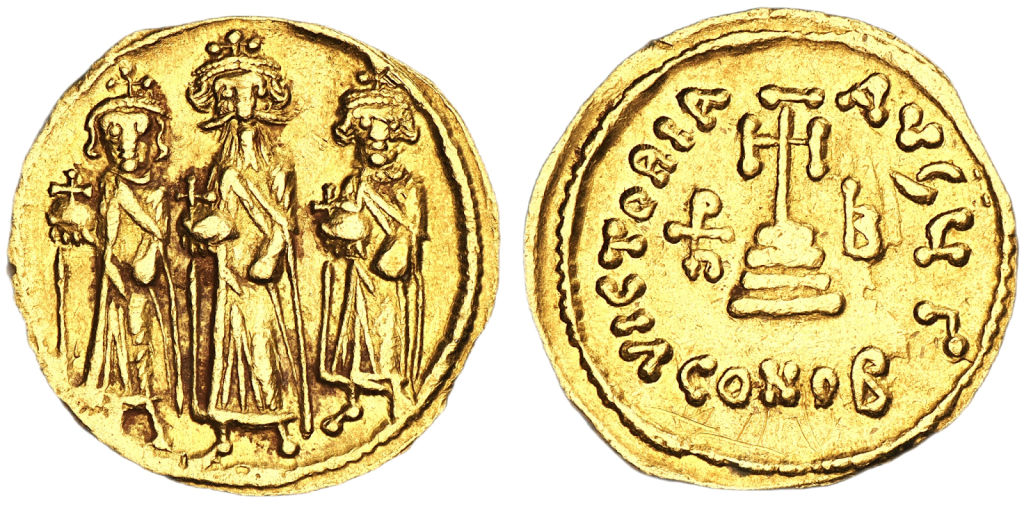
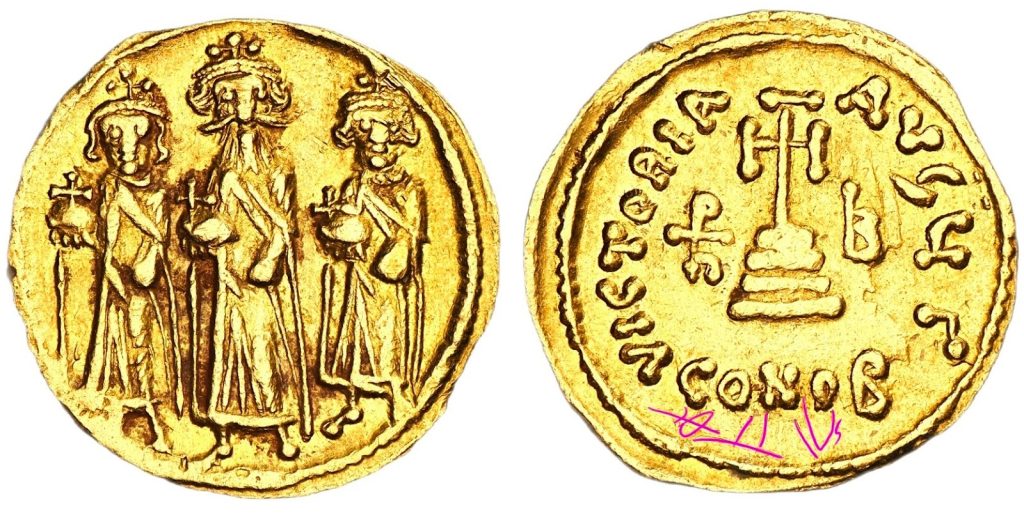
Obverse: [N/A]
Reverse: Θ [various markings]
Lot 418: Heraclius, Heraclius Constantine, and Heraclonas, 639. AV Solidus, Constantinople
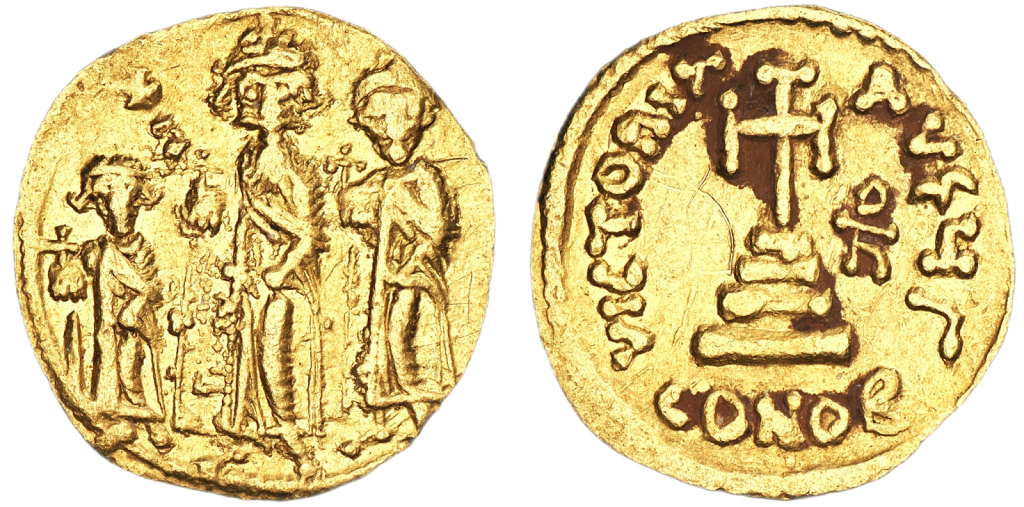
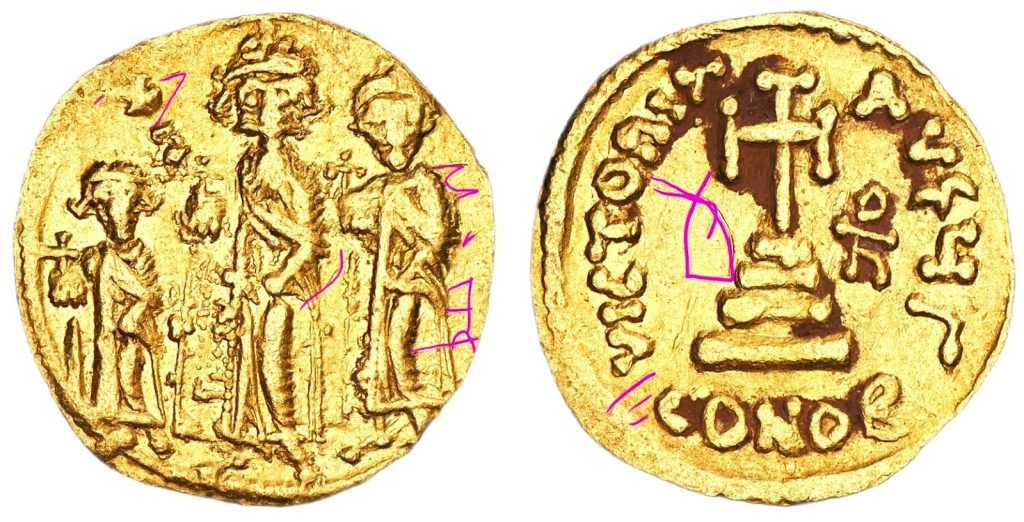
Obverse: [various markings] M Π?
Reverse: [various markings] ȣ
Lot 419: Heraclius, Heraclius Constantine, and Heraclonas, 639. AV Solidus, Constantinople
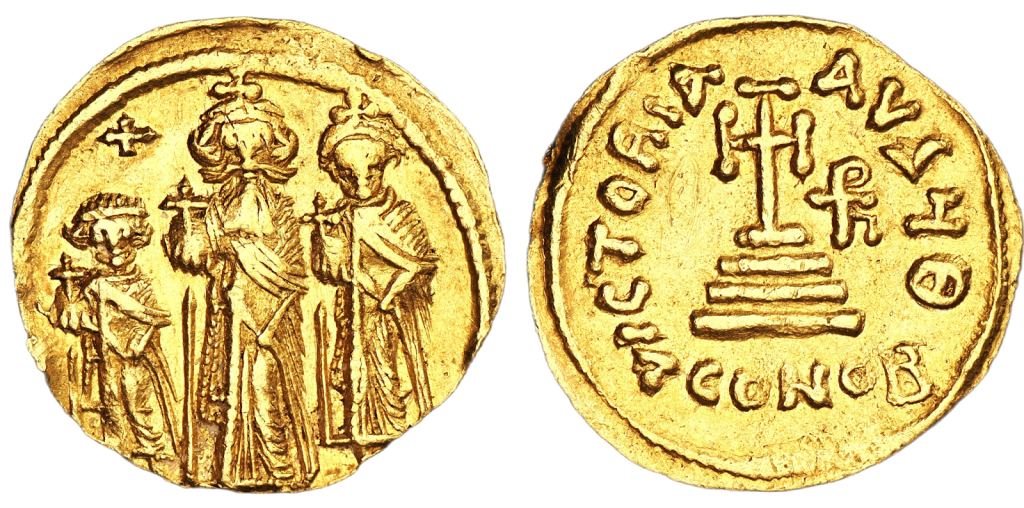
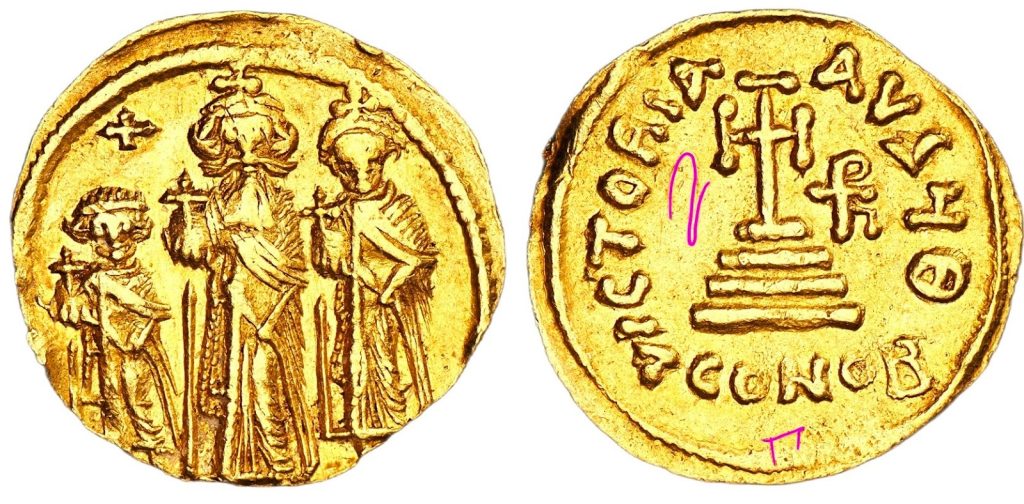
Obverse: [N/A]
Reverse: [various markings] Π
Lot 421: Constans II, 641-668. AV Solidus, Constantinople.
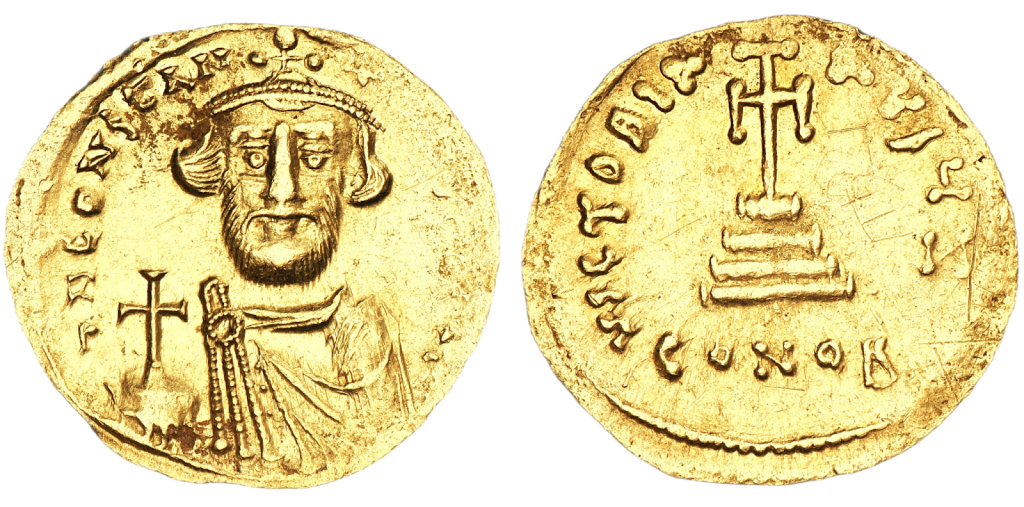
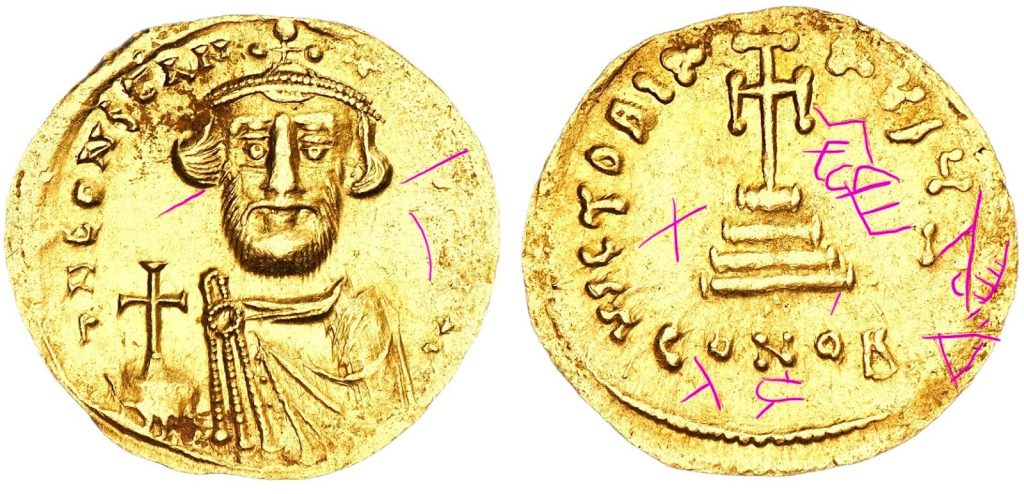
Obverse: [various markings]
Reverse: [uncertain script, Arabic? / various markings] X λC Δ
Lot 422: Constans II, 641-668. AV Solidus, Constantinople.
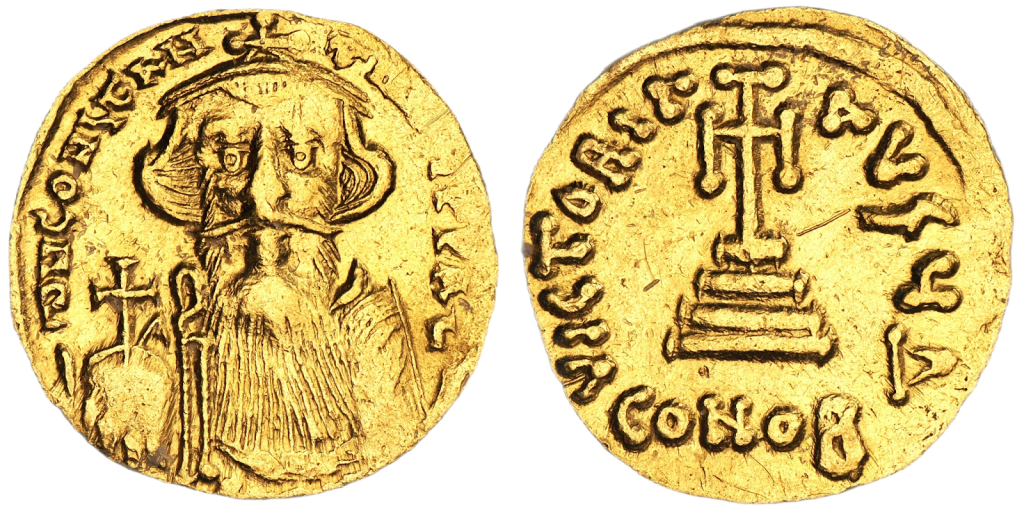
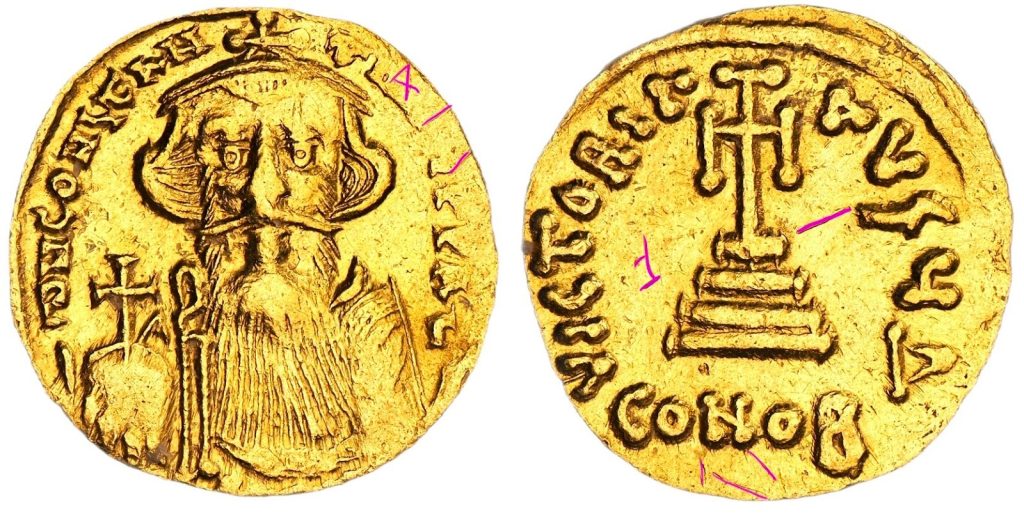
Obverse: [various markings] α
Reverse: [various markings]
Lot 424: Constans II with Constantine IV, 641-668. AV Solidus, Constantinople.
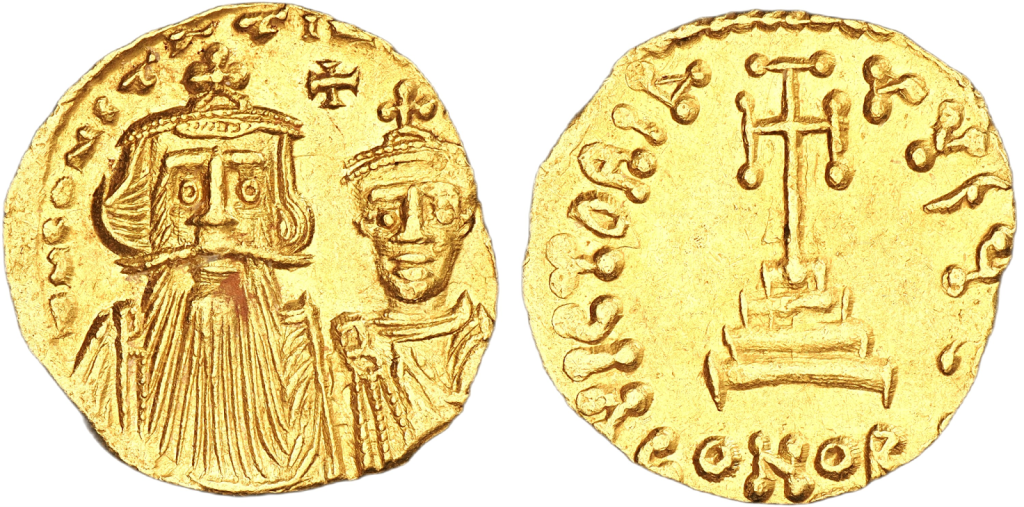
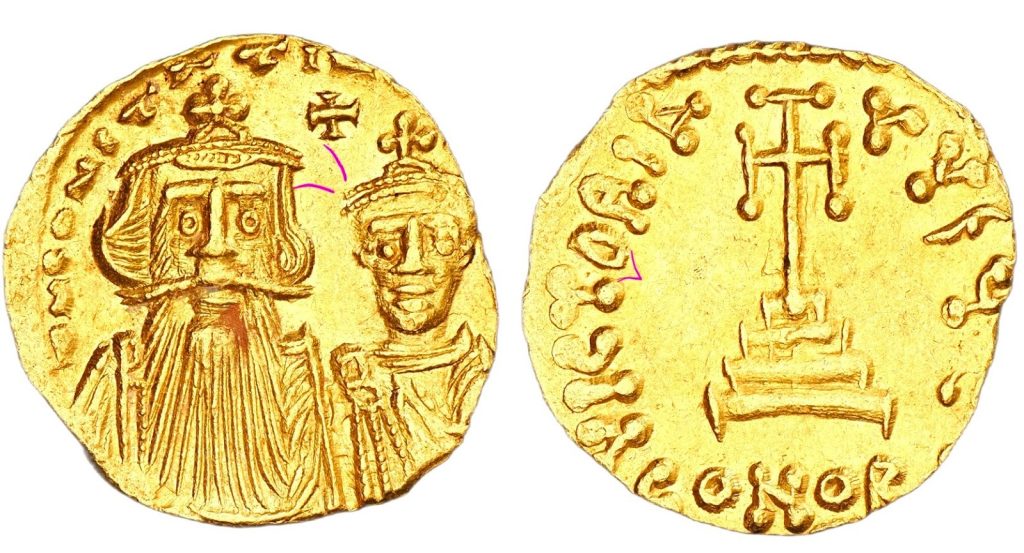
Obverse: [various markings]
Reverse: [various markings]
Lot 425: Constantine IV, Heraclius, and Tiberius, 668-685. AV Solidus, Constantinople.
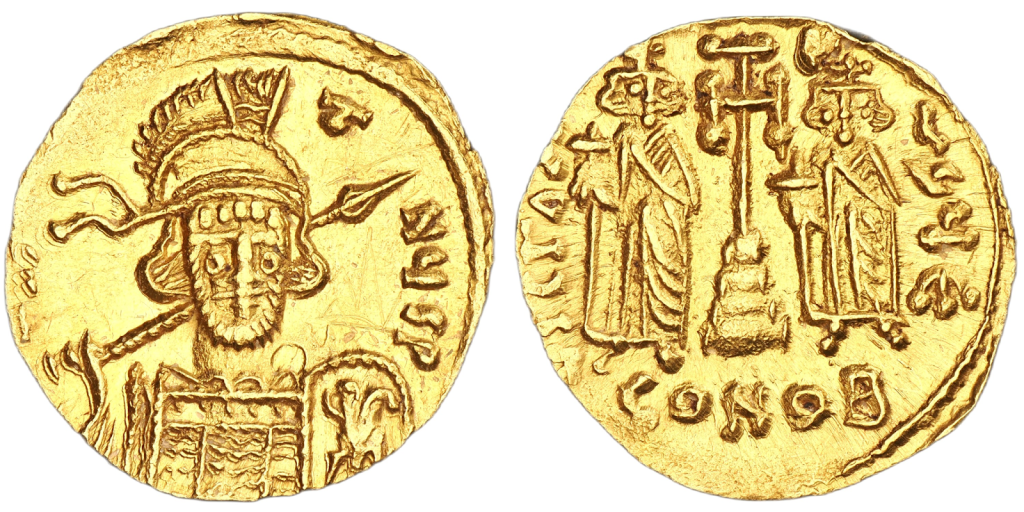
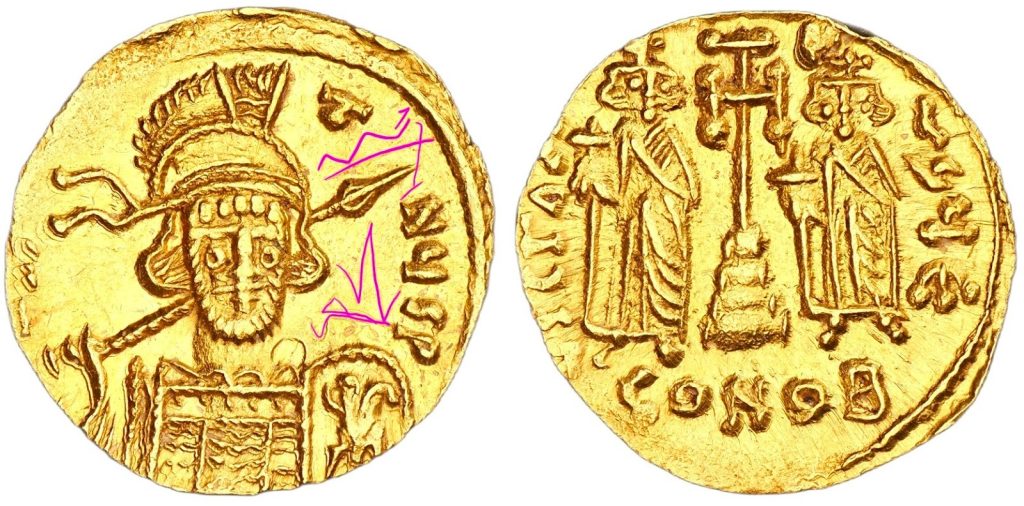
Obverse: [various markings]
Reverse: [N/A]
Lot 426: Constantine IV, Heraclius, and Tiberius, 668-685. AV Solidus, Constantinople.
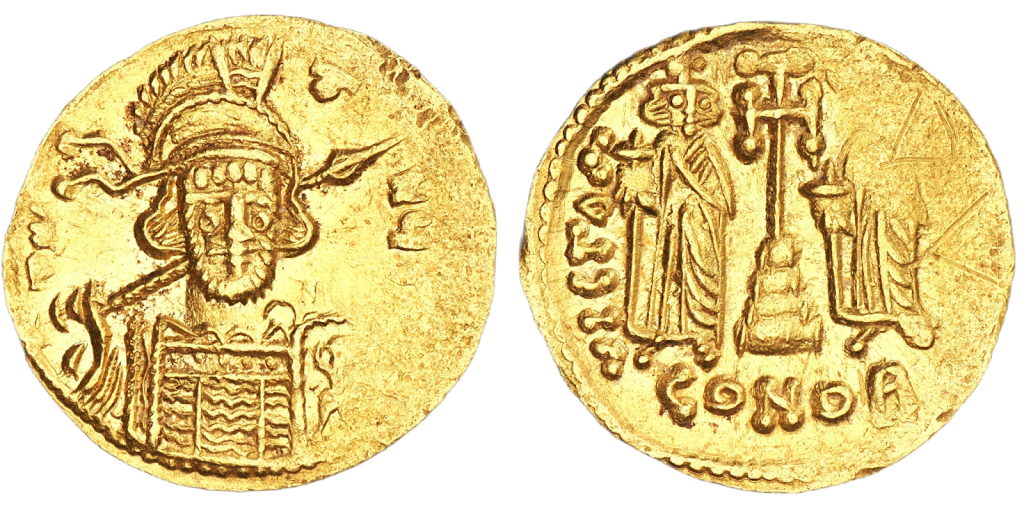
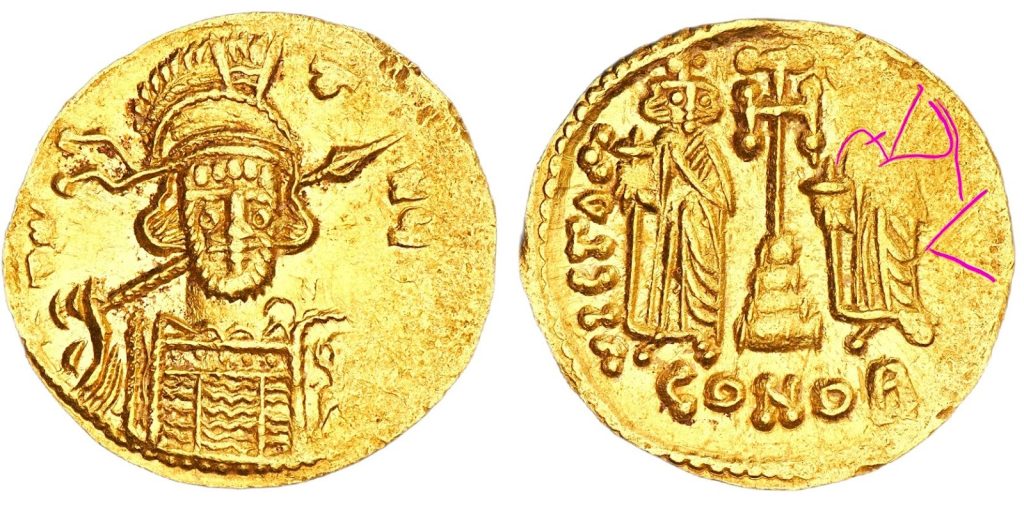
Obverse: [N/A]
Reverse: [various markings]
Select Bibliography
- АКОПЯН А. В., ДЖ. УНАЛ (C. Ünal). Предварительный анализ граффити на монетах Диярбакырского клада 1992 г. Двадцать третья Всероссийская нумизматическая конференция (Twenty-third Pan-Russian Numismatic Conference), 2025.
- Bijovsky, G. A Hoard of Byzantine Solidi from Bet She’an. Revue numismatique 158, 2002.
- Bijovsky, G. A Hoard of Solidi of Heraclius. Israeli Antiquities Authority (IAA) Reports 66, 2020.
- Bijovsky, G. A Byzantine Gold Hoard from Reḥob (Ḥ. Parwa). Israel Numismatic Society, 2012.
- Sanchez, F. and D. Chico. A Hoard of Seventh-century Byzantine Solidi found in Arbela (Iraqi Kurdistan). The Numismatic Chronicle 179, 2019.
- Sanchez, F. and D. Chico. A Seventh-Century Byzantine Hoard of Solidi from Andrinople (Edirne). The Numismatic Chronicle 183, 2023.
- Syon, D. A Hoard Of Bvzantine Solidi From Hurvat Kab. Israel Numismatic Journal (INJ) 14, 2002.
- Ünal, C. Kavakly hoard from Aydin Archaeology Museum, “A group of gold coins from the reign of Constans II”. XV International Numismatic Congress Taormina, 2015.