L5 News ·
Graffiti on 7th Century Solidi: Provincial Economic Practices at the Imperial Periphery
Introduction
Roughly incised, difficult to interpret, and potentially written in one or more languages, graffiti found on 7th century Byzantine solidi pose numerous problems for the numismatist. Often as simple as scratches or as complex as entire words, the graffito markings in question can vary in detail and legibility. The line between naturally occurring wear in circulation and crude graffiti is likewise difficult to traverse.1 While Greek and Latin characters form the overwhelming majority of graffiti found on 7th century solidi, Arabic is attested and far from uncommon.2 In spite of the prolific presence of graffiti, hoard publications often neglect to address this topic, let alone to catalogue it as found among the coins of the hoard. As a result of the above complexities, graffiti on 7th century Byzantine solidi are relatively little studied in comparison with the wider coinage on which they are incised.
With a dearth of study and paucity of dedicated publications, the purpose for these graffito markings is controversial if seldom addressed. Syon, publishing the Hurvat Kab hoard dating to AD 662-5, wrote that ‘[t]here is scant literature on the subject, and the reasons for applying graffiti to coins remains conjectural’.3 In the publication of Bet She’an hoard Dating to around AD 680, Bijovsky wrote that ‘[m]any of these marks are random illegible incisions, yet others represent geometric signs, symbols, monograms and single letters that sometimes match into short words. Graffiti occur more frequently in hoards deposited during the second half of the seventh century, although they are hardly ever noticed and described in detail. Apparently, it was a local, provincial practice’ Bijovsky continues, suggesting a possible explanation for the matter in that ‘[a] number of solidi of Phocas and Heraclius bear graffiti over worn inscriptions, suggesting that they were incised much later than their date of issue, after the coins circulated for a long period or showed signs of prolonged wear’.4 In the Ben She’an hoard this is the case, where the older the coinage, the more likely they are to bear graffiti.
- Bijovsky 2002, pg. 180. ‘Most of the graffiti that appear on solidi from the Bet She ‘an hoard are random incisions or undecipherable pothooks’
- Bijovsky 2002, pgs. 178-80; Syon 2002, pg. 218. For other languages found as graffiti on Byzantine coins, see the hoard published by Aкопян and Ünal. Though rather unlikely in the 7th century, later periods evidence graffiti in Georgian or Armenian. Syriac or Aramaic likewise would not be beyond the realm of possibility to find as graffiti.
- Syon 2002, pg. 218.
- Bijovsky 2002, pgs. 178-9.
Hoard Evidence and Problematic Reporting
Three Levantine hoards of the 7th century all exhibit significant percentages of their coins with graffiti:
Hurvat Kub Hoard (AD 662-665)
- 50 solidi, 7 were found to be marked with graffiti (14.0%).
| Ruler | Number of Coins in Hoard | Number of Coins with Graffiti | Percentage of Coins with Graffiti |
| Phocas | 6 | 1 | 16.7% |
| Heraclius | 22 | 5 | 22.7% |
| Constans II | 22 | 2 | 4.5% |
| Constantine IV | 0 | 0 | 0% |
| Justinian II | 0 | 0 | 0% |
Ben She’an Hoard (AD 680s)
- 751 solidi, 262 were found to be marked with graffiti (34.9%).
| Ruler | Number of Coins in Hoard | Number of Coins with Graffiti | Percentage of Coins with Graffiti |
| Phocas | 95 | 44 | 46.3% |
| Heraclius | 382 | 141 | 36.9% |
| Constans II | 219 *5 | 71 | 32.4% |
| Constantine IV | 55 | 5 | 9.09% |
| Justinian II | 0 | 0 | 0% |
*5. Bijovsky reports slightly conflicting numbers for the solidi of Constans II in the hoard, with 219 coins reported on pages 162 and 167, yet 210 coins is given as the sum on page 164. Considering the hoard is reported as 751 coins, the solidi of Constans II must comprise 219 coins elsewise the total would add to 742 not 751. This discrepancy explains why Bijovsky has calculated the percentage of coins with Graffiti for Constans II as 33.8% on page 179, but I have calculated 32.4%.
Rehob hoard (Terminus Post Quem AD 686)
- 28 solidi, 3 were found to be marked with graffiti (10.7%).
| Ruler | Number of Coins in Hoard | Number of Coins with Graffiti | Percentage of Coins with Graffiti |
| Phocas | 0 | 0 | 0% |
| Heraclius | 14 | 1 | 7.1% |
| Constans II | 9 | 1 | 11.1% |
| Constantine IV | 4 | 0 | 0% |
| Justinian II | 1 | 1 | 100% |
Of non-levantine hoards, we find that graffito is either entirely absent or almost so.
Adrianople hoard (Terminus Post Quem AD 660)
- 20 solidi, 0 were found to be marked with graffiti (0.0%).
| Ruler | Number of Coins in Hoard | Number of Coins with Graffiti | Percentage of Coins with Graffiti |
| Phocas | 5 | 0 | 0% |
| Heraclius | 11 | 0 | 0% |
| Constans II | 4 | 0 | 0% |
| Constantine IV | 0 | 0 | 0% |
| Justinian II | 0 | 0 | 0% |
Kavakly hoard (Terminus Ante Quem AD 668)
- 70 solidi, 1 was found to be marked with graffiti (1.4%).
| Ruler | Number of Coins in Hoard | Number of Coins with Graffiti | Percentage of Coins with Graffiti |
| Phocas | 0 | 0 | 0% |
| Heraclius | 0 | 0 | 0% |
| Constans II | 70 | 1 | 1.4% |
| Constantine IV | 0 | 0 | 0% |
| Justinian II | 0 | 0 | 0% |
For hoards that do not discuss whether graffiti is present, it is difficult to ascribe whether the absence of mention is due to a lack of evidence in the hoard or lack of attention by the author. As acknowledged by both Bijovsky and Syon, the topic of graffiti in hoards has been overlooked in the past, with Bijovsky able to confirm at least one hoard containing solidi with graffiti when the hoard publication made no mention of that fact.6 In light of this, it cannot be assumed that hoard reports making no mention of graffiti contain no coins with graffiti.
For the hoards that do discuss whether graffiti is present, Levantine hoards have significant levels of graffiti, especially those hoards deposited in the middle to latter half of the 7th century. Outliers like the Rohab hoard with a late 7th century solidus having graffiti do exist, but Levantine hoards tend to follow the pattern identified by Bijovsky, with the solidi of Phocas and Heraclius having comparatively high amounts of graffiti when contained in a hoard secreted at a date some time after those coins were minted. In comparison, non-levantine hoards display near non existent rates of solidi with graffiti.7
6. Bijovsky 2002, pg. 218 footnote 16. Syon 2002, pg. 218.
7. The Adrianople hoard does present some questions due to the nature of it being reported second hand to the authors. The Arbela hoard has been entirely excluded from analysis, whereby the hoard was only shared second hand to the authors with incomplete photographs of the contents.
Continuity of Graffiti Incisions with the Arab Population
While the incision of graffiti onto solidi is not a practice by any means exclusive to the Levant, this is the region in which such practices are most predominant as evidenced above. These trends for the countermarking of solidi in the 7th century Levant do not change with the advent of the Arabs. Bijovsky highlights a near contemporary Umayyad hoard found in Capharnaum ‘[containing] 76 gold dinars bearing graffiti, over a third of the entire hoard’. Of the 262 solidi with graffiti from the Bet She’an hoard, 5 have Arabic writing, further emphasizing continuity in incising graffiti on gold coinage during and after the 7th century transition between Byzantine and Arab control of the Levant. As Bijovsky writes, ‘[the presence of Arabic graffiti] is of extreme relevance since they constitute another evidence to the use of Byzantine gold by the Arab population, and put emphasis on the local character of this practice’.8
8. Bijovsky 2002, pgs. 179-80.
Conclusion
Study of graffiti on 7th century solidi is hampered by the historical lack of attention paid to documenting graffiti in hoards, and the small sample size of publications reporting about graffiti naturally creates a potentially skewed body of evidence. With this in mind, given the extremely high rates of graffiti found in 7th century Byzantine hoards in the Levant, it would seem appropriate that graffiti found on 7th century solidi indicate a greater likelihood of circulation in the Levant than elsewhere. At the edge of the Byzantine imperial periphery, the tumultuous epoch of the 7th century saw the devastation of this region through the two decade long Byzantine-Sassanian war and subsequent Byzantine-Arab war. The geographic and chronological specificity of 7th century Levantine countermarking of the Byzantine solidus (and later, Umayyad dinar) likely indicates a provincial response to economic needs, all in reaction to the external stimuli of war, conquest, and new practices of governance.
This article is the inception and primer of a forthcoming study on the same topic. Stay tuned for future updates.
Catalogue
Suggested interpretations of graffiti have been shared below.
Lot 506: Phocas, 602–610. AV Solidus, Constantinople
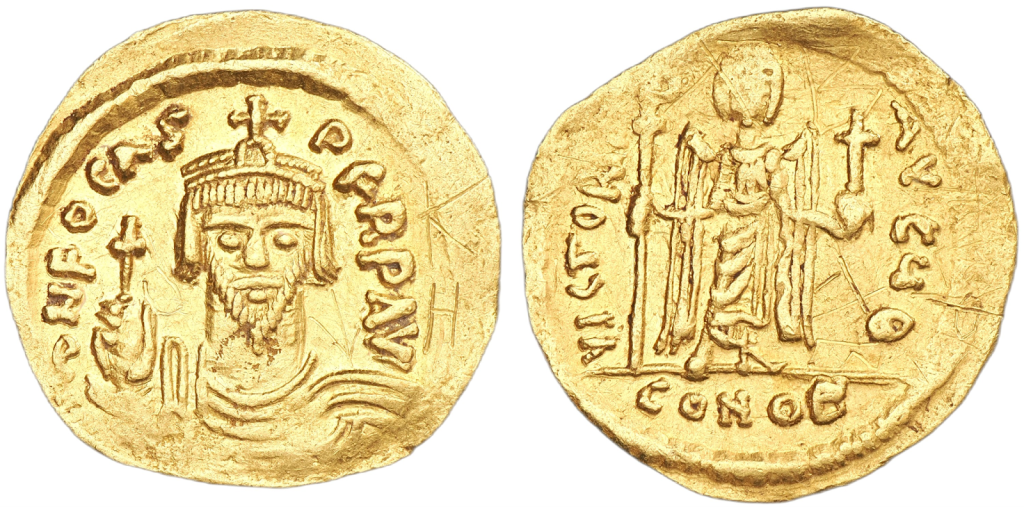
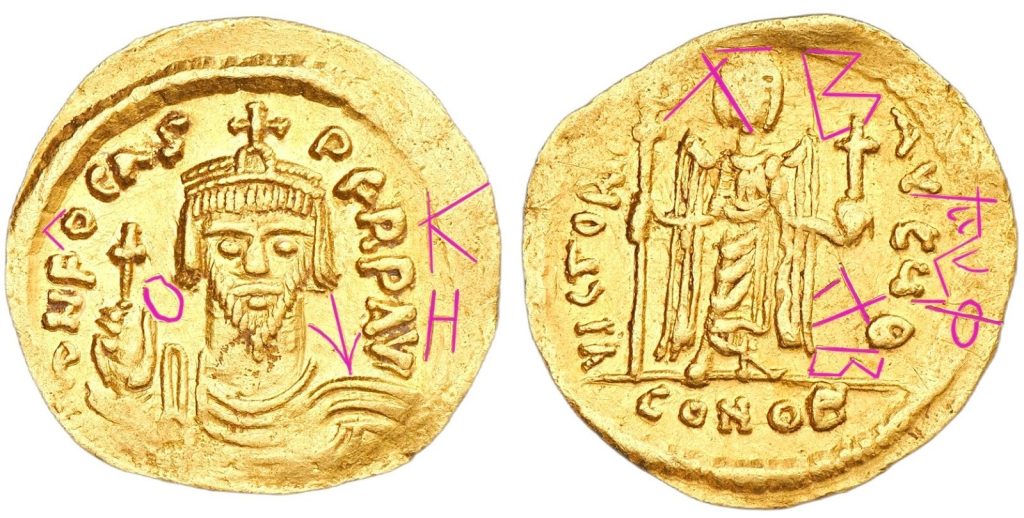
Obverse Graffiti: O Ψ KH
Reverse Graffiti: ΛB [Uncertain]Φ ΠB
Lot 507: Phocas, 602–610. AV Solidus, Constantinople
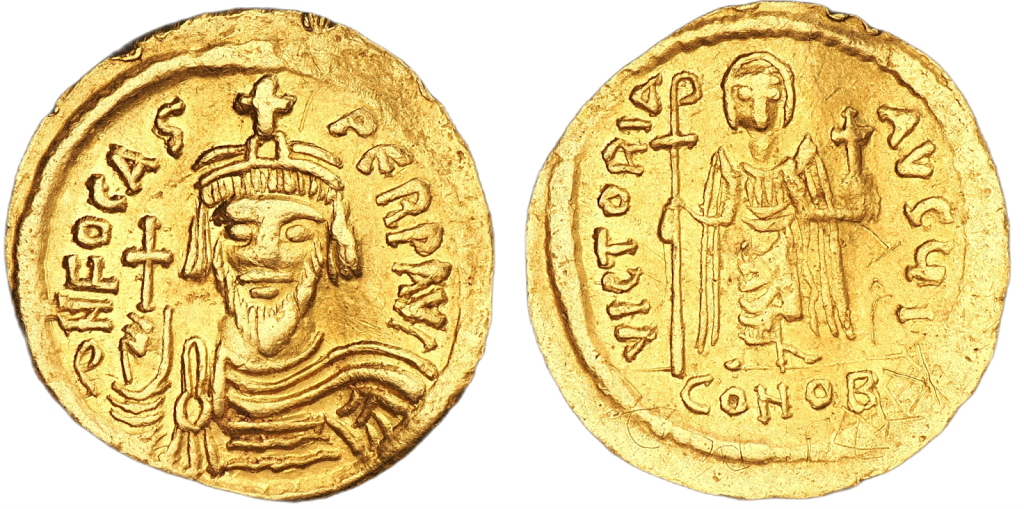
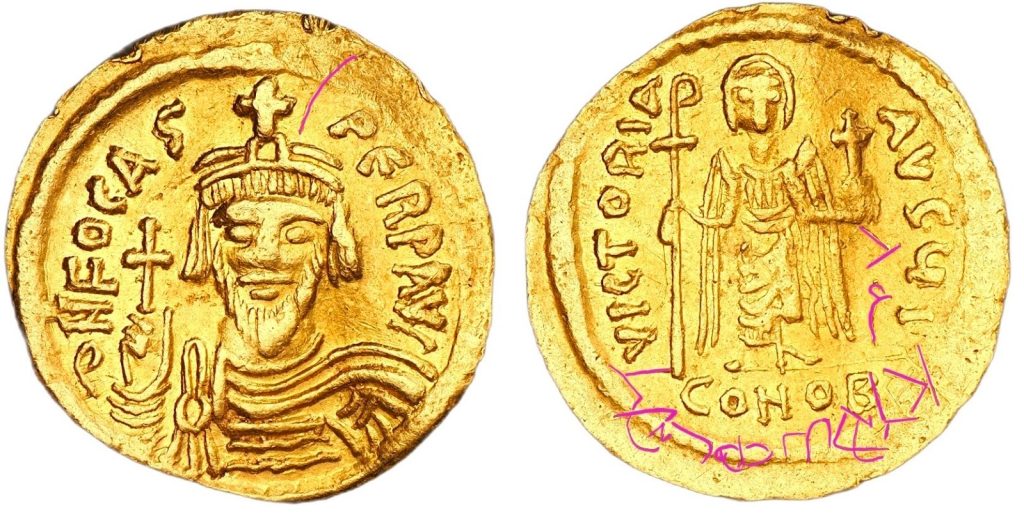
Obverse Graffiti: /
Reverse Graffiti: Λα KYȣωΦ[Uncertain]
Lot 511: Heraclius with Heraclius Constantine, 610-641 (616-625). AV Solidus
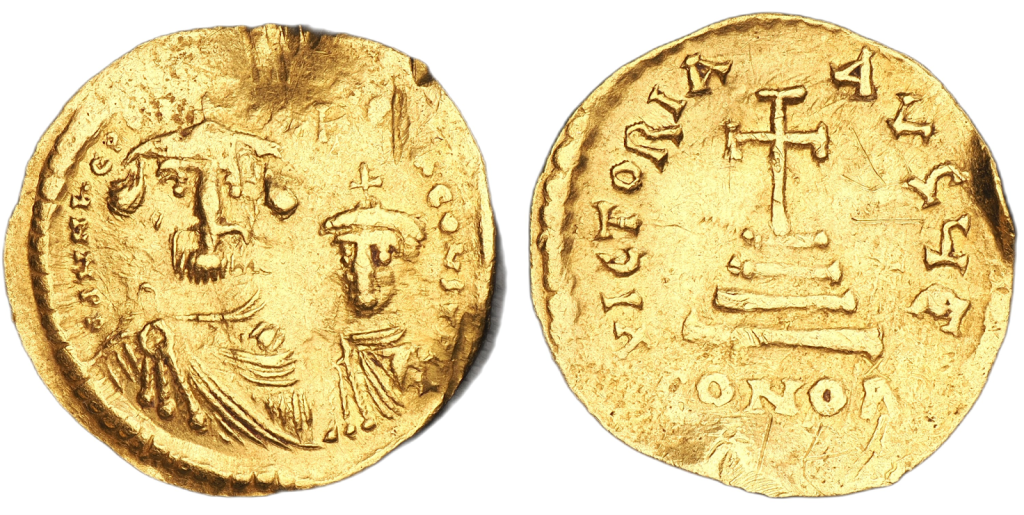
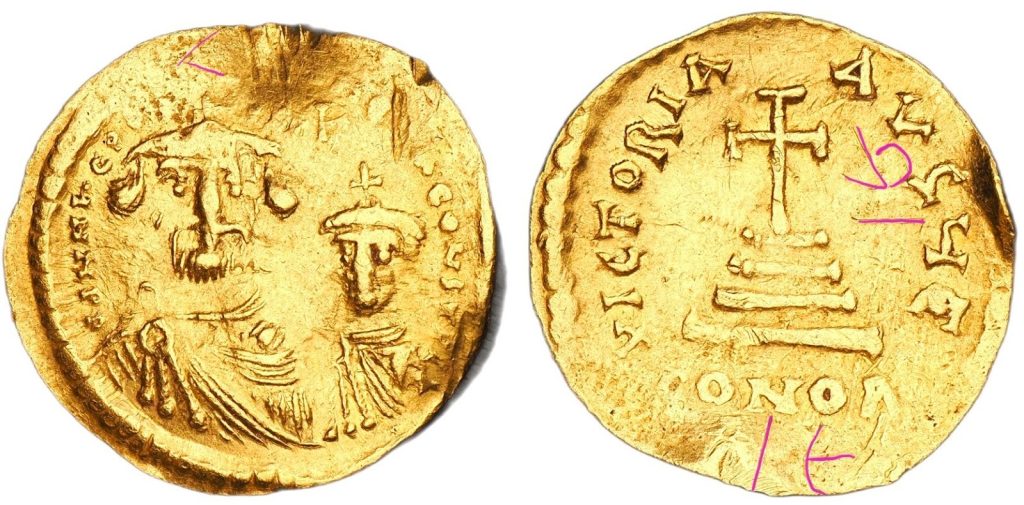
Obverse Graffiti: Λ
Reverse Graffiti: IƐ IƐ
Lot 513: Heraclius with Heraclius Constantine, 610-641 (616-625). AV Solidus
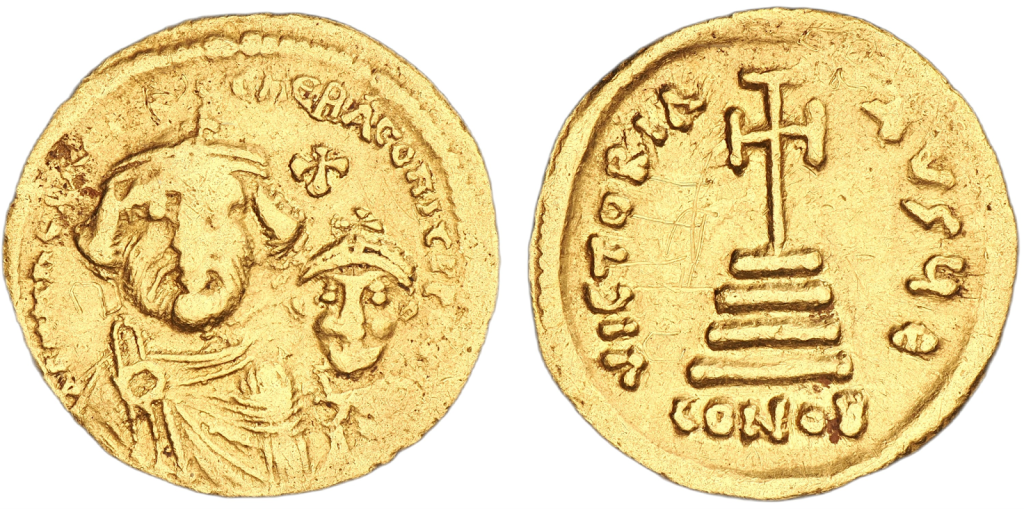
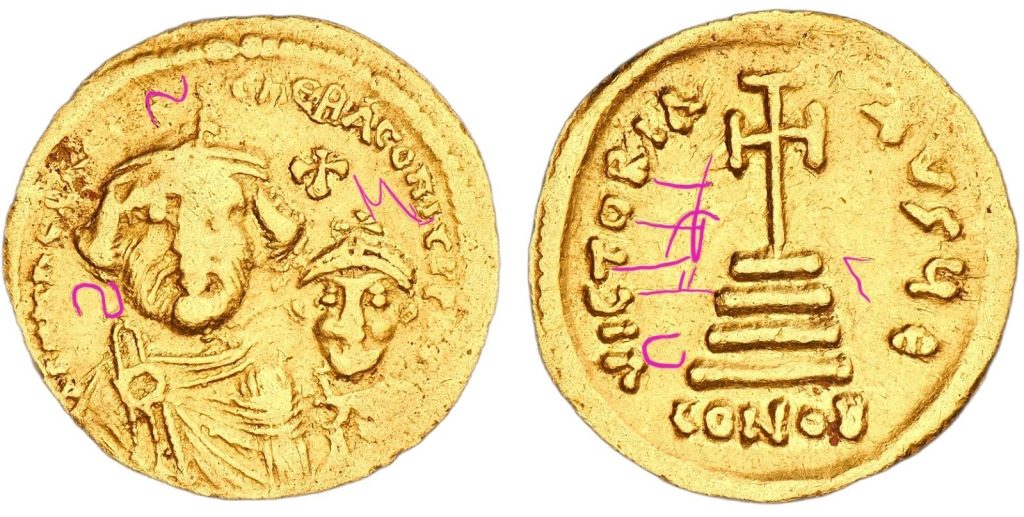
Obverse Graffiti: N N M
Reverse Graffiti: [Uncertain]
Lot 517: Heraclius, Heraclius Constantine, and Heraclonas, 639. AV Solidus
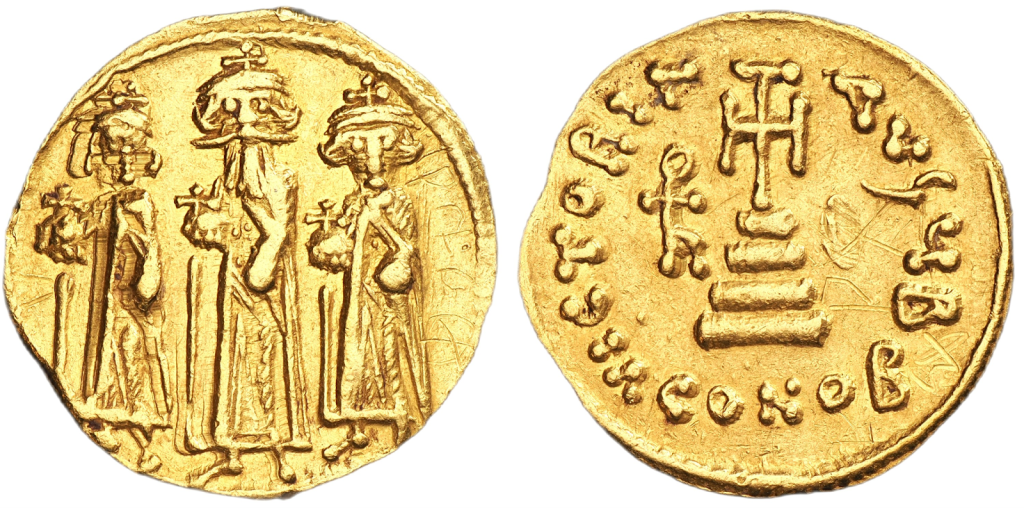
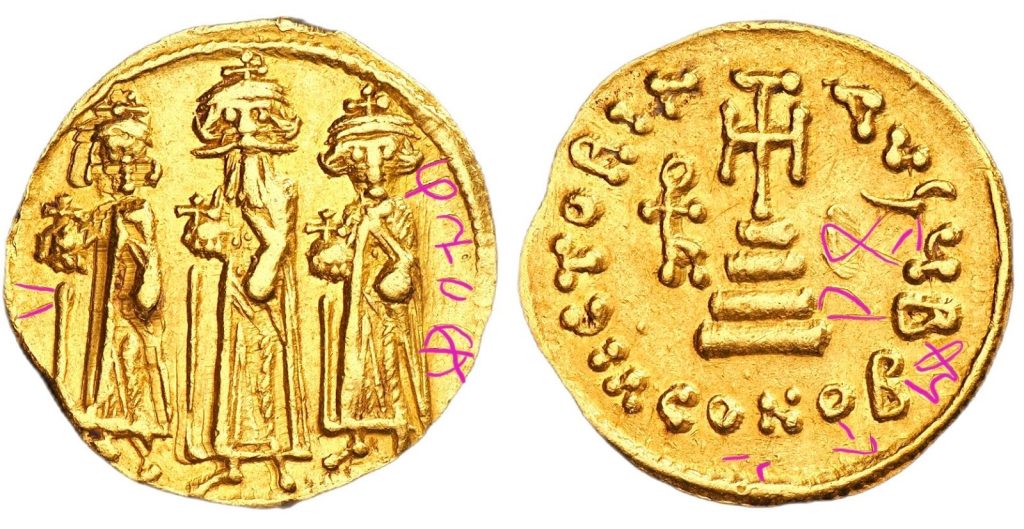
Obverse Graffiti: Λ ΦKVΘ
Reverse Graffiti: ȣ [Uncertain] MΦ [Uncertain]
Note: Like Hurvat Kab hoard specimen #17, the sigla in the right field has been deliberately erased9, in the case of the above solidus to make room for the graffito ȣ.
9. Syon 2002, pg. 218. ‘No. 17 The letter I in the reverse field right was deliberately effaced. This is class IVA of Heraclius, in which either a Θ or an I is always present in the reverse field at right.’
Lot 519: Heraclius, Heraclius Constantine, and Heraclonas, 639. AV Solidus
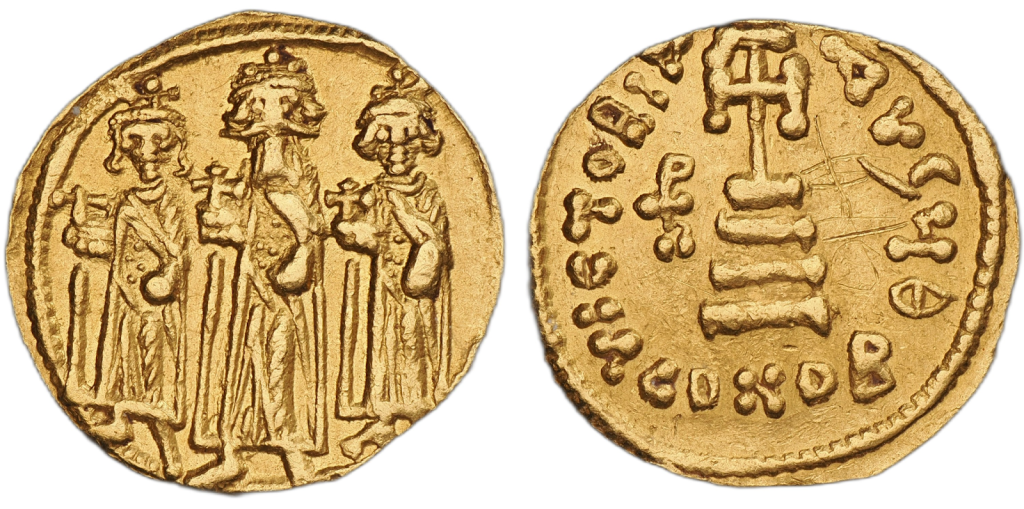
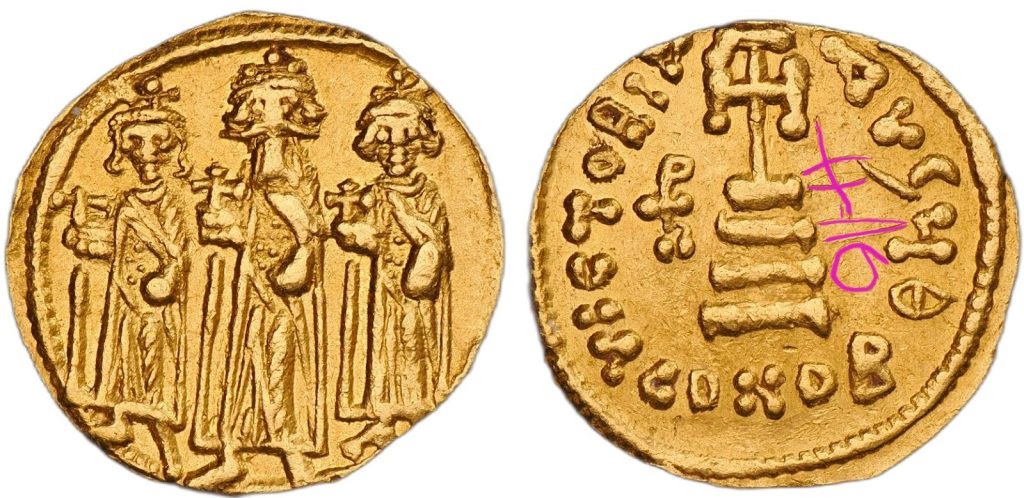
Obverse Graffiti:
Reverse Graffiti: ΛΘO
Select Bibliography
- АКОПЯН А. В., ДЖ. УНАЛ (C. Ünal). Предварительный анализ граффити на монетах Диярбакырского клада 1992 г. Двадцать третья Всероссийская нумизматическая конференция (Twenty-third Pan-Russian Numismatic Conference), 2025.
- Bijovsky, G. A Hoard of Byzantine Solidi from Bet She’an. Revue numismatique 158, 2002.
- Bijovsky, G. A Hoard of Solidi of Heraclius. Israeli Antiquities Authority (IAA) Reports 66, 2020.
- Bijovsky, G. A Byzantine Gold Hoard from Reḥob (Ḥ. Parwa). Israel Numismatic Society, 2012.
- Sanchez, F. and D. Chico. A Hoard of Seventh-century Byzantine Solidi found in Arbela (Iraqi Kurdistan). The Numismatic Chronicle 179, 2019.
- Sanchez, F. and D. Chico. A Seventh-Century Byzantine Hoard of Solidi from Andrinople (Edirne). The Numismatic Chronicle 183, 2023.
- Syon, D. A Hoard Of Bvzantine Solidi From Hurvat Kab. Israel Numismatic Journal (INJ) 14, 2002.
- Ünal, C. Kavakly hoard from Aydin Archaeology Museum, “A group of gold coins from the reign of Constans II”. XV International Numismatic Congress Taormina, 2015.