L5 News ·
Top 10 Coins of L5 Auction 5
The L5 team heartily welcomes you to another Top 10 Coin List! As winter thaws and spring approaches, so too are our consignment rates heating up! Auction 5 is only days away with a record-breaking 859 lots! From the medieval African empire of Axum to the piracy of Sextus Pompey, L5 auction 5 has something for every kind of collector.
Whether its high-end Roman gold or budget bronzes, L5 caters to everyone with great historical coins at the lowest fees anywhere. Peruse another exciting Top 10 Coin List, and don’t forget to visit the sale after reading!
The Top 10 Coins of L5 Auction 3
1. Celts (Boii), Central Europe. AV 1/24th Stater, 2nd Century BC
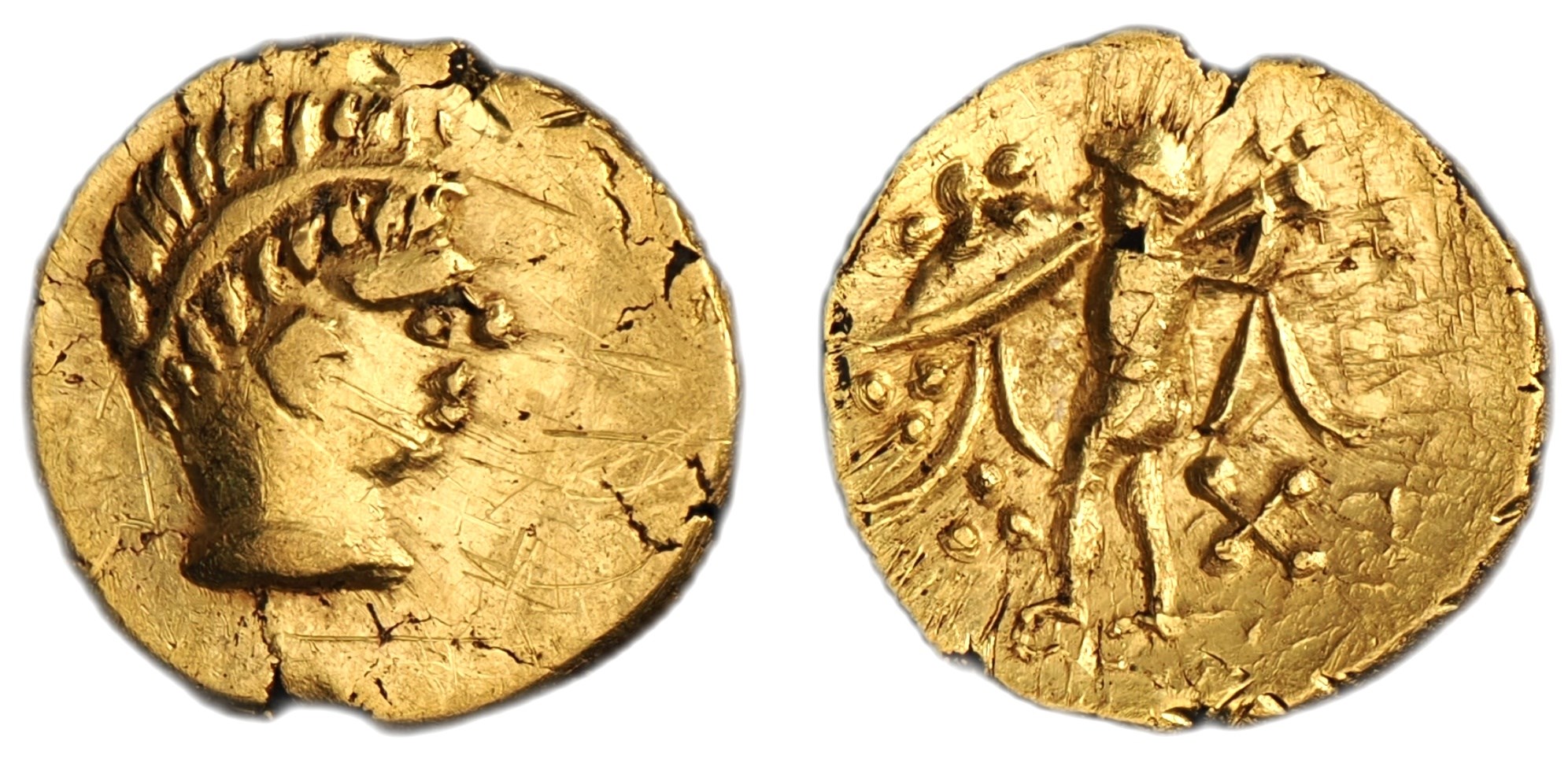
Celtic art is defined by a charming and eloquent expression of a civilization well attuned to both wider Hellenistic practices and deep connections with the natural world. Symmetry and iconographic motifs created through a zoomorphic lens offer beautiful simplicity to the refined collector of art. The above fractional stater represents one such example, whereby with a passing glance one might be tempted to brush off what indeed is a magnificent statement of a culture that dominated the heartlands of Europe for many a century.
Related to the Athena Alkis types of the Boii, the reverse of the above coin matches the expected depiction of Athena the protector boldly presenting shield and spear. Likely deriving from earlier coin types of Alexander the Great and his successors, the reverse motif is a Greek cultural facet adopted and morphed to meet the expectations of the middle European Celts. Syncretic religious practices allowed for the easy adoption of Greco-Roman deities into the Celtic pantheon. The above fractional differs from the expected type of the Boii with its obverse design, indicating an early emission from the series deviating from the commonly found bust of helmeted Athena. Here instead is a bareheaded and diademed bust of a youth, with muted expression bearing witness to the artistic capabilities of the Boii. Significantly rarer than the later emissions, this early 1/24th fractional stater captures the middle European Celts at a time of artistic transformation and innovation, heavy with influence from the Hellenistic world while still full of native expression.
2. Skostokos, Kings of Thrace. AR Tetradrachm, 290-280 BC.
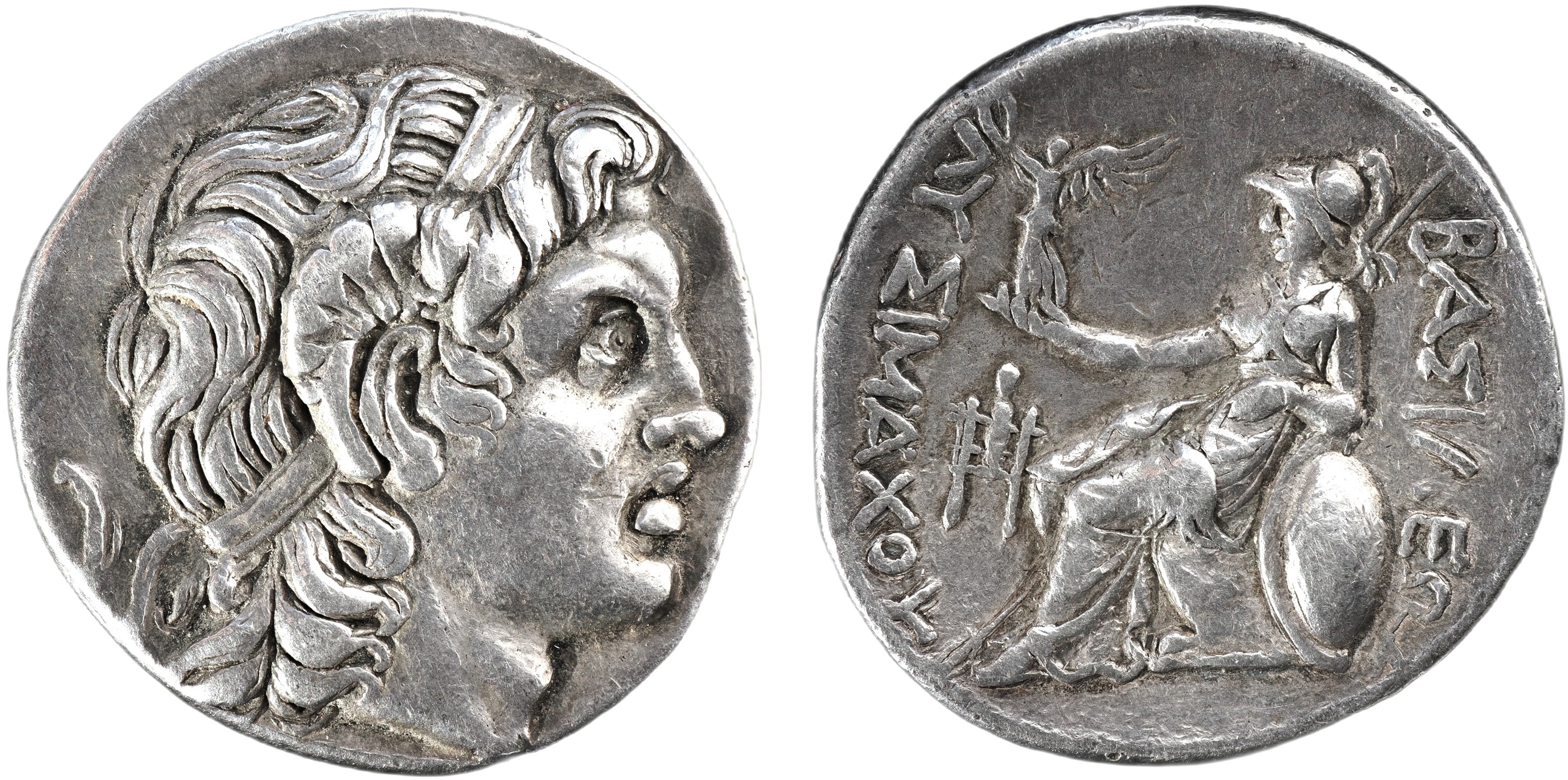
Skostokos and his coinage form an enigmatic series of issues related to king Lysimachos, struck in the early third century BC. The exact relationship of Skostokos to Lysimachos and other Thracian dynasts has been a point of controversy since the first series of coinage naming Skostokos was identified. Further research has proven other types such as the above tetradrachm to likewise have been minted by Skostokos. Otherwise unknown, Skostokos is only attested to by the short series of coinage he produced. Wolfgang Fischer-Bossert has argued in ‘Die Lysimacheier des Skostokos’ for the coinage of Skostokos to be understood as produced under the authority of Lysimachos as opposed to viewing Skostokos as an independent figure operating in Thrace. Whether this is to be accepted, and the nature of the relationship between the two men, still remain contested. The arguments of Fischer-Bossert are convinving, and it does seem likelier to place Skostokos under the authority of Lysimachos than elsewhere. Regardless of which argument is followed, the Skostokos issues are an exciting series of Thracian coinage with as many questions posed as left unanswered.
3. Shaka, Kushan Empire. AV Dinar, AD 320s-340s BC.
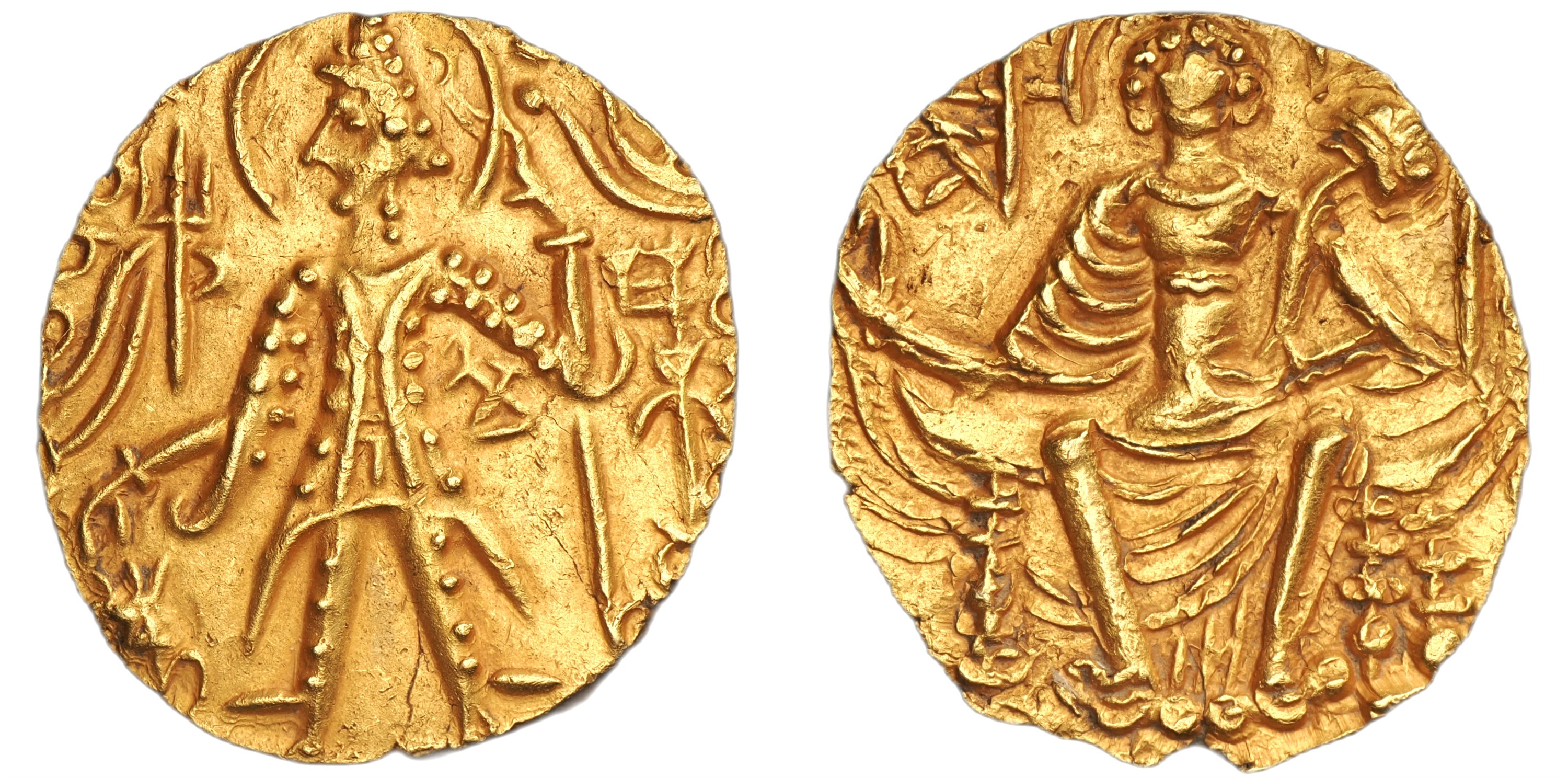
Shaka, like many of the Kushan kings, has rather little known about his life and reign. Practically no evidence survives for Shaka save his coinage. There is even debate as to how Shaka should be understood, whether that is a name or a title. In any case, the coinage of Shaka (whatever or whoever that may be) represents the later coinage of the Kushan state, with subsequent loss and collapse in the face of external pressures. The Kushan empire itself dated back three centuries before the the age of Shaka, and it was a state heavily influenced by a number of cultures including the Hellenistic world. Located between the trade routes of east and west, the Kushan state prospered from the facilitation of exchange from as far away as the Roman empire with the Han dynasty in China. Coins such as the above dinar showcased the power, might, and wealth of the king.
4. Anonymous, Rome. AR Quadrigatus, 225-214 BC.
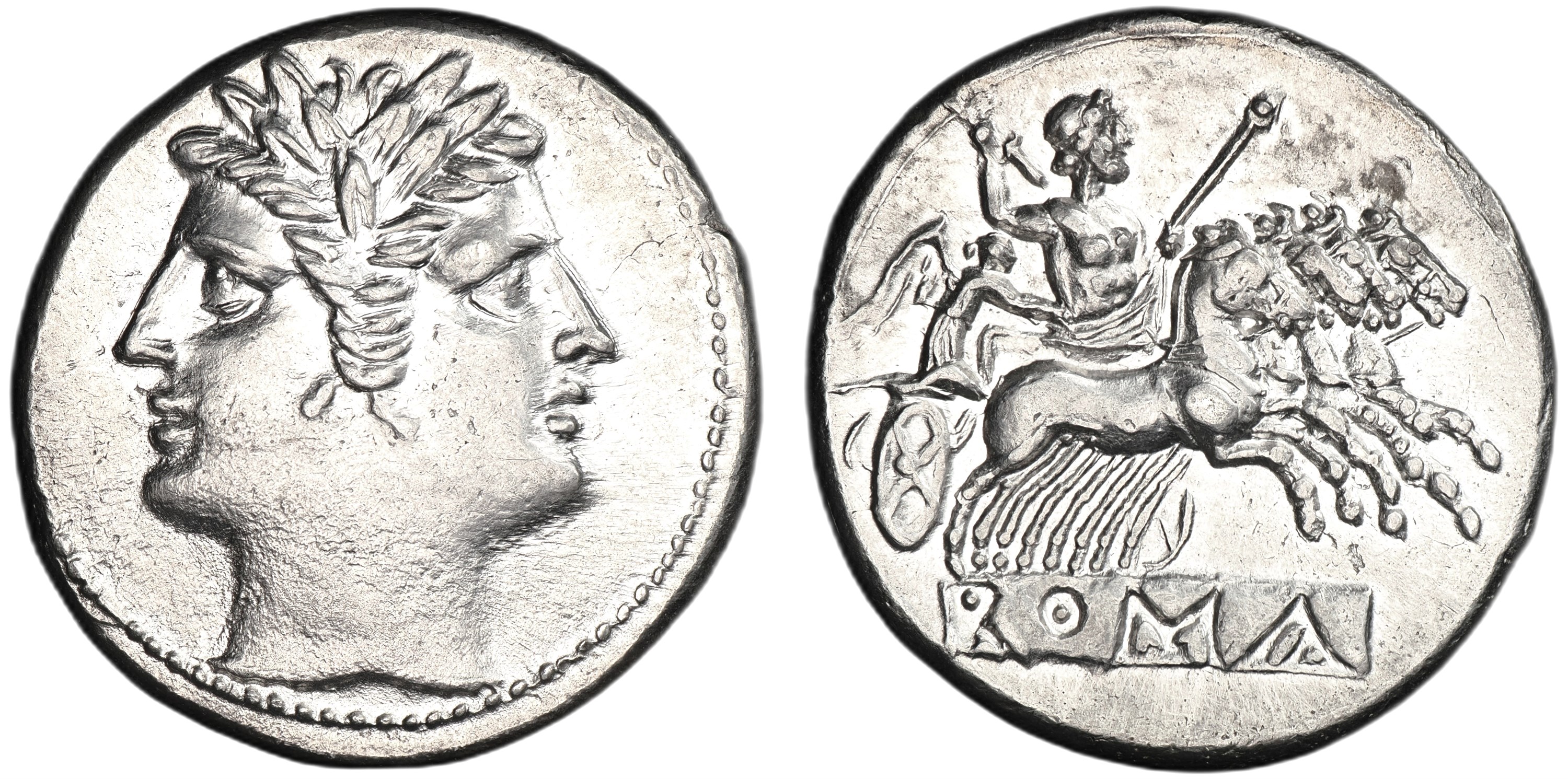
The quadrigatus helped to pay for Rome’s struggle against Carthage early in the Second Punic War. Starting in 225 BC, this final emission of the denomination continued through the worst loses Rome had ever faced in her history. Between the battles of Lake Trasimene and Cannae, around 100,000 Roman soldiers were left dead on the battlefield. Hannibal was all but triumphant, and surely the Roman people would see surrender was their best (and only) option.
In an alternate world, Rome surrenders after Cannae and the sporadic series of early Republican coinage up to the quadrigatus would be the summit of Roman numismatic production. Thankfully for the numismatist and collector alike, the quirite spirit was tempered in a metal more durable than the furnace within which it was placed for a long and tempestuous decade. With the appointment of Scipio came relief and eventual victory. During the slow progress Rome made after her nadir, it was decided around 212 BC to replace the quadrigatus with the denarius.
The above coin is a handsome specimen and symbolic of its period. Minted when the early Republic was on the brink of destruction, Jupiter drives his quadriga with confidence and assures the Roman state of ultimate triumph and salvation. While many more hundreds of thousands of Romans would not survive the decade to see the truth of that promise, Jupiter would fulfil his role as optimus maximus and the sons of Aeneas conquer the progeny of Dido.
5. Julius Caesar, Military Mint. AR Denarius, 49-48 BC.
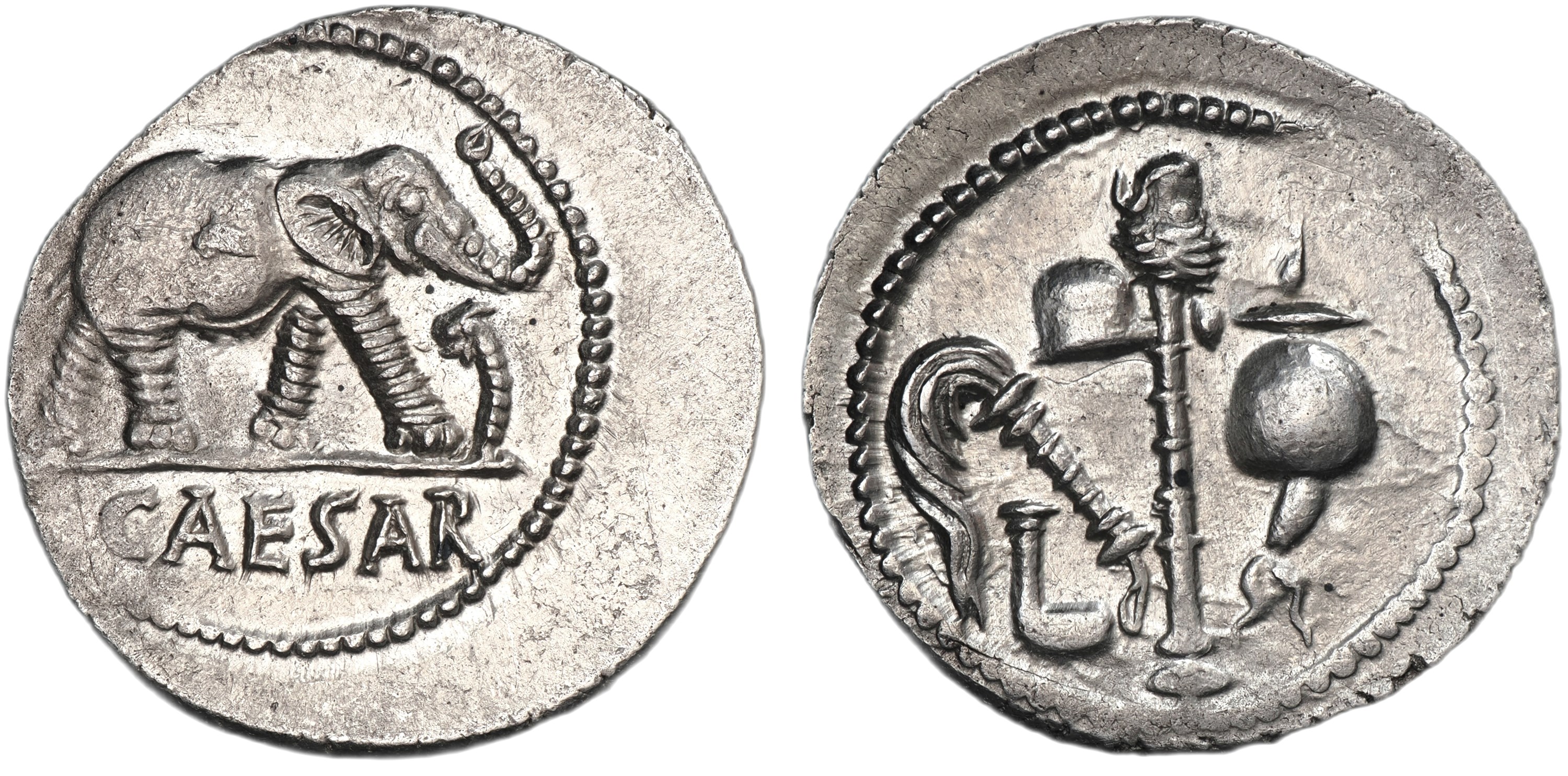
The fateful events of 49 BC have ramifications through to the modern day. From Augustus to Tsar Nicholas II, a wide swath of peoples and cultures are in obligation to Julius Caesar for not only their office and expressions of authority, but also the military genius and strategy that Caesar pioneered. The siege of Alesia is still taught in foundational courses at West Point Academy, and Napoleon esteemed Caesar to be one of the seven best generals ever to live. If Gaul placed Caesar among the greatest Roman commanders, the subsequent civil war and consolidation of power place Caesar among the greatest historical figures of any period.
The crossing of the Rubicon enabled Caesar to gamble his life and reputation for ultimate power and immortality in legacy. The above denarius is situated in the time period immediately subsequent to the Rubicon, and highlights the propaganda Caesar wished to push in the aftermath of inflaming domestic strife. The serpent has long been associated with evil, and Caesar portrays himself and his cause as nothing less than the magnificent and powerful elephant. Trampling over his opponents and the unrighteous, there is no question of what the ultimate outcome of this civil war will be.
6. Sextus Pompey, Sicily. AE As, 43-36 BC.
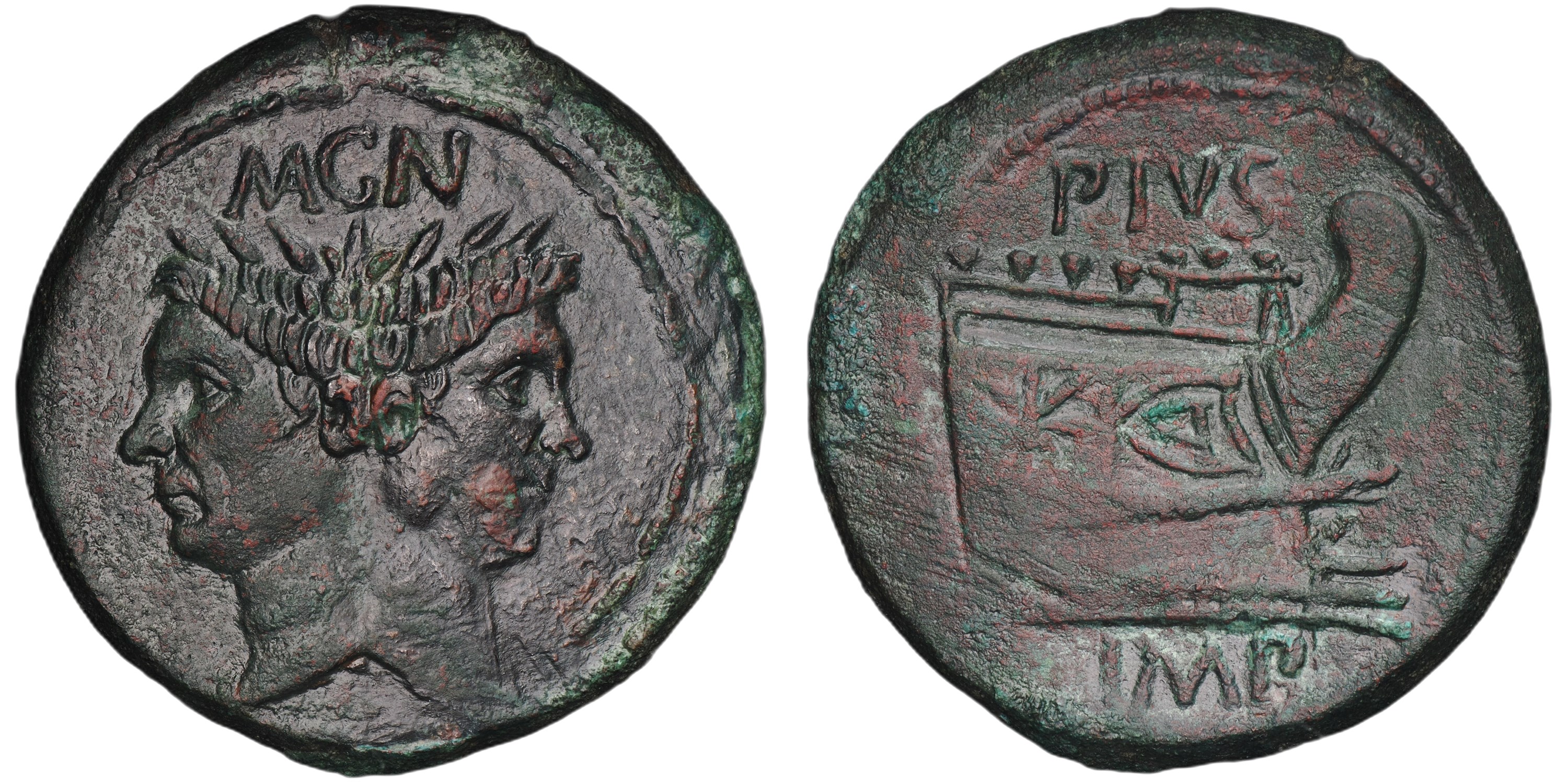
Pius filius, Sextus Pompey held out as the last remnant of a defeated generation. His father was crushed at Pharsalus, his ally Metellus Scipio at Thapsus, and he himself at Munda. The old ways of the Republic had been dead for a while, but the efforts to stop the spiral of civil strife dating back to the Gracchi brothers met its end with Sextus in Sicily. Reduced to the desperate straits of brigandage, the military genius of Agrippa ended whatever slim prospects Sextus had of partitioning Sicily for himself among the triumvirs. Reduced to an ignominious flight like his father before him, Sextus too was handed a quick and extrajudicial sentence at the end of a sword. The question of ultimate victory was no longer one between the Boni and Populares, but which champion of the Populares would triumph.
The reverse of the above As depicts a ship’s prow, symbolic of the Pompeian military prowess in Sicily – or, as others would see it, piracy. The obverse depicts the two heads of Janus, each with the features of Pompey Magnus, father of Sextus. One face looks back to the glory days of Pompey Magnus as uncontested champion, conqueror, and hero of the Republic, the other grimly to a future where survival of the family and political cause is slim indeed.
7. Nero, Rome. AV Aureus, AD 64-65.
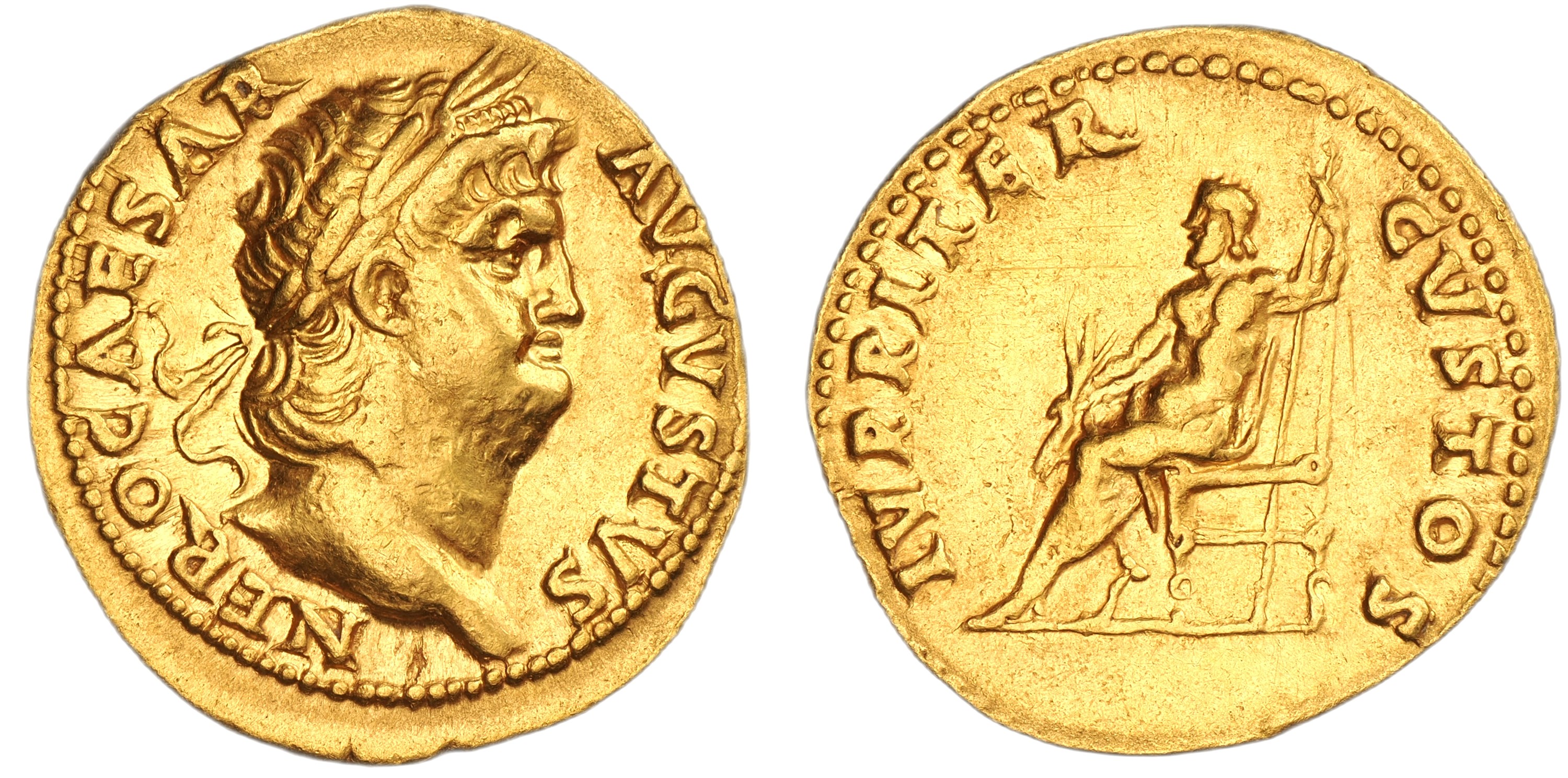
To Jupiter the protector did Nero turn when Rome burned. The line between religious sincerity and political pragmatism is oft blurred, and to the hallowed pantheon that saw the nascent Republic triumph over her enemies did Nero find promise and consolation in the aftermath of the greatest disaster to befall the eternal city since the sack of Brennus and the Goths. The truth of the great fire and public perceptions of blame are difficult to ascertain two millennia later. The general actions of Nero in the immediate aftermath indicate a capable ruler conscious of potential sentiment against himself and the desire to be perceived as proactive. The persecution of Christian subjects provided for a defenseless minority to shift blame upon, and the destruction of the fire allowed for Nero to implement grandiose building projects and forge a legacy by refashioning the city in his own tastes. Whether or not he indeed did start the fire, the haste of Nero to rebuild a palace on the burnt ruins of many a home while the majority of the city’s population faced homelessness and strife was a decision made in poor taste. Numismatic iconography was one avenue of propaganda available to Nero in the midst of this public relations crisis, and coin types like the above aureus helped to reinforce traditional ideals of safety and supremacy granted to the Romans by their gods.
8. Nero, Thessaly. AE Tetrassarion, AD 66-68.
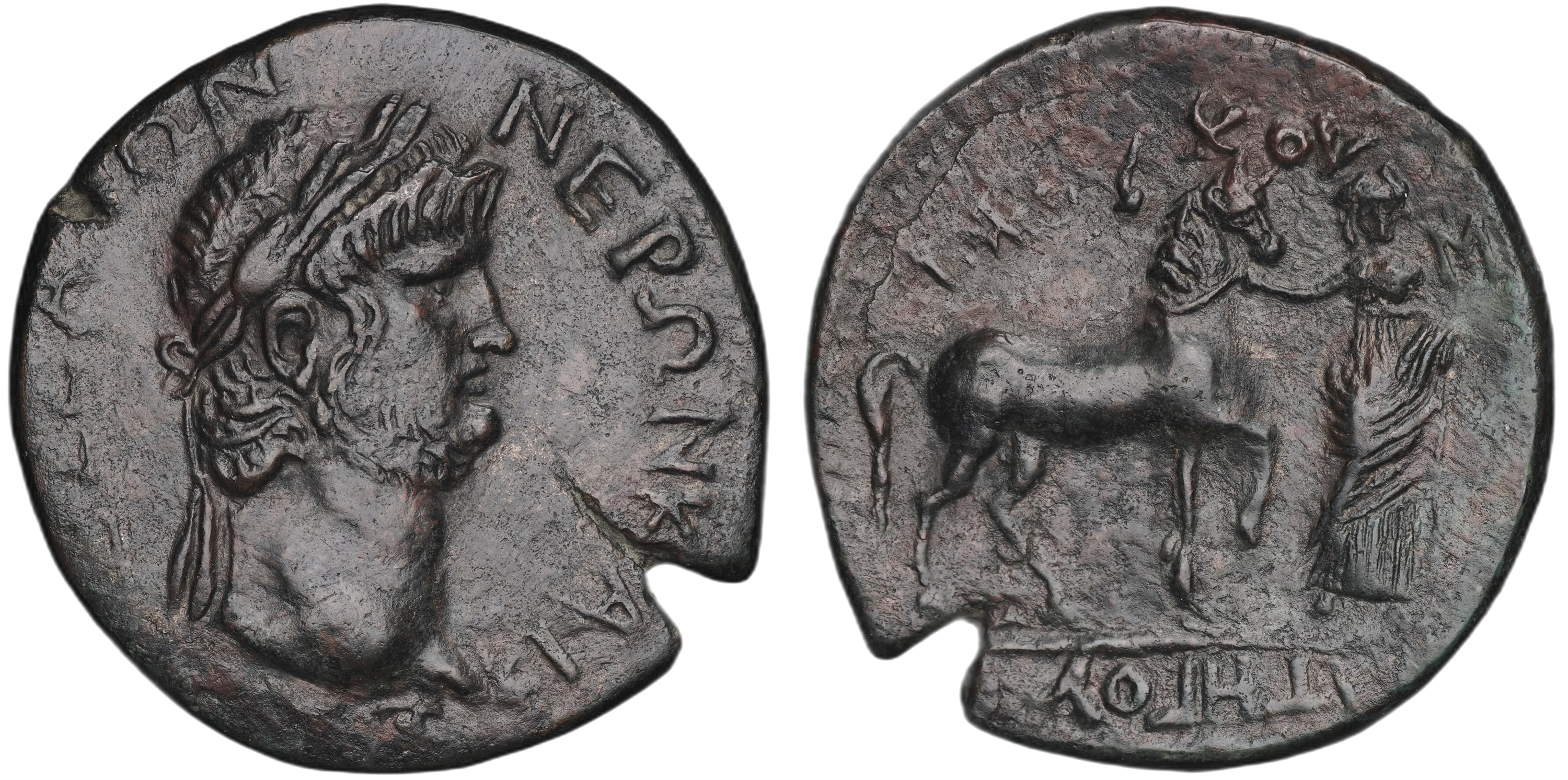
Ex Nomos AG, Auction 4, lot 1404. Coins of Thessaly, The BCD Collection. Zürich, 10 May 2011
The above tetrassarion represents the quintessential coin for the collector of Roman provincial issues from Thessaly. A key element in what is widely regarded as the foremost collection of Thessalian coinage ever assembled, this specimen represents the only opportunity to acquire not only what is perhaps the finest style issue of the type but one with illustrious provenance to the BCD collection itself. Elegantly engraved dies bolstered by dark brown patina, the serene and sublime portrait of Nero presents the emperor as something beyond merely mortal. Draped Thessalia holds a horse on the reverse, a fine depiction of the personification of fertile Thessaly.
9. Valentinian I, Antioch. AV Solidus, AD 366-367.
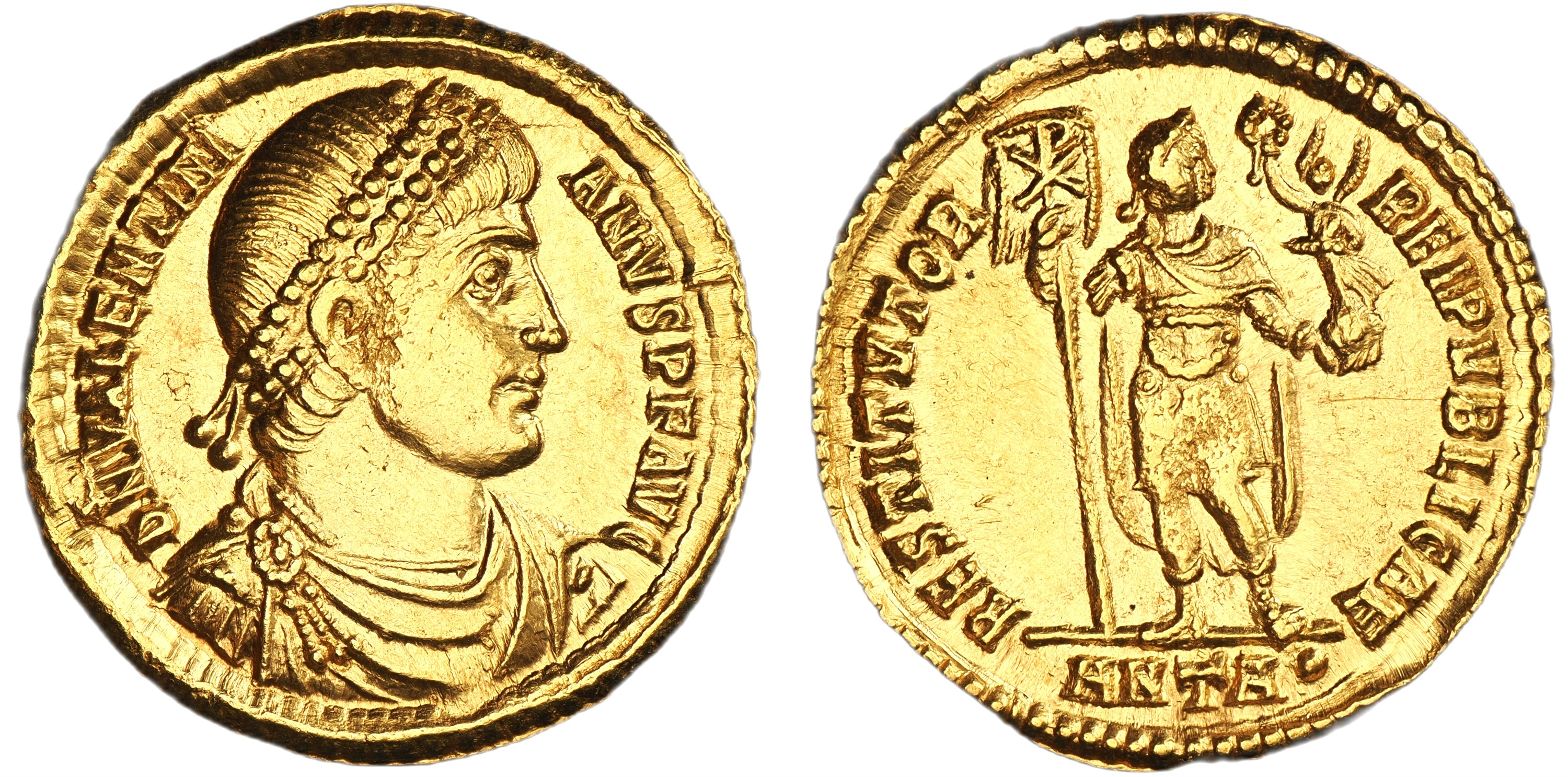
The boorish Valentinian stands among the more unflattering of the Roman emperors. Cruel, brash, and hot tempered, the man embodied the troubles plaguing and corrupting roman soldiers since the crisis of the third century. Dying as he lived, Valentinian succumbed to his temper and suffered a rage induced aneurism at perceived slights from a delegation of Germans. Having two wives as he did two bears, the former each begot for him an heir while to each of the latter he mercilessly fed both allies and enemies.
Elected to the office of sole emperor, rather unwisely Valentinian chose to share his labors with his brother. Valens, most known for the debacle at Adrianople and death at the hands of the Goths, by his failure at least paints his brother in a more favorable light. Two brothers with two noteworthy deaths, the inauspicious generation founded an inauspicious dynasty, fated to over see the gradual destruction of the west and weakening of the east. The reverse of the above solidus names Valentinian as the restorer of the Res Publica. The veracity of that claim the reader themselves must determine.
10. Ousanas I, Axum. AR Argyros, AD 320s

The mighty Axumite empire lasted for a millennium in the horn of Africa. Converted to Christianity by Saint Frumentius – himself chosen by the great Saint Athanasius, defender of Orthodoxy – the fortunes of Axum coincided with the burgeoning Christian religion rapidly overtaking the late antique world. Conversion brought tangible benefit to Axum and a natural alliance with Byzantium. The apogee of early Byzantine power coincided with that of the African empire, and the great emperor Justinian found a natural and willing ally in his Axumite counterpart, Kaleb. Much like Justinian, Kaleb fashioned himself as protector of Christians both within and outside of his domains. When king Dounaas in modern day Yemen converted to Judaism and began to persecute Christians, Kaleb invaded and drove the king to suicide. Lesser known than the famous Persian or Italian wars of reconquest, Kaleb nevertheless waged impressive campaigns to form a regional hegemony across the Bab-el-Mandeb strait, from the horn of Africa well into the Arabian peninsula.
Before Kaleb and the forging of an empire, the above coin represents Axum at the crossroads of geopolitical machinations and shifting alliances. The ‘Great Game’ of the late antique world was the forging of alliances between local Arabian tribes with either Byzantium or Persia. Indelibly colored by the subsequent rise of Islam, the forging of pantribal identities in Arabia and the gradual abandonment of Pagan religion in the region is of great importance for the study of this period. Axum played no minor role in this story, forming a key ally of Chalcedonian, Orthodox Christians against not only the Sassanians but Arians as well. King Ousanas, the last pagan king of Axum, minted the above coin. It would be his successor Ezana who received Saint Frumentius with open arms and converted to his religion. The missionary trip of Frumentius was of such importance, that an extant letter from emperor Constantius II to Ezana evidences the worry of the Arian court than a Nicene Christian should be proselytizing, and that the missionary Frumentius should be turned over to imperial authorities and replaced with an Arian. Fatefully, Ezana and his successors chose to follow the Nicene tradition and thus were in harmony with later Byzantine rulers – a momentous decision not only for the political alliances and struggles of the late antique epoch, but also for the many millions of Orthodox Christians living in Ethiopia and the horn of Africa today.
For their efforts in the conversion of Axum to Christianity and the defense of Christians throughout Africa and Arabia, apostle to Ethiopians (and later Bishop) Frumentius as well as kings Ezana and Kaleb have been canonized by the West and East. The great saint Athansius needs no introduction, and for the dramatic tale of Frumentius’ kidnapping and subsequent missionary work, we shall turn to a lesser known antiquarian publication by F. A. Forbes:
One day, when he had been but a few months Patriarch, a message was brought to him from a stranger who wished to speak with him. His name was Frumentius, and he had traveled from a distant country. Athanasius was presiding at a meeting of Bishops. “Let him be brought in,” he said, “and let him tell us what he desires.” The stranger was a man of noble bearing and gentle manners. He had a wondrous tale to tell. He and his brother Ædesius, left orphans at an early age, had been adopted by an uncle who was a learned man and a philosopher. Desiring greatly to undertake a voyage to Abyssinia to study the geography of the country and unwilling to interrupt the education of his two young charges, he took them with him, that they might continue their studies under his care. His work finished, he set sail for home with the two boys, but the boat, having put into a port for provisions, was set upon by savages, and everyone on board was killed.
Now, it happened that the boys had landed and were reading together under a tree on the shore. The savages had pity on their youth and, instead of killing them, carried them off and presented them to their King as slaves. The boys, who were intelligent and lovable, soon gained the affections of their barbarian master. Arrived at manhood, they were given positions of trust in the kingdom and loaded with every honor. Frumentius, the elder, was especially beloved by the King, over whom he gained a great influence for good. But the King fell sick and, being near to death, called his wife, to whom he had left the guardianship of his young son. “Let Frumentius help you in the government,” he said; “he is wiser and more faithful than any in the kingdom.”
The Queen Mother accordingly appointed Frumentius as the tutor of the young King, and Governor of the State, while his brother Ædesius was given a less important position. Frumentius, whose earnest desire was to see the land that he governed Christian, summoned all the Christian merchants who came to trade in the country and, giving them presents, begged them to build houses of prayer and to do their utmost to win the barbarians to the Faith. There were many conversions, and by the time the young King had reached his majority, several Christian communities were scattered throughout the State.
His task being now at an end, Frumentius asked leave to return to his own land with his brother Ædesius. They had a hard task to persuade the King and the Queen Mother to let them go, but at last they prevailed. Frumentius, whose heart was yearning over the country to which he owed so much, had come straight to the Patriarch of Alexandria to beg of him that he would send a Bishop to preside over the growing number of churches in Abyssinia and to preach the Faith in the districts where it was not yet known.
The Patriarch and the Bishops had followed the story with the greatest interest. When Frumentius ceased speaking, there was a moment of silence, broken suddenly by Athanasius himself, “who is more worthy of such a ministry,” he cried, “than the man who stands before us?”. The suggestion was approved by all. Frumentius was ordained by the Patriarch, who gave him his blessing and bade him return to his mission. He was honored as a Saint in Abyssinia, where he labored zealously all his life for Christ. Ædesius, his brother, became a priest also and helped in the good work.
So ends the top 10 list for L5 Auction 4. If any of these coins should have intrigued you, O’ reader, rest assured that many more treasures are to be found in the full sale. What was shared here is but a small preview. I hope that I have played my part well and to your satisfaction.
Acta est fabula, plaudite!