L5 News ·
Top 10 Coins of Auction 2
- 98.5% of lots sold
- Hammers of $154,367 compared to estimates of $81,334
- $47,894.05 in fees saved for collectors
- 2,381 registered bidders
- 8,413 visitors on auction day!
Over the hills yonder dawns a new day at which all wonder! The deepest of night is washed away at the first glimpse of the sun, craggy rocks whose pure shadow to the warmth of the sun surrender. The cockcrow cries, herald of the celestial body rising from oriental slumber. Harken the halcyon days of the numismatic field! Lo, L5 Auction 1:
A platform run by collectors for collectors, such an accomplishment would not be possible without you! We at L5 extend our heartfelt thanks and appreciation to everyone who has supported us thus far, whether that be by selling, bidding, grading, commenting, or simply by following along on this journey of ours!
The sequel must always be bigger, be better, be more bold. If Philip became hegemon of Greece, then Alexander that of the known world! If Caesar dictator for life, Augustus princeps and emperor. If l5 Auction 1 had 350 coins, then L5 Auction 2 over 700!
Vitality driven by the community, the top 10 coins previewed here from the 710+ pieces being sold in L5 Auction 2 have coins of interest for everyone! From heroic Bactrian silver to gold of emperor Philip the Arab, practically every typological and metallurgical desire is herein contained. Be not astounded, wonder not! What is shared comes from collectors like you, for collectors like you. Coins so tangible, of such indelible beauty can not easily be forgotten.
O Attic shape! Fair attitude! with brede
Of marble men and maidens overwrought,
With forest branches and the trodden weed;
Thou, silent form, dost tease us out of thought
As doth eternity: Cold pastoral!
When old age shall this generation waste,
Thou shalt remain, in midst of other woe
Than ours, a friend to man, to whom thou say’st,
“Beauty is truth, truth beauty”—that is all
Ye know on earth, and all ye need to know.
John Keats, 1819
The Top 10 Coins of L5 Auction 2
1. Thrace, Ainus. AR Tetradrachm, circa 400-397 BC.

Ancient Ainus, of divine stock and lineage, how far back do your roots trace! Sons of Apollo, with the blood of noble Olympus coursing through your veins, your people are among the oldest. Proud Thracian warriors, you who for a decade valiantly fought with king Priam on neighboring Anatolian shores, the yoke of stiff necked Ionians you bore with grace. Nicias you did follow to distant lands, and great empires you helped furnish with blood and tribute. Exchanging hands between your many subjugators, eventually you rested free, reunited with Trojan kindred, a millennium after Troy fell the sons of Aineus and Aeneus were one again!
And where in the English tongue has the vivid style of Homer been better captured than the eloquent pen of Alexander Pope:
Apollo thus from Ilion’s lofty towers,
Array’d in terrors, roused the Trojan powers:
While war’s fierce goddess fires the Grecian foe,
And shouts and thunders in the fields below.
Then great Diores fell, by doom divine,
In vain his valour and illustrious line.
A broken rock the force of Pyrus threw,
Who from cold Ænus led the Thracian crew,
Full on his ankle dropp’d the ponderous stone,
Burst the strong nerves, and crash’d the solid bone.
Supine he tumbles on the crimson sands,
Before his helpless friends, and native bands,
And spreads for aid his unavailing hands.
The foe rush’d furious as he pants for breath,
And through his navel drove the pointed death:
His gushing entrails smoked upon the ground,
And the warm life came issuing from the wound.
His lance bold Thoas at the conqueror sent,
Deep in his breast above the pap it went,
Amid the lungs was fix’d the winged wood,
And quivering in his heaving bosom stood:
Till from the dying chief, approaching near,
The Ætolian warrior tugg’d his weighty spear:
Then sudden waved his flaming falchion round,
And gash’d his belly with a ghastly wound;
The corpse now breathless on the bloody plain,
To spoil his arms the victor strove in vain;
The Thracian bands against the victor press’d,
A grove of lances glitter’d at his breast.
Stern Thoas, glaring with revengeful eyes,
In sullen fury slowly quits the prize.
Thus fell two heroes; one the pride of Thrace,
And one the leader of the Epeian race;
Death’s sable shade at once o’ercast their eyes,
In dust the vanquish’d and the victor lies.
Alexander Pope’s Iliad, Book Four
No mention of the Iliad can be complete without the Trojan Horse. If Odysseus had the foresight to imagine a plan so cunning, it was Epeius who built the dream. Soldier and craftsman, Epeius did not limit his activities to zoomorphic constructs of extraordinary size. He built a statue of Hermes Perpheraios that miraculously floated from Trojan shores to the waters of Ainus. This divine flotsam was clearly a message from Hermes, and the good citizens of Ainus were not one to ignore the gods! The statue was given a proper shrine and reverence, worshipped ever since. The above tetradrachm reflects this mythological imagery and cultural heritage dating back to Homer and the proud days of chariots thundering across the Troad. In a remarkable style untouched by blemish or wear, 3/4 facing Apollo looks with mute satisfaction beyond fields of muted green and red toning. Hermes the wanderer (Perpheraios) has come to retire at last in the quaint harbor town on the Hebros.
At the end of the 5th century BC, the citizens of Ainus could boast of Homeric martial prowess and illustrious history, but comparatively little else. The region was poorly endowed in comparison to the fabulously wealthy Shahanshah in the East and Athenian empire of the West. The saving grace of and great peril for Ainos was one and the same. An easily traversable harbor at the mouth of the Hebros enabled trade and riches, while attracting the unwanted attention of neighboring states. Decades after Persian and only years after Athenian control, Ainos issued this wonderful piece recalling to mind happier days of rustic simplicity and heroes of old.
2. Satraps of Caria, Pixodaros. AR Didrachm, circa 341-336 BC.
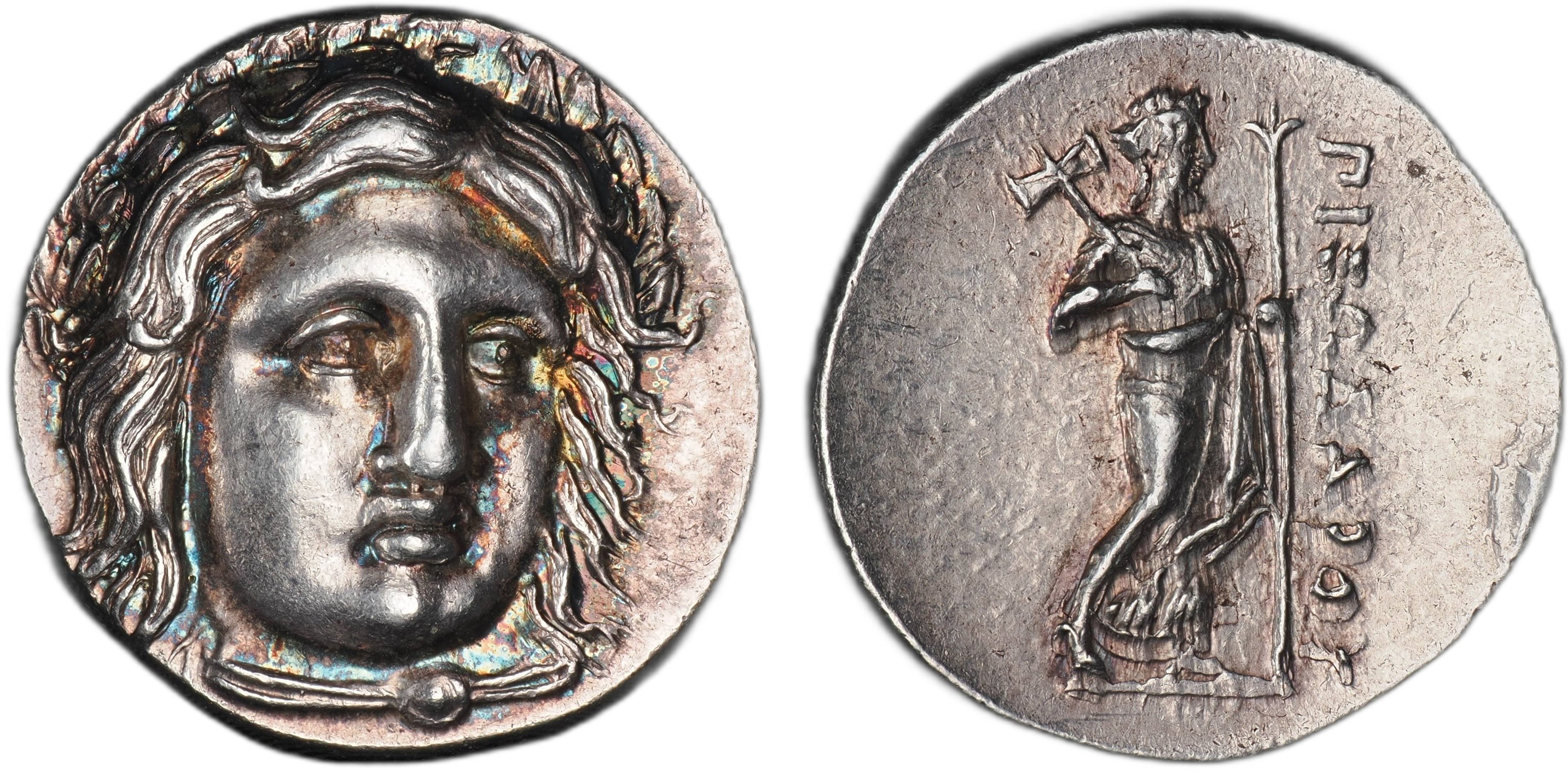
As we discussed Mausolus and the famous Mausoleum of Halicarnassus in the last top 10 auction preview, it is only right that his younger brother Pixodaros should be equally treated in the following preview. If a less accomplished architect and incestophile than his other siblings, Pixodaros can at least lay claim to a famous episode with Alexander the great, bringing to limited relevance an otherwise rather obscure if important satrap of late 4th century Caria.
Pixodaros, balancing the position of his satrapy between the Macedonian king Philip II and Persian king Darius III, sought to navigate the tumultuous currents of the Aegean and bring his Satrapy to a safe (and preferably independent) proverbial harbor. Contacting the one-eyed hegemon who had well known plans to invade the Western portions of the Persian empire, Pixodaros sent an embassy to the Macedonian court concerning his daughter Ada and a marriage alliance. Philip II offered his son Philip III Arrhidaeus, and Pixodaros agreed. Young Alexander III (not yet) the great, with great emotional insecurity directly sought out Pixodaros with a proposal to marry Ada himself. From disabled Philip III to dashing Alexander III, young Ada must have found herself thrilled with the change in bridegroom. Pixodaros, likewise delighted, acquiesced.
Macedonian king Philip II was less than enthused and called off the marriage alliance entirely. A powerful and useful ally in the satrap of Caria was thus spurned, and Pixodaros reentered negotiations with the Persians. The Macedonian marriage compact dissolved into naught and Alexander III was punished for it. His friends Nearchus, Ptolemy, and Harpalus among others were exiled as a result. One needn’t even explain the historical significance that these men would have on the campaigns of Alexander and the sources which describe them, and this episode surely must have been a formative experience for young Alexander and his friends who paid a heavy price for loyalty.
The kaleidoscope of toning on the above coins’ obverse brings a unique color palette to an already colorful character. Pixodaros confidently stares as a satrap who parlays with Macedonians and Persians alike, ruling from a quasi-independent and powerful state. He even went so far as to strike his own gold coinage, normally the prerogative of the king. Pixodaros only had the misfortune of large ambitions in an age where those of others were colossal.
3. Calabria, Tarentum (Punic Occupation). Half Shekel, circa 212-209 BC.
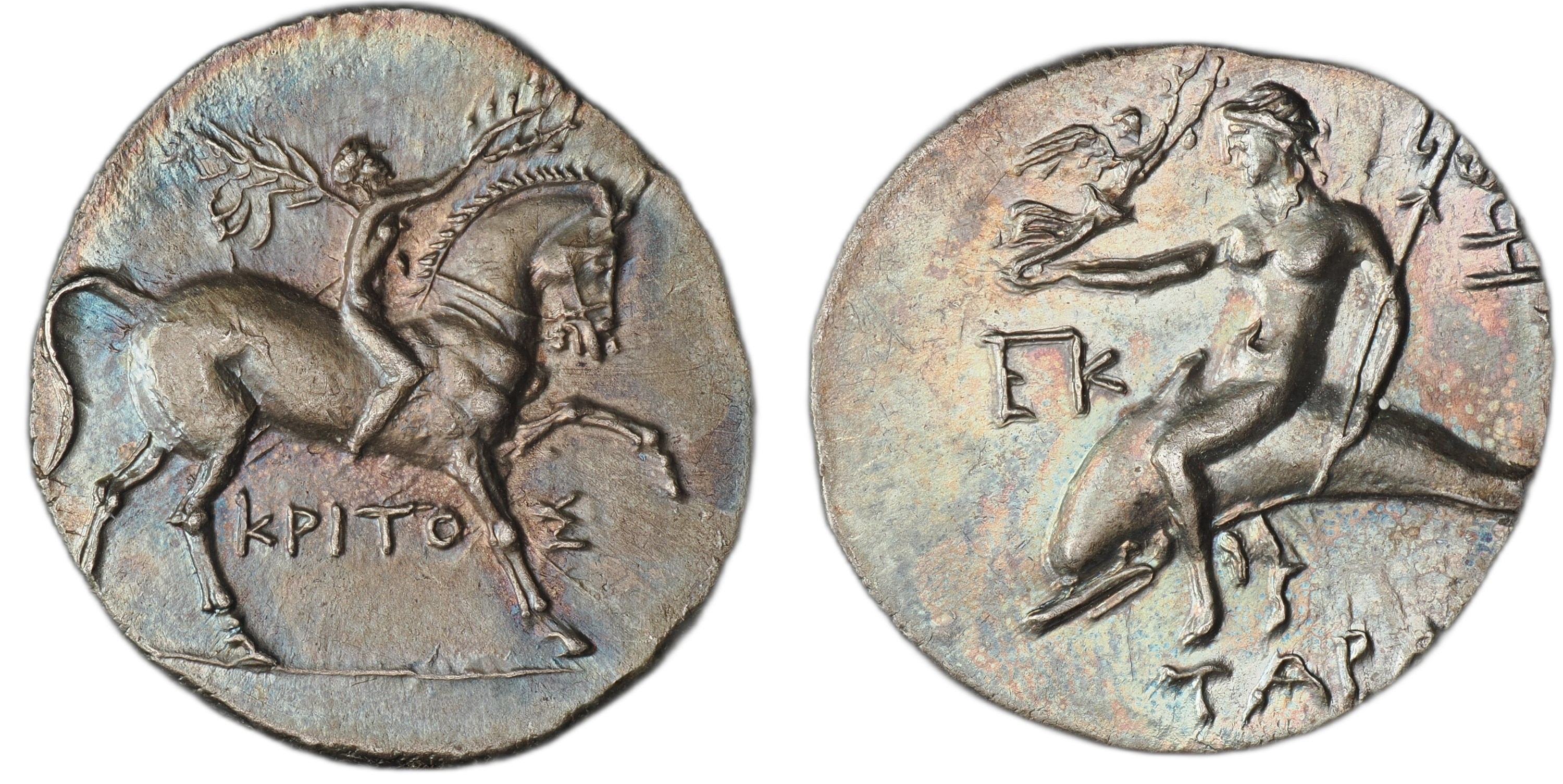
Lacedaemonian influence reaches across the pages of history, and Tarentum is no exception. Founded as a Spartan colony by exiles, the city grew to flourish and prosper over the following centuries. Long at conflict with Rome, Tarentum famously invited Pyrrhus of Epirus to fight on her behalf. Soon after it was conquered by Rome, stripped of its wealth, and had the majority of its inhabitants sold off into slavery. It comes as no surprise that Tarentum rebelled against Rome only 60 years later, assisting Hannibal in capturing the city though not the citadel. Tarentum would remain in Carthaginian hands for three years, before it was reconquered by Rome. The brutal 209 BC sack seems to have quieted Tarentine hopes for freedom. Where the Romans made a desert, they called it peace.
This half shekel represents the intricate diplomacy of Hannibal in the Second Punic War. Whereas other Carthaginian controlled mints tended to adopt standard Carthaginian iconography, the mint of Tarentum was permitted to issue coinage with traditional civic designs. Whether this reflected limited Carthaginian control of the city or leniency with local control as an incentive to defect from Rome is unclear. At the intersection of Greek, Roman, and Carthaginian history, this intriguing type represents the delicate balance struck between Hannibal and the various allies who helped him to wage war against Rome.
4. Bactria, Eucratides I. AR Tetradrachm, 170-145 BC.
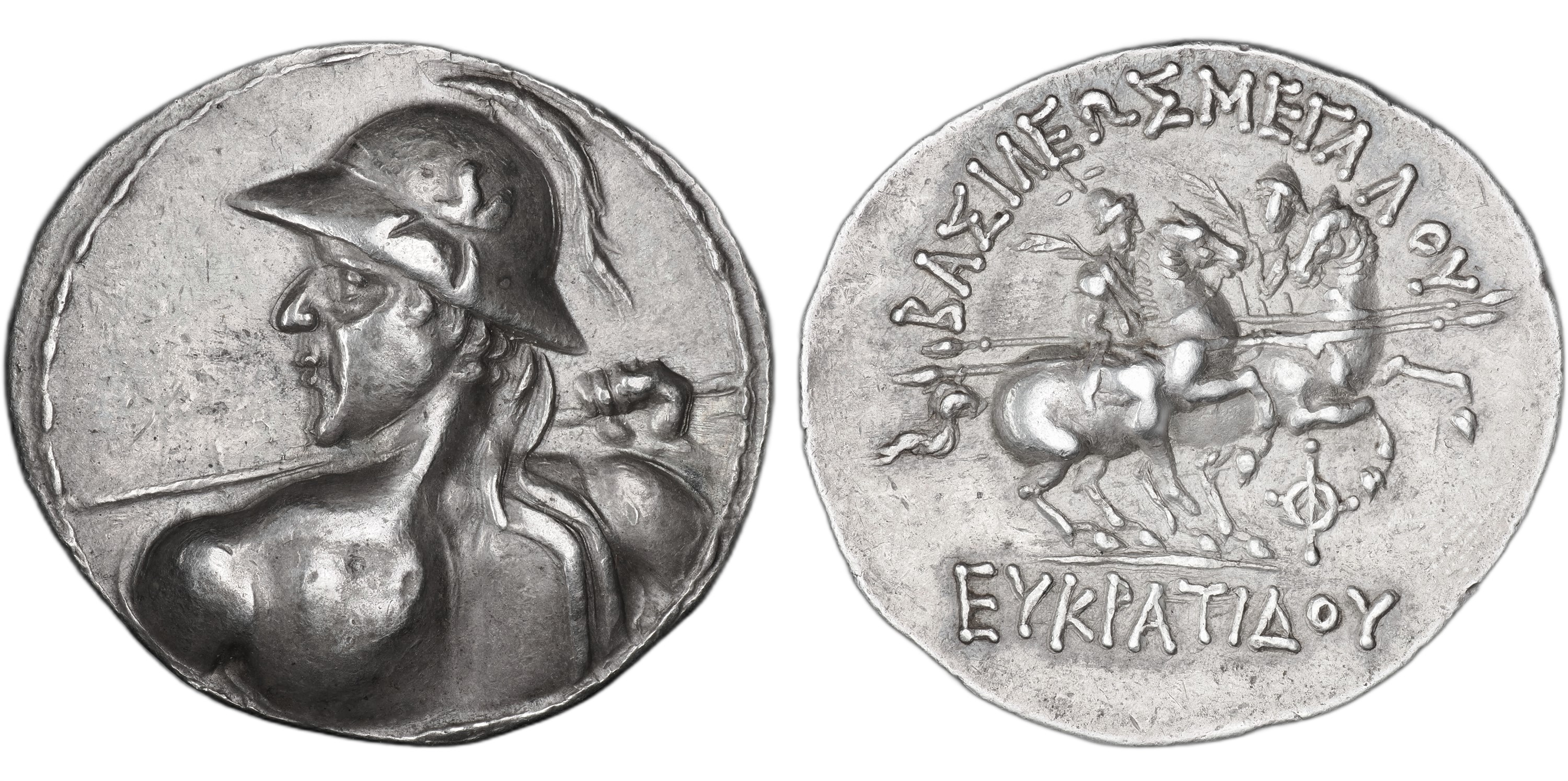
As is the case with most Bactrian history, there is little we have in the way of written sources describing events or people. That Eucratides was king of Bactria, conquered the kingdom of India, and was murdered by his own son is known. He is also described as a man of power and ability who waged wars, though no other information about him has survived. Fittingly then, Eucratides introduces numismatic innovation and a design perfectly encapsulating the man himself. Modelled in the ideal of eastern divine kingship, Eucratides stands as untouchable and unknowable. In the hellenistic ideal, with detailed musculature he braces with his spear ready to thrust into the heart of his enemies.
Resembling the highest classical forms of chiseled marble found across Hellas, no hint of Eucratides’ sorrowful fate is foreshadowed. What Demetirius of India could not accomplish, Eucratides’ own relations would do. Still king, still divine, it would take a blow from his very progeny to defeat the man who united Bactria and India into a single empire. If we know next to nothing about his ventures or campaigns, the little information and wonderful art that survives from the reign of Eucratides does lend credence to his deserving of a title perhaps overused in the annals of history: ‘the great’. Alas, if history is written by the victors, Eucratides has the poor luck to be seldom written about by friend, foe, or anyone else at all.
5. Rome, Octavian/Augustus. AR Denarius, circa 30-27 BC.

“For these Romans I do not place limits on time or deeds; their empire shall be without end” (his ego nec metas rerum nec tempora pono; imperium sine fine dedi).
The warlord has been retired, and the enlightened despot brought to stage. The man is no mere youth, Augustus no mere Octavianus, and the empire no mere republic. The fertile fields of Rome have been watered by streams of blood, and the flower of youth cut down serves as fertilizer for new growth. Men old in tooth and long in beard cannot remember the days before, of the citizen farmer and virtue rewarded. Travel through the provinces and Italian heartlands reveal industrial farming and exploitation of slave, citizen, and landscape alike. The agrarian enfranchisement fought for by the Gracchi is by now but a dream, and a distant one at that. For many, it’s a terrible nightmare. The lucullan feasts of oysters, rare game, and vintage wine surely would be bothered if the masses dared to share in the lands and wealth that in previous generations were won by the sacrifice of all. A population who takes interest in participation for things civil only serves to stir the pot so recently brought down from a boil. Delicate dishes cannot long withstand heat, and lukewarm is the temperature at which statecraft is best served. The year is 27 BC, and an old master has a new name.
Jupiter proclaimed that Rome has no limits, and that eternal she shall be. Augustus serenely presents himself in the guise of Jupiter Terminus, the god who would ensure Rome irrevocably marched on, never stopping, never surrendering. At the height of power and prestige, Augustus sits on the curule chair, delegating and commanding. He is ignorant of future Germanic humiliation and dynastic failure, and can still bask in the glow of triumph. Having the good sense to found an office upon which many subsequent rulers and states would trace their authority, he can rest assured of comfortable reputation and idealistic simplicity. With his new title comes a new mask, and we bid adieu to the rash, violent, cutthroat brute Octavianus, welcoming Augustus, generous benefactor with forever youthful eminence.
6. Rome, Nero. AV Aureus, circa 64 AD.

The stalk planted by Augustus with the founding of his dynasty would be pulled out by the root with the suicide of Nero in 69 AD. Tales of wanton abandon always draw a ready ear, and discussion of Nero remains at the forefront of the Western zeitgeist. The most infamous Roman, Nero has a reputation that supersedes any emperor in the popular consciousness. Caligula and his sisters may be more licentious and the murder of Caesar famous, but few on the street can recall the deeds of either. The story of Nero playing his lyre as Rome burns is seared into the popular memory and held up as the nadir of autocratic rulership. Democratic states have pointed to Nero as a prime example for why power should never rest in the hands of one person. Nero’s inception of and viciousness in prosecuting Christians likewise accords him certain prominence and disrepute in a society that is majority Christian. Scorned by modern church and state, the above aureus of Nero was minted at the epicenter of the facts and legends that have been used to castigate Nero for millennia.
If matricide stained Nero’s image early into his reign, Nero washed away salacious whispers with liberal donatives and public games. Ever disliked by the aristocratic classes, Nero at least had the popularity of the masses. It was the great fire of Rome that was the catalyst for his downfall. Differing theories exist as to why the fires started, from megalomaniacal cravings of the mad emperor to pure chance. Whatever the truth of the matter, rumor leapt, licked, and spread as quickly as the flames themselves: Nero started the fire to claim prime real estate for himself, and composed poetry from a hill as he overlooked the great conflagration. Nero did not mitigate rumors with the decision to build his Domus Aurea on the ruins of the burnt out city. The enormous private complex of the emperor was crowned by his 30 meter (100 foot) colossal likeness. The reverse of the above aureus depicts this very statue in numismatic form. So impactful was this statue on contemporary cultural memory that even after its repurposing and the construction of an amphitheater near its spot, the new building adopted the name of the old statue: the colosseum.
Whatever the current ebbs and flows are in the debate about Nero and potential rehabilitation of his image, the overwhelming crass indecency of his actions make it difficult to take seriously the contrarian attempts of scholars to present Nero as a dignified statesman with far sighted plans. The man murdered his adoptive brother, murdered his mother, in a fit of passion murdered his pregnant wife and gestating child by beating the pair to death, and castrated an unwilling slave child who he married on the basis of the unfortunate boy having a similar likeness to said murdered wife. Such deeds do not represent a calculating ruler who delicately balances policy but a debauched hedonist utterly controlled by his own whims and passions. Nero’s actions dug his own grave, and starting with the great fire Nero began to alienate the populace. Hated by the senate, Nero had to now worry about the people too.
Vindex and Galba rose in revolt, and the praetorian guard abandoned Nero. Roaming his great palace, Nero found it empty. There was no friend left for the most powerful man in the world. Fleeing the city, he was quickly tracked down by troops sent to capture him. Scorned and alone, with the sound of approaching soldiers, Nero decided his fate was better determined with his own hands than that of others. Quo vadis, domine?
7. Rome, Caracalla (with Geta). AV Aureus, circa 211 AD.
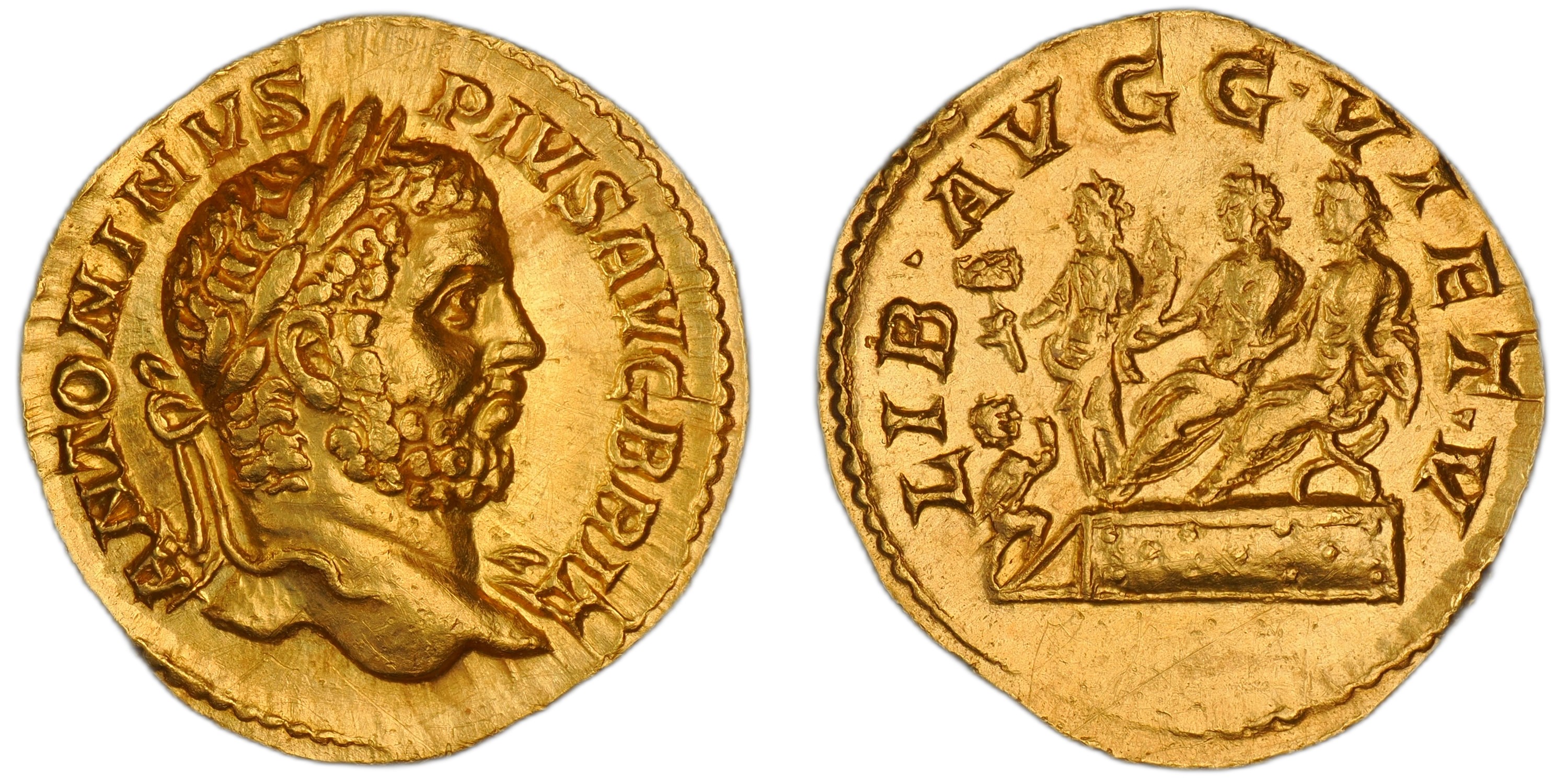
Fraternal friendship is a theme not well attested to in Roman history. If even the great Romulus and Remus could not work out their differences amicably, what hope did Geta and Caracalla have? Indeed fratricide is an odorous deed, though the unscrupulous and distasteful event is performed so frequently by the Romans as to become banal.
If Roman fratricide is banal, then the sheer brazenness of the attack by Caracalla starkly stands aside. Inviting his brother Geta to a meeting with their mother, Caracalla proposed discussions to reduce tension and discord between the brother emperors. Caracalla did not mislead both by announcing that a final and serious peace would be made. On the altar of their shared womb, Caracalla and his henchmen slayed Geta. Over the cries and intercession of his mother, Caracalla became kinslayer, and with his dark deed done, he broke his word to keep it. With the instigation of violence, peace returned.
The reverse of the aureus depicts Caracalla and Geta harmoniously seated side by side. The legend proclaims the liberality of the emperors (LIB[ERALITAS] AVG[VSTORVM]), an important aspect of rulership. For whom this liberality was intended is clear, as the famous maxim of Septimius Severus states, “be harmonious, enrich the soldiers, and scorn all other men”. How splendid is the philosopher king, and how munificent his generosity! The singular difficulty with a wise monarch lies only in the process of first finding one.
8. Rome, Philip I. AV Aureus, circa 244-247 AD.
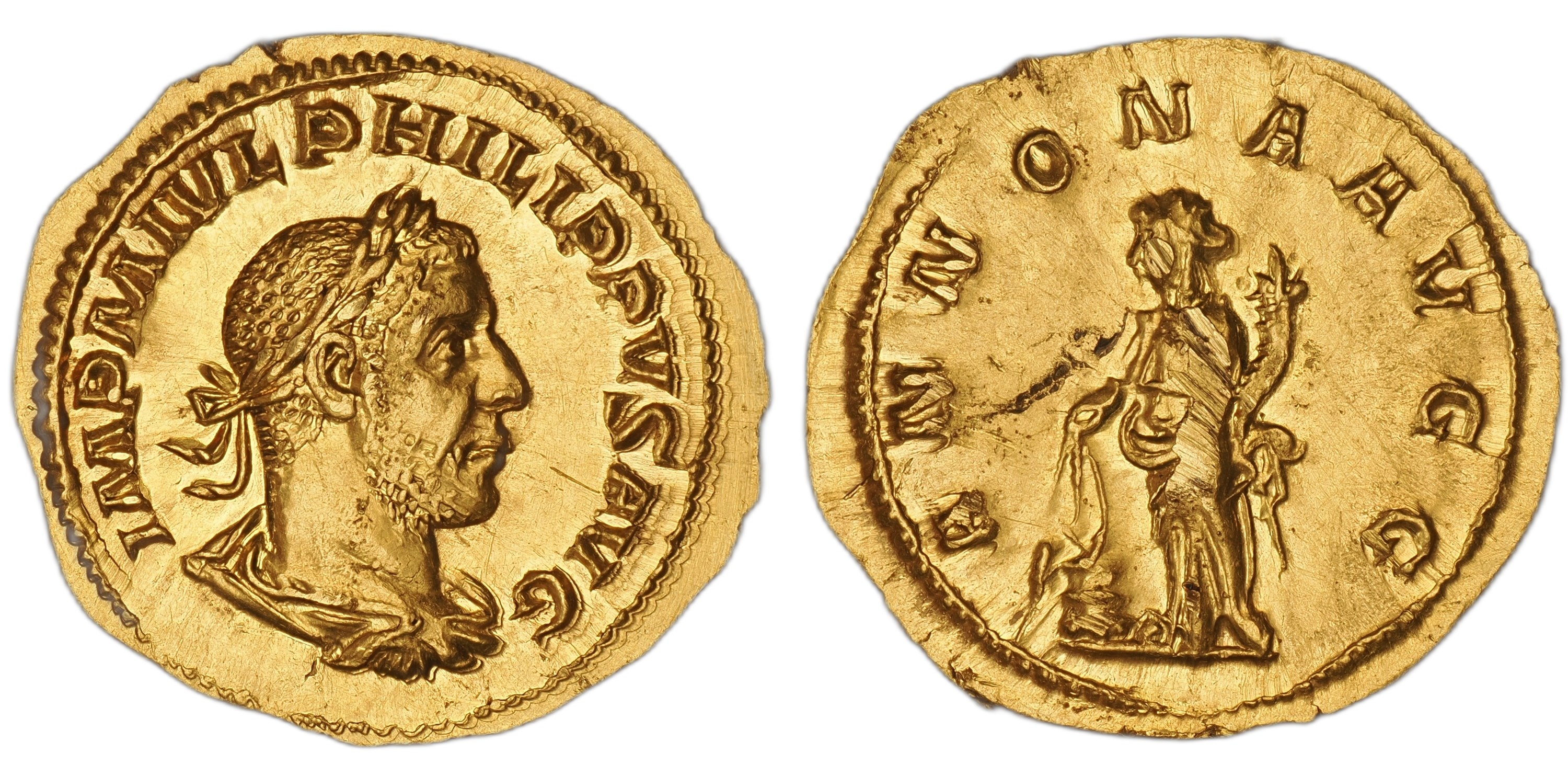
A lush oasis in deserts of lamentations, the reign of Philip I served as respite for the beleaguered Romans of the third century. Civil wars, barrack intrigues, and barbarian invasions overwhelmed the weakened empire both before and most especially after Philip. During his brief rule prosperity yet flourished, and for half a decade the weary citizens of Rome could hope in a future that was not theirs to live out.
Philip emerges from the murky waters of history in the reign of Gordian III. From a relatively unclear (if probably humble) background, Philip had his brother Priscus to thank as the two rose through the ranks of the Roman aristocracy. The squabbling of Caracalla and Geta brought to an end their own lives and reigns, the unity of Philip and Priscus the inception of one. Priscus, a well connected governor who transferred into the praetorian guard, secured for Philip the role of praetorian prefect after the death of Gordian III’s leading minister. From this dominance of the imperial bodyguard came the highest promotion of all. After Gordian III was slain by the great Persian king, Philip was elevated from praefectus to imperator. The king is dead, long live the king.
Philip began his reign in an unenviable position, in conflict with a hostile enemy after a devastating loss in a far away land. Recovering quickly, Philip made peace and returned to Rome to secure his reign. In fairness to Philip, if he had to introduce and maintain higher taxation, it was because of the difficult geopolitical situation he inherited, not one he created. Persia required tribute, and the terms must not have been too onerous, for Philip even minted coinage commemorating the peace bought with treasure sent East. Embracing the citizenry, Philip led widespread infrastructure works. He famously celebrated the thousand year anniversary of the founding of Rome with spectacular games. In this context of restoration and rejuvenation is the above aureus placed. Annona personifies the supplies of food and general safety that the emperor provided to the city of Rome and to the Roman people. Philip, unlike the majority of his third century counterparts, could with a straight face present such propaganda.
Focused on restoring old Roman virtue and the senate, Philip dedicated effort to rebuilding a shattered Roman society and to restore civic institutions abandoned in the chaos of his predecessors. It was in his very attempts to restore ancient honor that Philip was treated most dishonorably. Unprovoked usurpations fractured the empire and Philip offered to the senate his resignation in order that Roman blood may not be shed. Trajan Decius, a senator of renown, gave a vivid speech imploring Philip to remain on the throne and defend his imperial rights. Philip, bowing to the pressure of the senate and the eloquence of Decius, agreed.
Moved by the words of his friend and ally, Philip sent the senator Decius to lead the military campaign against the usurpers, whereupon Decius was successful. Accomplishing his mission, Decius, the very man who but a few months earlier implored Philip to remain on the throne, turned against the emperor who had taken his advice. Decius killed Philip, and more savagely both his child Philip II and his brother Priscus. Even the man who succeeded Decius would not stoop so low as to kill the child of the man he replaced.
Little wonder then that a man of such gross action and immorality would rekindle the fires of persecution across the empire. From his ill-gotten cathedra pestilentiae Decius would betray his old friend in policy, as he had betrayed him in life. Decius, harbinger of woeful times to come, would have a short reign of exacting cruel misery on the populace before falling to either the knives of friends or the spears of invading barbarian tribes. Such would be the fate of almost all emperors in the years to come. Of the 37 men who claimed purple in the crisis of the third century, 33 died a violent death.
9. Constantinople, Theodosius I. AV Solidus, circa 379-395 AD.
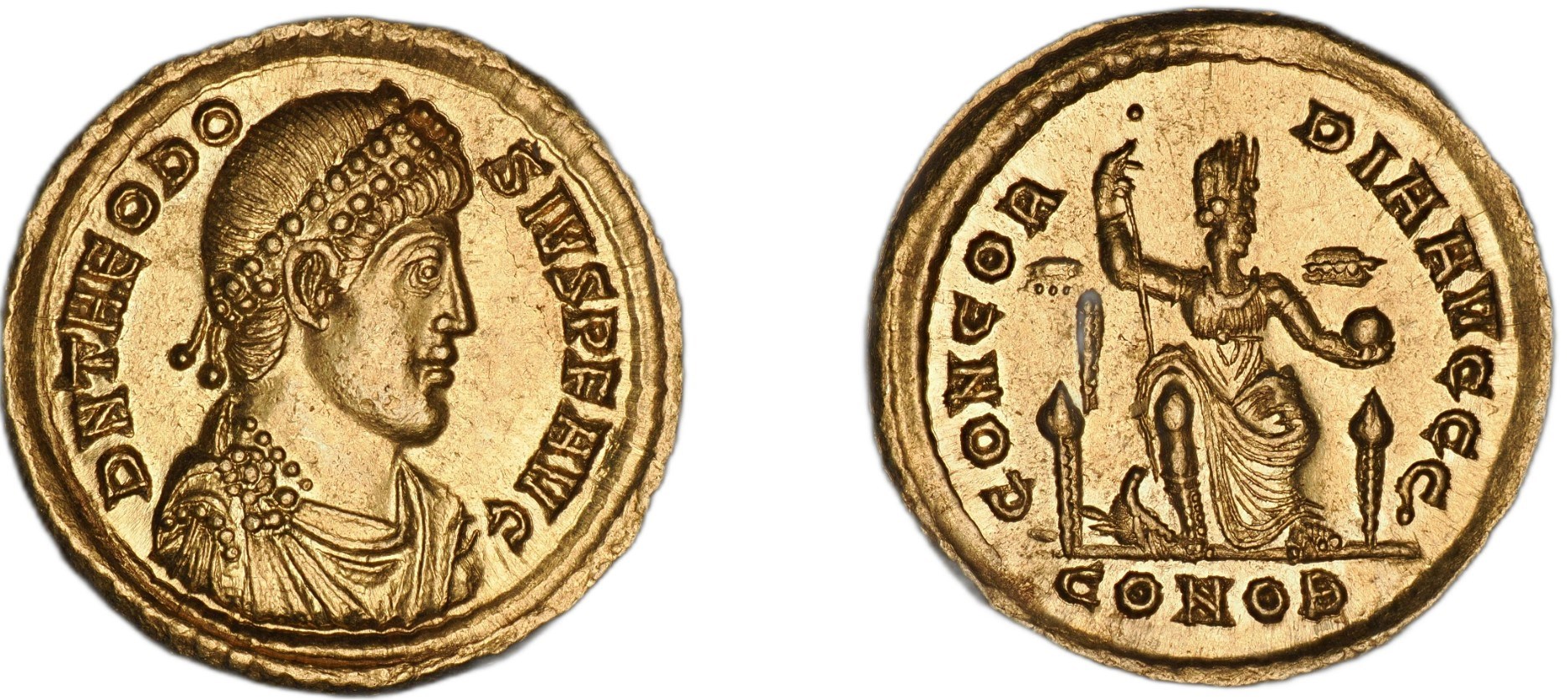
The watershed moment of Christian triumph came not with the conversion of Constantine or death of Julian, but on the footsteps of the cathedral of Milan. Even if earlier emperors proclaimed a Christian faith, their limited adherence followed the arian sect and the emperors themselves behaved in a manner little different than their pagan predecessors. It would take a gauntlet thrown by a powerful nicaean bishop to a nicaean emperor to change the dynamic forever. At far away Thessalonica, the emperor Theodosius ordered a massacre of the population in reprisal for riots and the lynching of a high ranking officer. 7,000 civilians lay dead in the streets, and the powerful bishop of Milan received word. Ambrose would not, could not stand for such violence upon the innocent. Sharpening his quill, he wrote to the emperor:
“An act has been committed in the city of Thessalonica, the like of which is not recorded, the perpetration of which I could not prevent, which in my frequent petitions before the court I had declared to be most atrocious, and which by your tardy revocation you have yourself pronounced to be very heinous: such an act as this I could not extenuate…
I advise, I entreat, I exhort, I admonish; for I am grieved that you who were an example of singular piety, who stood so high for clemency, who would not suffer even single offenders to be put in jeopardy, should not mourn over the death of so many innocent persons. Successful as you have been in battle, and great in other respects, yet mercy was ever the crown of your actions. The devil has envied you your chief excellence: overcome him, while you still have the means. Add not sin to sin by acting in a manner which has injured so many.”
How many tens of millions of people have been slaughtered by the generals and emperors of Rome? How many tens of millions of Greeks, Spaniards, Punics, Celts, Britons, and more faced certain death and the end of a sword? How many hundreds of thousands to millions of Romans faced death at the hands of their own armies? How many were consumed by the proscriptions? By purges?
The tens of millions killed faced no hope, no justice. Humanity did not have intrinsic value, and only those of status and wealth were deemed to be fully equal members of society. The poor, the unwashed, the enslaved were all expendable. Who stood up to the thugs of Marius running rampage through Rome? Who stood up to the thugs of Sulla? Who stood up to the proscriptions of the second triumvirate? Who stood up for Cremona when a Roman city was sacked by a general of Vitellius? Who stood up for the 30,000 Alexandrians massacred by emperor Caracalla because one actor dared to tell a joke?
One stood up for the 7,000 Romans massacred in Thessalonica. With Ambrose, for the first time in the history of Rome, there is a recourse for the populace against the brutality of their overlords. Ambrose, bishop of Milan, has stood up against imperial authority and come out victorious. Emperor has bent knee to bishop, and the teeming masses of humanity across the empire are liberated in a theology that for the first time in human history assigns inherent value and dignity to all individuals, master and servant alike. If the procession and proskynesis at the stairs of the cathedral of Milan by emperor Theodosius ushered in the dark ages, the countless hoards of impoverished and abused citizens breathed a sigh of relief and thanksgiving for it. The above solidus captures the crossroads of the Roman empire. Theodosius is a powerful emperor who depicts himself in iconography tracing back centuries, but the denomination itself hints at changing times and economies. Before Theodosius stands an empire grappling with its own fate and identity. After Theodosius stands an empire newly reforged in firm belief that would survive for over a millennium longer.
10. Constantinople, Manuel I Comnenus. EL Trachy, 1143-1180 AD.

The zenith of the later Byzantine empire occurred under Manuel I. Unlikely imperial aspirant, his reign marked the peak of Byzantine influence and prestige among Westerners and Easterners alike. Triumphal entry into Antioch fulfilled the dream of Manuel’s grandfather, and short sighted policy dashed Manuel’s dream of a grandson. Emperor of renown, friend of the Latins, and great power of the East, under Manuel came the last twinkle of the Comnenian star before in a few decades the proud Romans would be forced into ignominious exile and under foreign yoke.
The closest comparison in history to Manuel may well be the other bookend of Byzantine temporal power, Justinian I. Both men married powerful wives who altered their trajectory as ruler. Both men nurtured the tales of the bygone glory of their empire. Both men inherited copious treasuries, the result of previous fiscal responsibility and the means by which they might enable their visions of grand conquest. Both men were adept lawmakers and took interest in legal reform. Both men meddled in theological controversy and promoted formulations unpopular by all parties in dispute. Both men sought closer ties to the Papacy and a strengthening of the Eastern and Western churches. Both men sought to reclaim lost Byzantine lands in the West. Both men launched grand expeditions and military campaigns of a size long not seen. Both men ultimately were met with mixed results. Both men expended and extended fiscal resources to a breaking point without consideration for the future. Both men in hindsight doomed the empire they tried to strengthen, the former to an Arab onslaught and the latter to a Western onslaught.
Whatever the degree of blame that Manuel has in dooming the empire to subsequent events, it is undeniable that of the Byzantine emperors his rule is most charming of all. A dashing figure, famously swarthy and handsome, ladies both East and West swooned over the emperor born in the purple. Jousting with the prince of Antioch Raynald of Châtillon, he proved his courage both in personal contest and military campaigning. Active and energetic, he led campaigns from Sicily to Cilicia. Under his octopus banner he rode, galloping across Levantine plains to assert the authority of an office long known, respected, and now newly feared in the region. A bold theologian and perceptive ruler, he attempted reunion with the Papacy, his eye towards the future to avert the hostilities that so plagued the final centuries of Byzantium. Ever striding forward, Manuel was acknowledged by East and West as the supreme prince of Christendom and the man most valorous in an age full of valorous men. The above trachy represents a formidable emperor at the apex of global power, well endowed with charm, chivalry, looks, intellect, and dignity. At the height of the medieval period, Manuel embodied the medieval ideal in every way. Truely, ὁ Μέγας indeed.
So ends the top 10 list for L5 Auction 2. If any of these coins should have intrigued you, O’ reader, rest assured that many more treasures are to be found in the full sale. What was shared here is but a small preview. I hope that I have played my part well and to your satisfaction.
Acta est fabula, plaudite!