L5 News ·
Top 10 Coins of Auction 1
Non arma virumque cano sed nummos auctionemque / I sing not of arms and a man, but of coins and an auction!
Lo, how the herald sounds! Listen, how the bells ring! The stables are open, and the rivers diverted! What a king could not manage, what Eurystheus could not imagine, Hercules has washed clean. His fifth labor most odorous, most laborious, most tedious, reveals the gleaming and glistening marble of the stables underneath. Such valor, such glory, such inspiration can only serve to move the hearts of whoever should hear. Wherever there indeed this might be, that muck built up for all to see, noble souls are stirred up with glee, stables by rivers moved they free.
Behold, the Augean Stables of our own times are cleaned! Washed away are selling fees, often surpassing 10%! Washed away are lengthy consignment timelines, taking anywhere from 6-18 months! Washed away are ever increasing and eye watering Buyer’s Premium fees! Washed away are undisclosed handling fees! Washed away are exorbitant shipping costs! Washed away are the days of an invoice totalling 125-150% or more of the original hammer! The cries of the collector are heard!
What, silent still? and silent all?
Ah! no—the voices of the dead
Sound like a distant torrent’s fall,
And answer, ‘Let one living head,
But one, arise—we come, we come!’
In the words of Lord Byron do we harken this seculum aureum! The fifth labor repeated! Its namesake marketplace is created: L5!
Dirumpamus vincula eorum,
et projiciamus a nobis jugum ipsorum!
The Top 10 Coins of L5 Auction 1
The thread of history woven by Nona and the Parcae is long, and the shadow it casts longer still. The eminent father of history, Herodotus himself, wrote ‘…so that human history will not be forgotten by time’ (…ὡς μήτε τὰ γενόμενα ἐξ ἀνθρώπων τῷ χρόνῳ ἐξίτηλα γένηται…). Others like the Venerable Bede so that “…indeed should a good history concern itself with good things, the anxious listener too is urged to do good” (…enim historia de bonis bona referat, ad imitandum bonum auditor sollicitus instigatur…). People across time have undertaken various actions for a variety of reasons, and numerous historians each with their own goals and agendas have recorded events for posterity. The story of every coin lies at this intersection of where history meets tangibility, peoples and events long gone still physically manifest in the 21st century via their material creations now millenia old. Capturing cultural sentiment, capturing valor, capturing infamy, no coin and its historical context is quite like another. From a wide breadth of stories, peoples, and events, each coin shared in the list below can be found at L5 Auction 1!
1. Ionia, Uncertain Mint, 625-600 BC: EL Trite
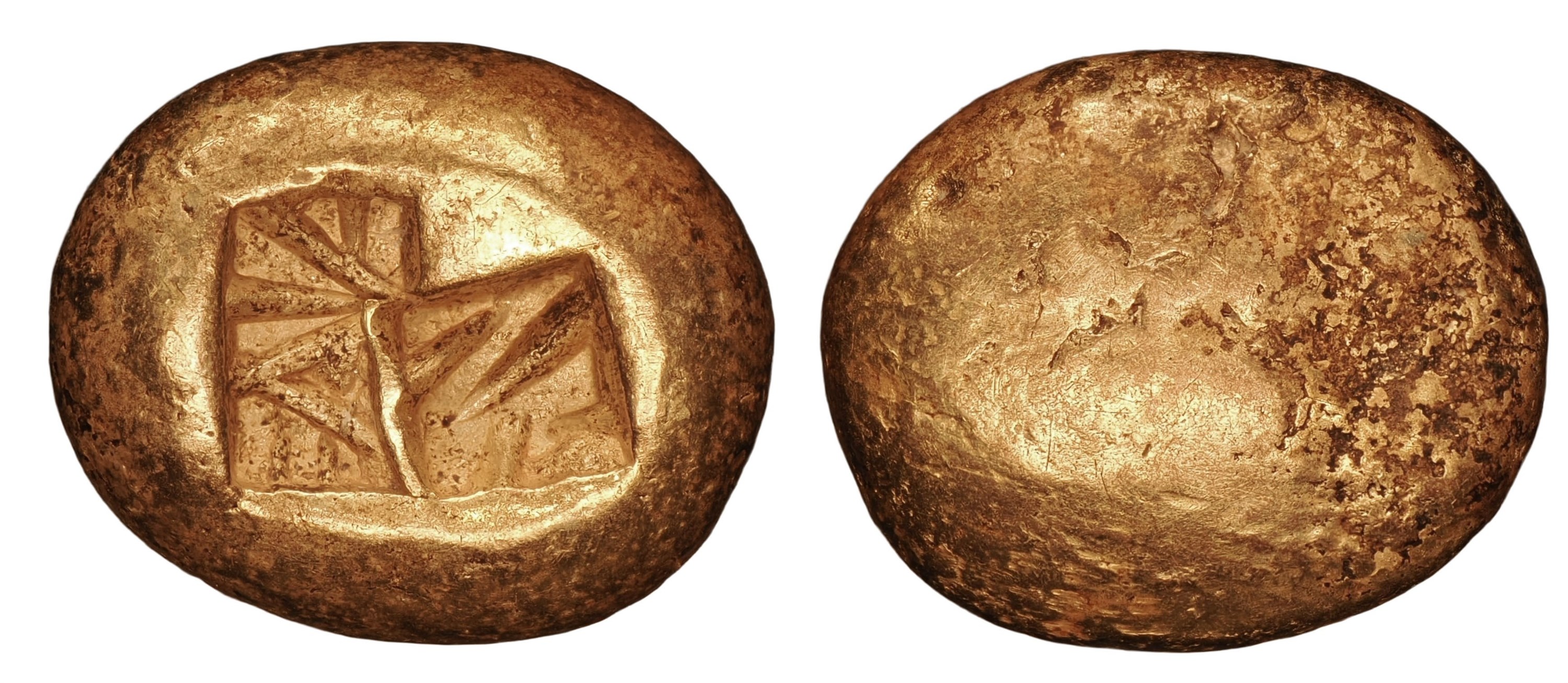
Lot 93
The dawn of coinage was rather globular. For the lover of all things spherical, just the lot for them is graced to not only open this top 10 list of coins in L5 Auction 1, but in fact is the first coin to ever be shared in an L5 email. Such an illustrious place in early L5 history is quite fitting for a coin like this, itself having an illustrious and early part in numismatic history. As is apt to happen with ‘firsts’, the early electrum coinage forms something of an enigma, oftentimes having more questions than answers. Exactly who minted these coins and where is difficult to say beyond generic geographic-based appellations. What is more clear is that the electrum was sourced from naturally occurring deposits in the Pactolus and Maeander rivers. Herodotus, our erstwhile compatriot, claims it was the Lydians who first struck coinage.
Regardless of the veracity of that statement, Herodotus and his words had a profound cultural impact. Two millennia later in the year 1200, Byzantine political figure and churchman Mesarites referenced both Herodotus and the existing prolificity of the Pactolus river. “[The mint workers are] experts with hammer and anvil. They are hidden away in chambers, which never see the light of day, but which run with gold, like another Pactolus. From there flowing like a river minted gold is scattered to the four corners of the world”. This extremely early coin is evidence of some of the first coinage to be minted, the pervasiveness and cultural impact of Herodotus, and bears witness to the geographic conditions that have remained continuous from the dawn of antiquity to today, namely the electrum deposits to be found in the Pactolus. Round, simple, historic. What is there not to like?
2. Attica, Athens, 545-515 BC: “Wappenmünze” AR Obol
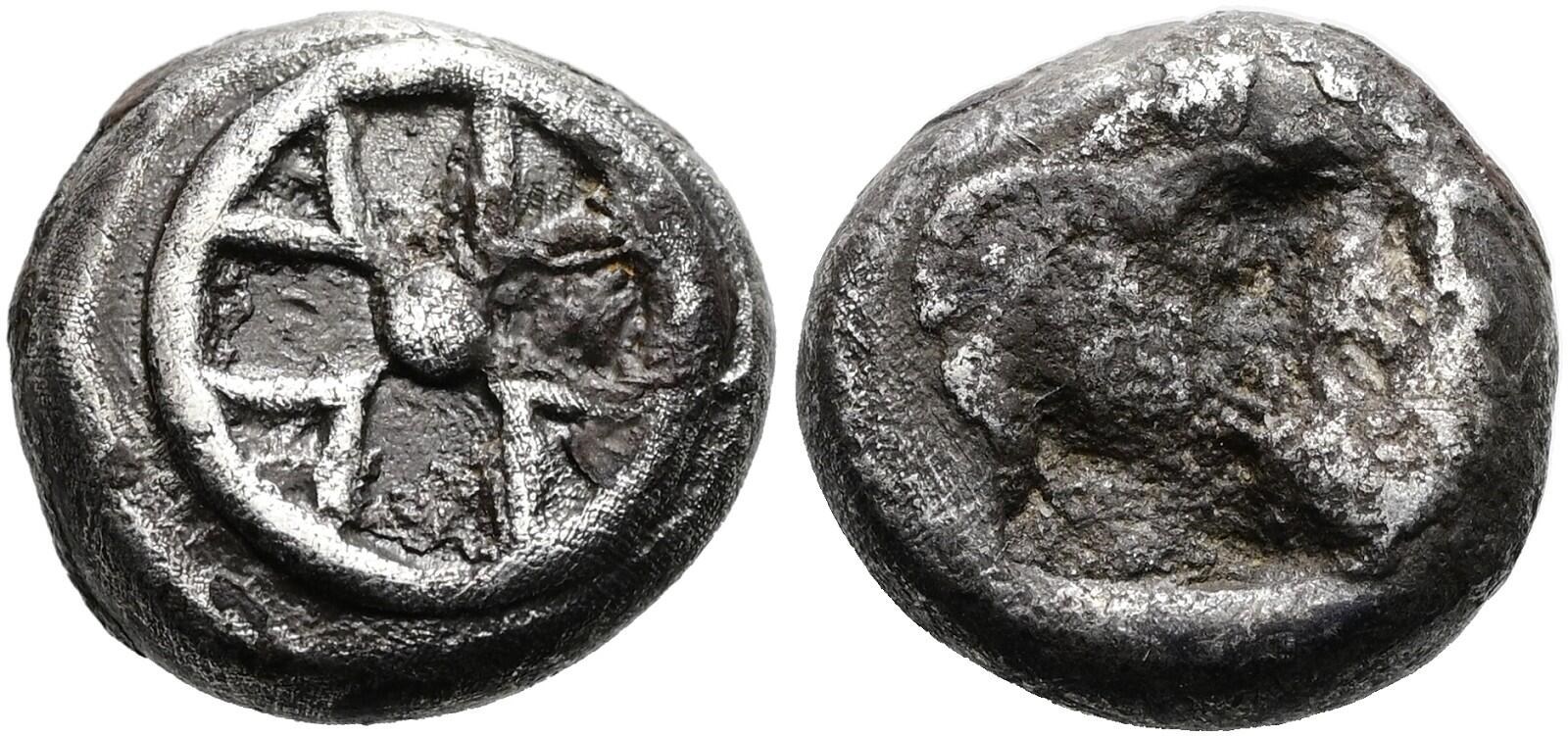
Lot 44
Look once more, ere we leave this specular mount,
Westward, much nearer by southwest behold
Where on the Ægean shore a city stands
Built nobly, pure the air and light the soil,
Athens, the eye of Greece, mother of arts
And eloquence, native to famous wits
– John Milton
So the Athens of John Milton. Yet before her grandeur, before her temples of splendor, before Plato, before Socrates, before Pericles, before her arts, before her eloquence, and before her famous wits, there was an Athens. Nascent in the cradle, barely emerged from the post Mycenaean dark ages, few could have predicted that in the rustic, illiterate, and poverty stricken Attica region lay the future of Western civilization. Archeological evidence highlights brutal conquest, forceful assimilations, widespread conflict, and the ever increasing consolidation of power and wealth by local elites.
While much remained the same, the end of the ninth century saw a general reversal of fortunes for Athens. Far from the academy and philosophers, the city could at least by the turn of the eighth century boast again of literacy. In the seventh century, it could boast of a written law. If it had to still wait for Cleisthenes and democracy, it could at least take solace in Solon. Reorganizing the political body into four distinct classes based on wealth, the reforms of Solon attempted to address the many social issues plaguing Athens and put an end to political instability. While initially unsuccessful as turmoil led the tyrannical Pisistratids to power, the fields sown by Solon would be reaped by later generations.
The wappenmünze pictured above is a rare issue encapsulating these formative years of Archaic Athens in the period leading up to Persian wars and Athens’ greatness beyond. Once theorized to be the emblazoned heraldry of leading Athenian aristocratic clans, the wappenmünzen series today stands uncertain as to purpose and intended iconography. Much a product of its era, the Archaic period of ancient Greece and Athens remains today still shrouded in myth and mystery. Produced in the Pisistratid tyranny, the coin represents an era that later Athenians would look to as defining their own civic consciousness. Harmodios and Aristogeiton would slay Hipparchus, the tyranny in Athens would fall, democracy would be established, and, as they say, the rest is history…
3. Corinthia, Corinth, 500-430 BC: AR Stater
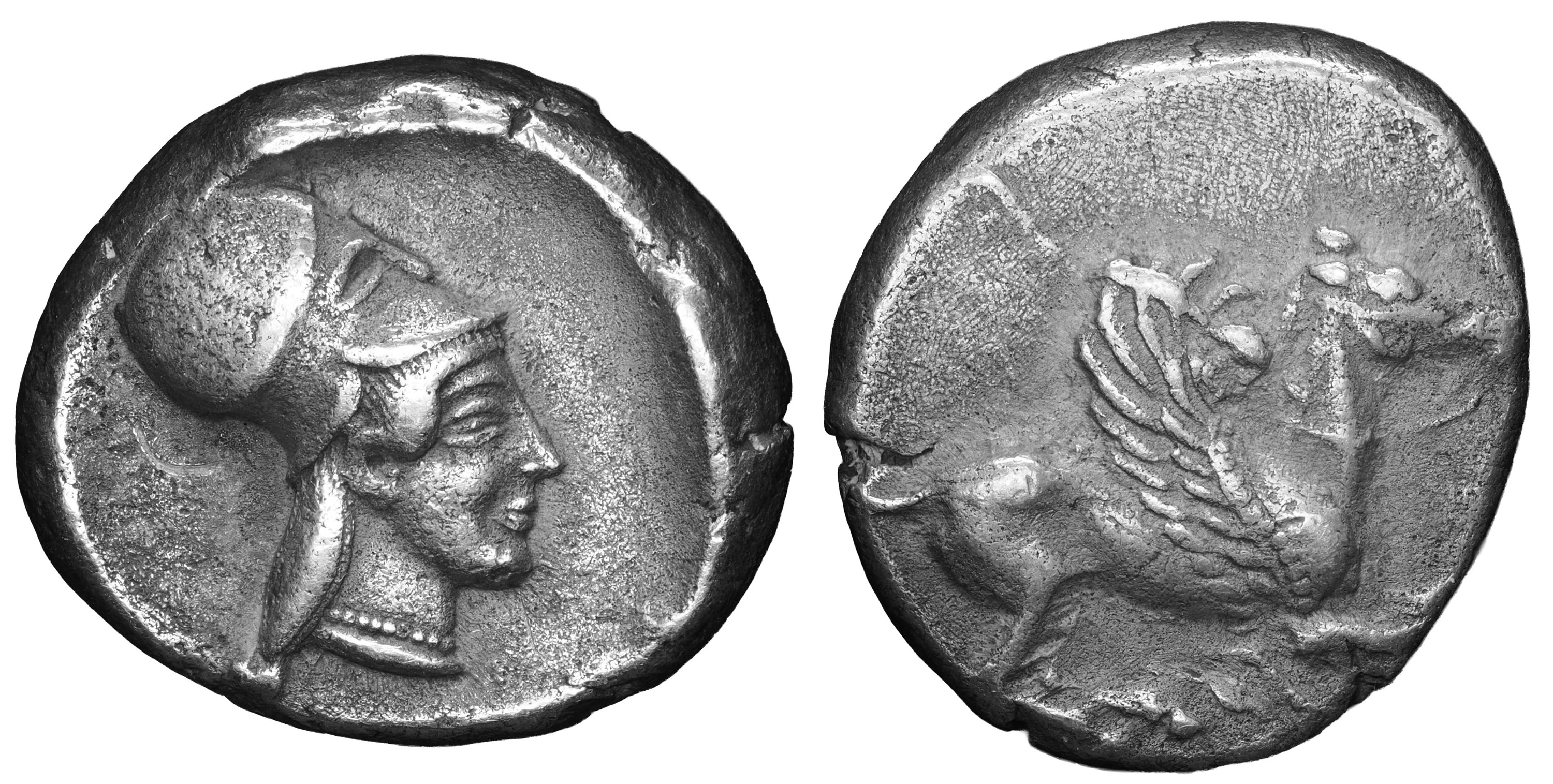
Lot 23
Ex. Ars Classica XII, 1489 (10/18/1922). Plated in Ravel, 229 (1936)
“…the supreme and most fertile Corinthian land…” (…agrum optimum et fructuosissimum Corinthium…), so speaks Cicero in his De Lege Agraria about fabled and fabulous Corinth. While the farmland of the Corinthian region was fecund as ever, the city itself was in the Roman Republican age a devastated husk of what earlier once had shone as metropolis and entrepôt. Another display of the wanton avarice and rapacious cruelty of the insatiable Roman lust for land and power, the words later uttered by Calagius here ring true: “where they create a desert, they call it peace” (“ubi solitudinem faciunt, pacem appellant”). Yet before the writings of Tacitus, before the age of the golden tongued orator, before the total war of Mummius, before the endless conquests of the Latins, there was the flourishing of the Hellenes.
Corinth, glorious polis, shimmering light, crown of the Peloponnese, stands on the very entrance of not only that illustrious peninsula but the history of Greece itself. Rival of Athens, she not only participated in but helped to define the most famous battles, campaigns, and legends of the Greeks. Inventor of the trireme, defender at Thermopylae, creator of Corinthian architecture, her arts range from militaristic and scientific to aesthetic. It is no surprise that a state of such capabilities could produce coinage so fine as the three examples shared above.
Remarkable not only for their fine style and states of preservation, the provenance of each piece marks the coins out as examples long treasured and acknowledged by generations of collectors who appreciated their outstanding quality. From the slight smile that so ideally captures the charm of late archaic Greece to a flourishing of Classical Greek art that reaches such a height to where a renowned state cabinet once acquired the piece, the above lots represent Corinth and her colonies at the height of her refined tastes, infamous luxury, and cultural niceties.
4. Caria, Halikarnassos, 377-353 BC: AR Tetradrachm
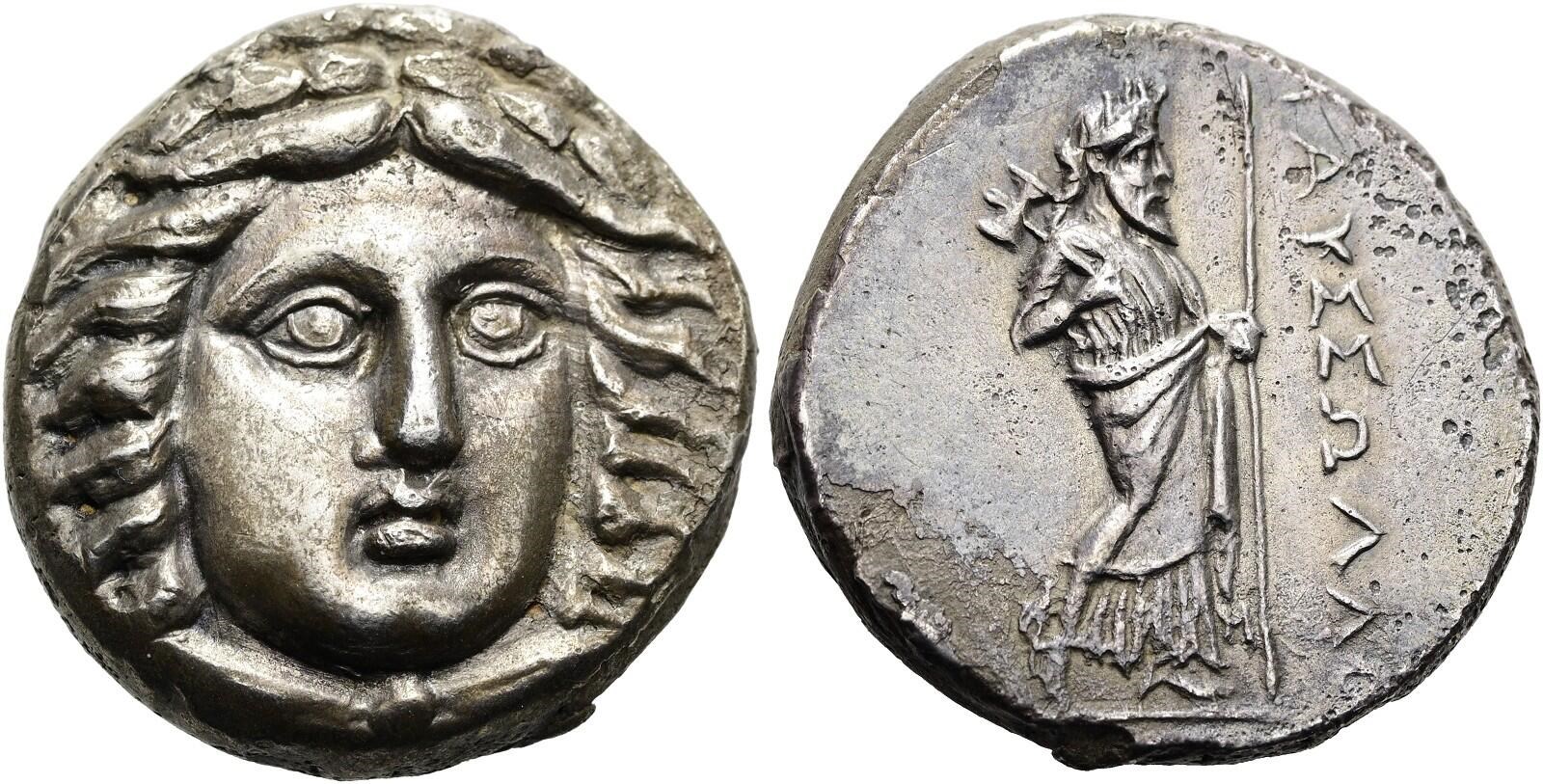
Lot 54
Bold facing Apollo and elegantly draped Zeus, these design choices speak to a ruler who never held back but with alacrity engaged in every kind of venture. Few can claim to have to have built such an impressive structure as to lend their name to an entire architectural genre. Even fewer can claim to have built one of the seven wonders of the world. Only one can claim both: Mausolos of the Hecatomnids. The grand structure that he built reigned intact for centuries, a tomb for whom perhaps no man could worthily lay inside. The confluence of megalomania, grandiosity, affluence, ability, and taste created a marvel and sensation quite unlike any other. In order that we may soak in the poet’s vision of the lost magnificence that once was the standing Mausoleum, it is not to the ancients we shall turn but a nineteenth century Scotsman. The pangs of grief that sister-wife Artemisia expressed for her dead brother-husband are here captured with refined sorrow:
A monument of love! More glorious love
Than ever bloom’d beneath the eternal sun,
Than any which the poets harp upon,
Or old Romance hath into being wove.
It stood far distant from the under grove,
Upon a mountain pinnacle, alone;
Large as the giant piles of Babylon,
Silent as if no living thing did move
Within its halls; the whisper echoes slept,
Subdued to silence by the lordly gloom,
For with a timid air the daylight crept,
And hardly broke into the middle room,
Where a dark-veiled woman sat and wept—
‘Twas Artemisia by her husband’s tomb!
William Edmonstoune Aytoun
5. Macedonian Empire, Amphipolis, 325-319 BC: AU Stater

Lot 60
Before the advent of the twentieth century, perhaps no person in the history of mankind could claim the ignominious and odious distinction of having caused more suffering, more violence, more death, and more conquest on so flimsy a pretext as Alexander ‘the Great’. The longing, the ‘πόθος’ so famously attributed to Alexander is nothing more than unbridled and unquenchable rapacity, a gluttony unslakeable exercised upon the innocent and unsuspecting at the miserable end of a sword. It would be futile to write what another has expressed more eloquently, so we turn to Jacob Abbott for further insight:
“In fact, it is probable that Alexander’s slaughter of the Persian army at Arbela, and subsequent spoliation of Susa, constitute, taken together, the most gigantic case of murder and robbery which was ever committed by man; so that, in performing these deeds, the great hero attained at last to the glory of having perpetrated the grandest and most imposing of all human crimes. That these deeds were really crimes there can be no doubt, when we consider that Alexander did not pretend to have any other motive in this invasion than love of conquest, which is, in other words, love of violence and plunder. They are only technically shielded from being called crimes by the fact that the earth has no laws and no tribunals high enough to condemn such enormous burglaries as that of one quarter of the globe breaking violently and murderously in upon and robbing the other.”
With these deeds done, the desires of Alexander were not satiated but like at the palace of Persepolis, drunk on the wine of success an inebriated and blinded Alexander sank ever further into the madness of endless violence and conquest. Exactly in this context of robberies and aggression is the above coin situated. As the systematic looting of the East began, the treasures of the Achaemenids were melted down and reused to mint coin, in order that the ever expanding war machine might further have its gears oiled by the endless veins of gold discovered. The obverse depicts Athena, goddess of wisdom and strategy, but Bacchus and Ares might have been better suited to the goals of Alexander. That the goddess of victory should be depicted on the reverse certainly is fitting, though a contemporary would be forgiven in wondering where the ever increasing crescendo of violence was headed.
The above are but a few events in the drama, and we shall turn to yet another. Abbot writes of Darius and his final minutes, “Darius was too weak to say much more. They gathered around him, endeavoring to sustain his strength until Alexander should arrive; but it was all in vain. He sank gradually, and soon ceased to breathe. Alexander came up a few minutes after all was over. He was at first shocked at the spectacle before him, and then overwhelmed with grief. He wept bitterly. Some compunctions of conscience may have visited his heart at seeing thus before him the ruin he had made. Darius had never injured him or done him any wrong, and yet here he lay, hunted to death by a persevering and relentless hostility, for which his conqueror had no excuse but his innate love of dominion over his fellow-men. Alexander spread his own military cloak over the dead body. He immediately made arrangements for having the body embalmed, and then sent it to Susa for Sysigambis, in a very costly coffin and with a procession of royal magnificence. He sent it to her that she might have the satisfaction of seeing it deposited in the tombs of the Persian kings. What a present! The killer of a son sending the dead body, in a splendid coffin, to the mother, as a token of respectful regard!”
So the famous clemency of Alexander. With the wound intentionally inflicted, the assailant has offered a bandage and is lauded for it! Woe to that man, for the miseries he directly delivered by his own hand onto the world are too innumerable to reckon. Of course, the grievous injuries that Alexander inflicted did not heal, but rotted and festered. The calamity and hardship of millions forged his empire, and millions more would pay the price for his irresponsibility in the succession. For not being satisfied as having become the greatest single source of human suffering ever inflicted upon the world in any age up to his day, Alexander had one cruel joke left: “To the strongest” he uttered. For Alexander it was but a game, a cheap imitation of Homeric idealism. But the centuries of rapine plunder and internecine warfare thanks to the instability he caused in his succession are testament to the damage that this criminal inflicted not only upon his own generation but many of the following.
6. Ptolemaic Kingdom, Alexandria, 304-282 BC: AR Tetradrachm

Lot 121
Ex. Hess sale, Spencer Churchill & W. Vogel collections, lot 462 (1929)
Deeply interconnected with the exploits of Alexander, Ptolemy emerges as the clear winner in the succession sweepstakes of Alexander’s empire. He would develop the satrapy of Egypt into a thriving kingdom, founding the longest surviving of the diadochi forged successor states. By the end of his reign both king and pharoah, Ptolemy began the process of cultural fusions that would see Alexandria and Egypt become a wealthy center of learning.
Historian himself, Ptolemy wrote a now lost history which forms the basis for the surviving works of Arrian. Economic reformer and patron of the arts, many foundational mathematical principles that form the basis of modern science can be directly traced back to the stipends of that generous statesman. If guilty of helping to perpetrate the crimes of Alexander, Ptolemy at least can later exculpate himself by his well grounded rulership, firmly implanted succession, general welfare and prosperity of his realm and subjects, as well as the creation and implementation of long lasting reforms.
The tetradrachm shared here is a superb example, undoubtedly among the finest known. Deeply struck with iridescent toning, the attention paid to the engraving of these dies by the celator is clear. Ptolemy is represented in the Hellenistic ideal, heeding the tastes and expectations of the wider Mediterranean as opposed to those of his local Egyptian subjects. Something of the vigor of the man is well captured, and the obverse hints at the tenacity which would so define Ptolemy and his long career. The eagle, proud and imperial, perched upon the thunderbolt represents the herald of a new dynasty that would be of importance until it and its most famous member played out their final act on the highest stages of drama: the death throws of the Roman Republic.
7. Aulerci Eburovices, 2nd-Early 1st Century BC: EL Hemistater
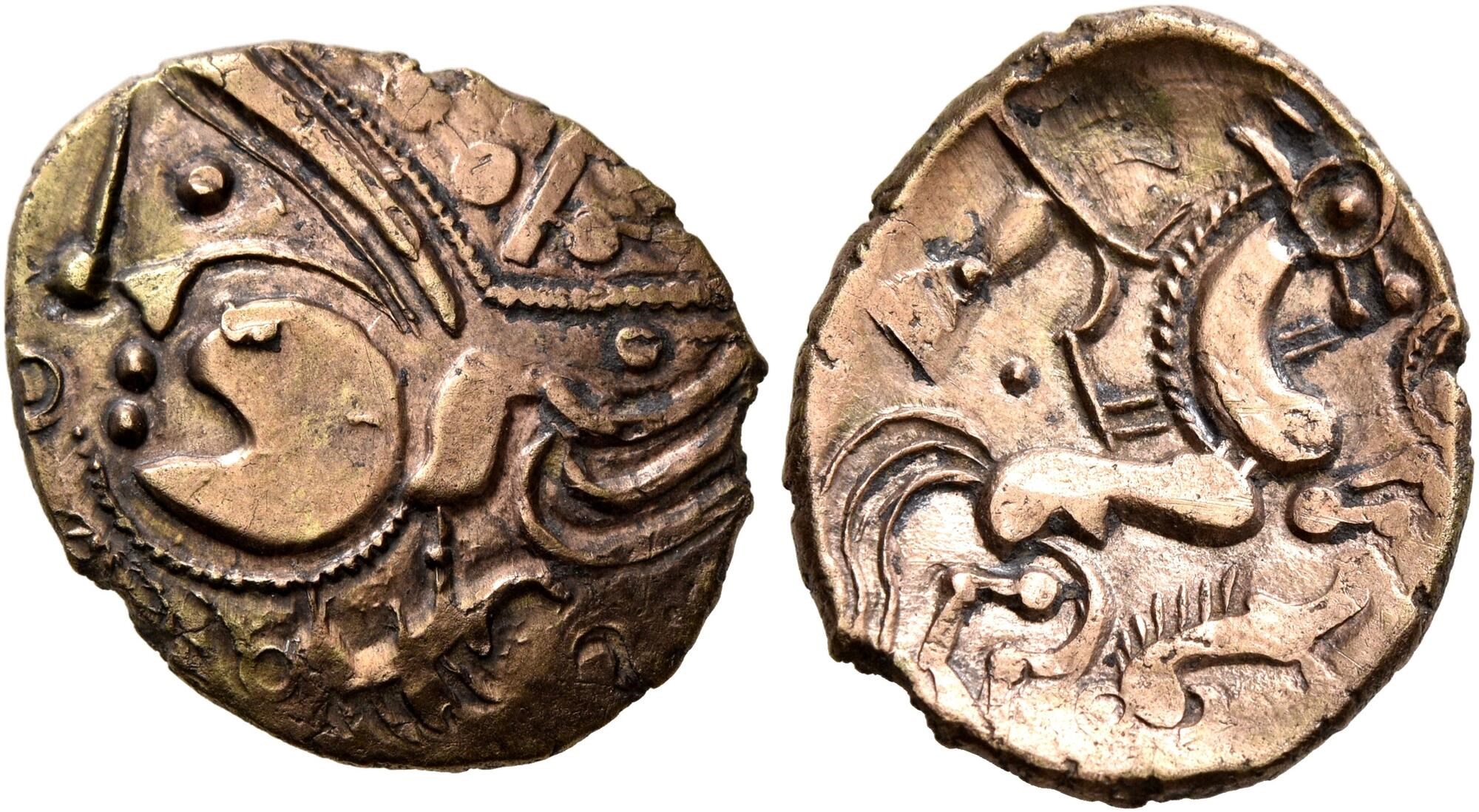
Lot 7
A draught from the well of the Celts shall replenish the thirsty listener on this journey through the first L5 auction. A people more humble than some of the predecessors on this list, the frank answer (anachronistic pun intended) that the Celts gave to Alexander when asked of that which they most feared bemused contemporary writers and subsequent generations alike. Rather than giving the desired response of reporting that they indeed feared Alexander the most, the simple tribesmen reported that collapse of the sky indeed caused them the most anxiety. Regally adorned in simplicity, anyone who should argue that the Celts fall short of their neighboring civilizations would do well to study the above piece. Bold, provocative, and tasteful in the disproportions depicted, such a piece reflects a culture in which adherence to wider Greco-Roman artistic norms was neither possible nor desired. The Celtic man on the obverse stares with determination to the left. Emblazoned with boar below, his is a fierce countenance and disposition. Raging like that dangerous beast, his warlike tusks do tremendous damage when provoked. On the reverse onwards the chariot rides, into recorded history, into the legendary wars that still make Caesar and his foes household names over two millennia later.
8. Roman Republic, Cisalpine Gaul, 43 BC: AR Denarius
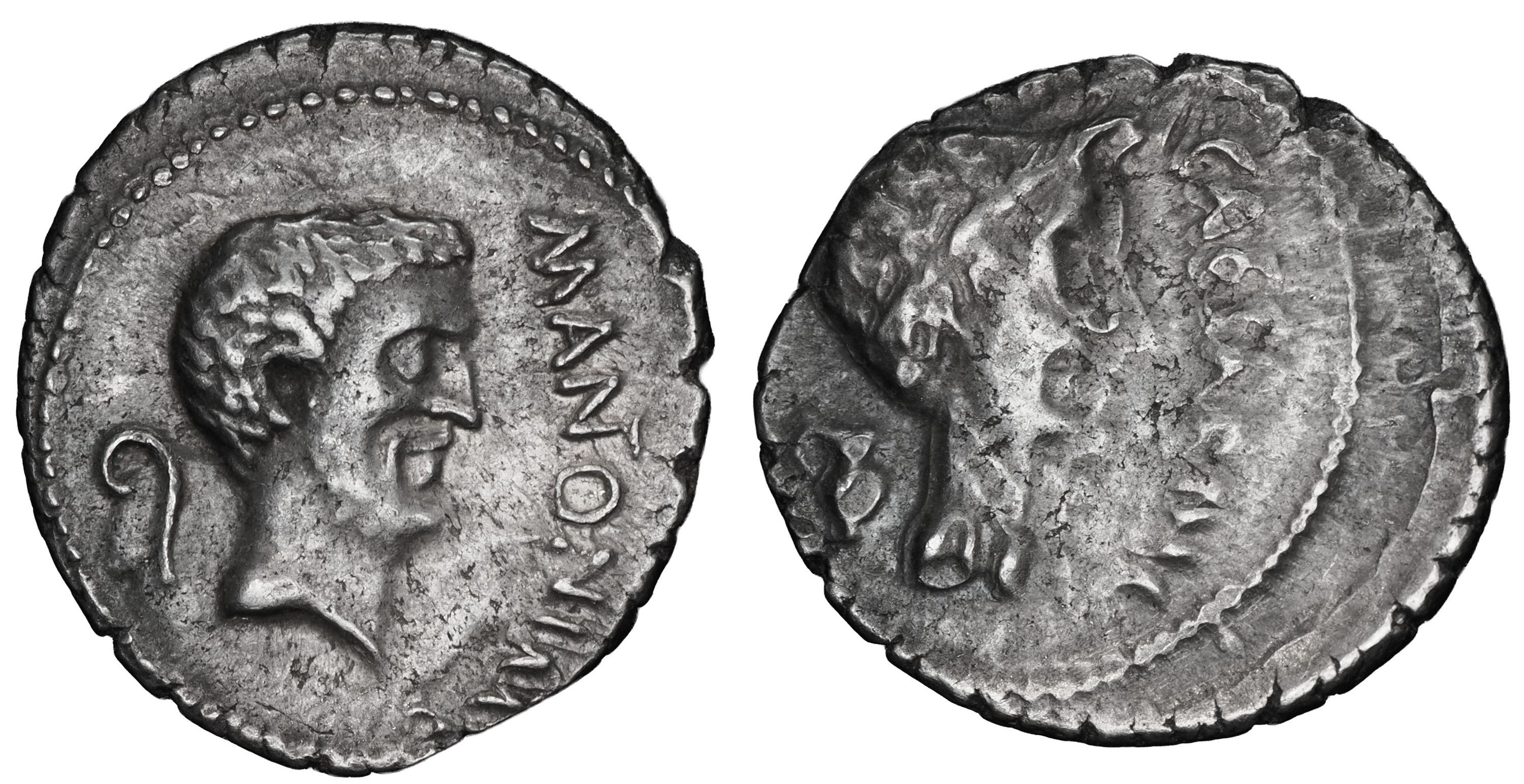
Lot 143
Ex. Münzen & Medaillen AG List 306, 32 (1969)
“The winning cause pleased the gods but the losing Cato” (“victrix causa deis placuit, sed victa Catoni”). Weary generations, for how much longer must father fight son, brother attack brother, citizen slay citizen? The tired people of Rome have from adolescence grown into old age, watching the flower of youth cut down by the scythes of civil war.
Perhaps no Roman has so captured the imagination of succeeding ages as Marc Antony. Caesar might be the better general and Augustus the winner, but neither of those men have come to define an entire archetype. Courageous, valiant, dashing, drunkard, womanizer – Antony presents a romantic, flawed nobility of character that has drawn attention from many a writer. Fated to face a man more cold and cunning than himself, the passionless cruelty of Octavian marks a strong contrast to the affable if savage Antony. The two men, presented side by side on the above denarius, yet remained united in alliance as of its minting. Octavian, still boy faced, presents the beginnings of a beard. Proudly bearing the title of Caesar, he makes it clear wherefrom his authority is sourced. Antony, clean shaved, mirrors his partner in look and ideology. The other denarius shared above goes even further, depicting Antony on one side with the bust of the soon to be deified Julius Caesar on the other. United by common cause in revenging the murdered Caesar, their triumvirate asunder would usher in an age of civil strife sadly oft paralleled in the preceding decades, though the peace to come afterwards would provide the Romans with a respite.
You all did love him once, not without cause:
What cause withholds you then, to mourn for him?
O judgment! thou art fled to brutish beasts,
And men have lost their reason. Bear with me;
My heart is in the coffin there with Caesar,
And I must pause till it come back to me.
Erstwhile friend and compatriot, ever loyal and to be trusted if at times prone to excess, Antony was a key figure in the Caesarian victory and later in his own right. Star crossed lover with Cleopatra, in spite of the scorn of his countrymen Antony remained true to his heart. An Octavian disposes of those who are no longer useful, an Alexander slays friends in his drunkenness, an Antony remains true to the very end.
Lament nor sorrow at, but please your thoughts
In feeding them with those my former fortunes
Wherein I lived the greatest prince o’ th’ world,
The noblest, and do now not basely die,
Not cowardly put off my helmet to
My countryman—a Roman by a Roman
Valiantly vanquished. Now my spirit is going;
I can no more.
9. Roman Empire, Rome, 151-152 AD: AU Aureus

Lot 224
“If a man were called to fix the period in the history of the world, during which the condition of the human race was most happy and prosperous, he would, without hesitation, name that which elapsed from the death of Domitian to the accession of Commodus.” The famous quote by Edward Gibbon, the greatest scholar of the Georgian age, rings true through the ages up to this very day, if one were only to ignore the plight of the over 90% of the population of the empire who eked out a subsistence living, suffered under the burden of oppressive taxation, who toiled in the fields of Italy and Sicily condemned in their chain ganged slavery to a harsh life and harsher death, those sent to spend their piteable and wretched remainder in the mines, those in need who had no recourse, the widows, the orphans, the unseen, the unrecorded…Of course, Gibbon needn’t concern himself with the plight of the unwashed masses, for they too existed and they too were ignored and abandoned in his age just as they were in that of the Antonines.
That splendid epoch, hallmarked by unparalleled prosperity, if we can ignore the entire population save the smallest fraction, indeed forms a kind of apogee of the Roman empire. The period is inseparable from the five men who governed the empire and its greatest extent. Noble Nerva, court informer and not a man to trust with information that he could betray for personal enrichment, upon ascending to the office graciously assented to adopt Trajan as heir with the implicit threat of military action in the case of him doing elsewise. Trajan himself, forged in the model of Alexander of old, voraciously devoured far off kingdoms and people, and in the pinnacle of unprovoked destruction offered a morsel of clemency. With his conquests unsustainable, overextended, and leaving the empire dangerously exposed, he managed to die at an inconvenient place and time. His successor, only ‘adopted’ if one considers court intrigue occurring after the death of the emperor as representing the previous monarch’s wish, paved the way for one of the most paranoid and debauched rulers in the long history of the empire. Torturing and killing the innocent on the slightest pretext, Hadrian appointed Antoninus his heir on the condition that Marcus and Lucius follow Antoninus in the succession. Antoninus himself, noteworthy for his unnoteworthiness, kicked many a proverbial can down the road which would bring the empire in the following century to its knees. Upon his death came Marcus and Lucius to the throne, many a year after the original timeframe planned by Hadrian.
The coin above captures the spirit of the man Marcus was in his youth, preparing and waiting in the wings of the palace for a day that was long to come. Handsome with an aquiline nose, the obverse of the aureus captures the physiognomical ideal of the Roman aristocrat. Wide eyed and bearded, the portrait is undoubtedly one of youthful exuberation, a man full of potential who looks forward to the day when he can step into his own.
And the great philosopher himself, upon coming to the throne, who for all his writings and journaling, for all his thoughts, for all his musings, for all his quips, in the end abandoned his own life’s work and ideology in the hour of reckoning. Rejecting his own beliefs, the stoic discarded the mantle of honor that he had wrested for himself, abandoning his reputation, responsibilities, office, and even his own country for the desire of blood continuation on the throne. No better than any other miserable despot across the ages, the philosopher-king ultimately embraced the allure of tyranny in the end. The succession of adoption is broken, and the wretched son is heir. Hypocrisy fulfilled, his very own people he condemned to the yoke of oppression out of a craven desire that his line should rule the empire forever. All modesty and virtue thus discarded, the predictable fruits of such a decision soon came to bear.
O’ wretched barbarian across the frontier, with the knee bent to none, living in your woodland squalor, how you must yearn for the trappings of the court, the pining of the sophist, the waxing of the stoic, the pretentiousness of the philosopher, the very chance to join the uncountable multitudes crammed into the jostling streets of a dirty and unplanned city, to join the innumerable in miserable subjugation.
10. Sasanian Empire, Ctesiphon (?), 260-272: AU Dinar
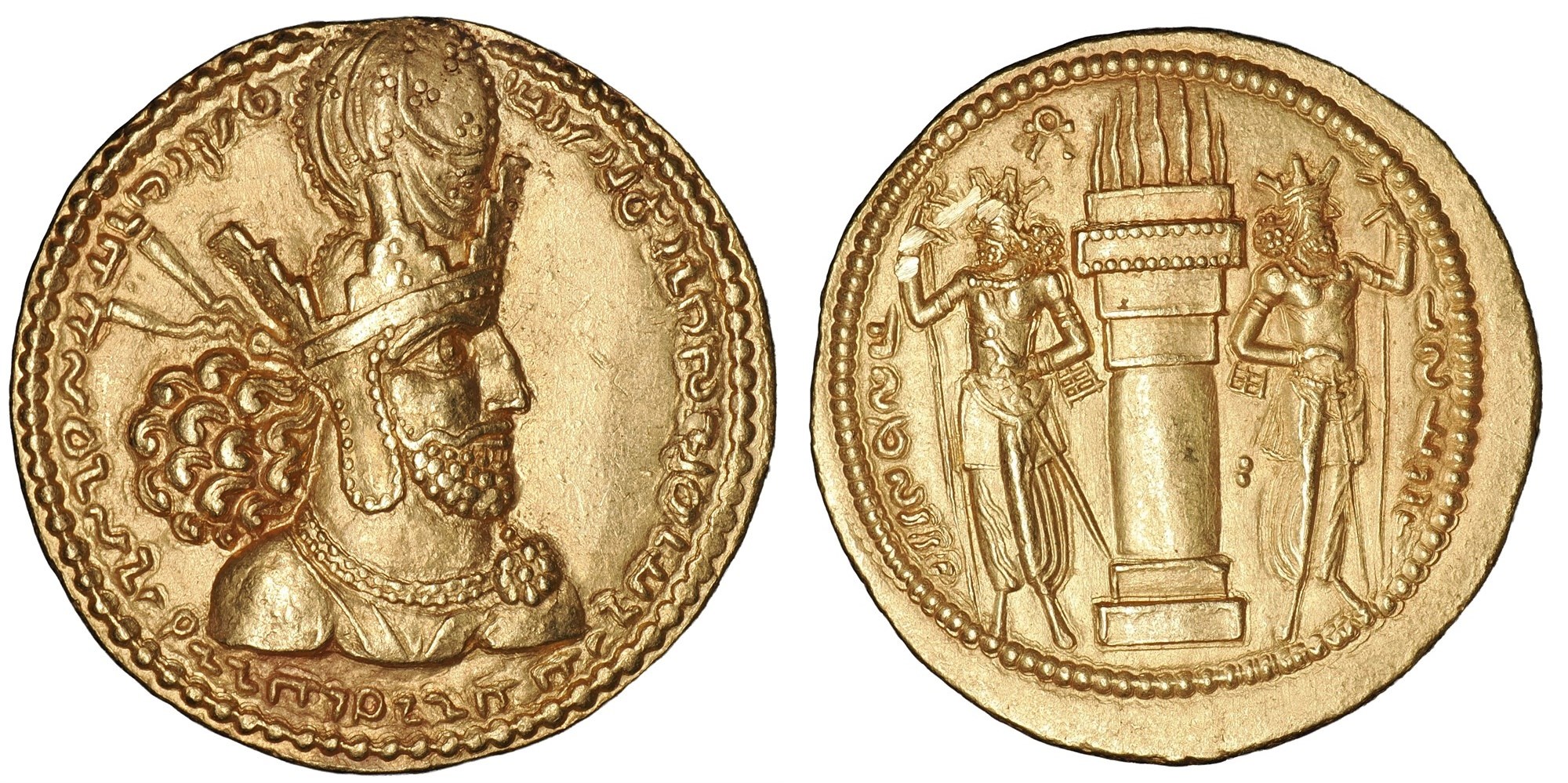
Lot 305
The 3rd century AD recontextualizes the relationship between East and West, with the scales decidedly heavier on the side of Sasanian Persia. Famously described by emperor Galerius as the “two eyes of the world’, the exact view each empire had of the other is ambiguous and difficult to fully articulate. Certain periods are more easily defined than others, and the reign of Shapur I surely is such an era. If the two empires represented the two eyes of the world, then Shapur had blinded the one to better illuminate the other. The Roman empire stood hapless before his might, and not one but two emperors were dethroned by the mighty king of kings in the East.
The first ill-fated emperor was Gordian III. While exact details remain murky, Gordian led his army to a crushing defeat at the hands of Shapur. Either Gordian was killed in battle, or the result so humiliating that he was murdered by his own men in the immediate aftermath. The two foes who faced each other across the battlefield here face each other in numismatic form. Gordian, youthful and expressive, is unaware of his fate to come. Shapur, with the benefit of hindsight, boastfully displays himself in a manner well earned: unchallenged primacy as supreme ruler of the world, the twinkling, sparkling, eastern eye cast upon his less fortunate counterpart with permanent conquest in mind.
After Gordian, the other ill-fated emperor to succumb was Valerian. Even more ignominiously, Valerian was not so fortunate as to die at the hands of Shapur but was captured alive and transported back to Persia as the ultimate war trophy. Apocryphally said to have spent his final years as the footstep for Shapur to climb into the saddle before eventually being stuffed and preserved after death, what exactly happened to Valerian after relocation is unclear. What can be confirmed are the thousands of Roman civilians and soldiers forcefully remigrated into the Persian empire to serve the king of kings as a labor force.
Vae Victis.
So ends the top 10 list for L5 auction 1, and so too ends the very first email blast for L5. If any of these coins should have intrigued you, O’ reader, rest assured that many more treasures are to be found in the full sale. What was shared here is but a small preview. I hope that I have played my part well and to your satisfaction.
Acta est fabula, plaudite!