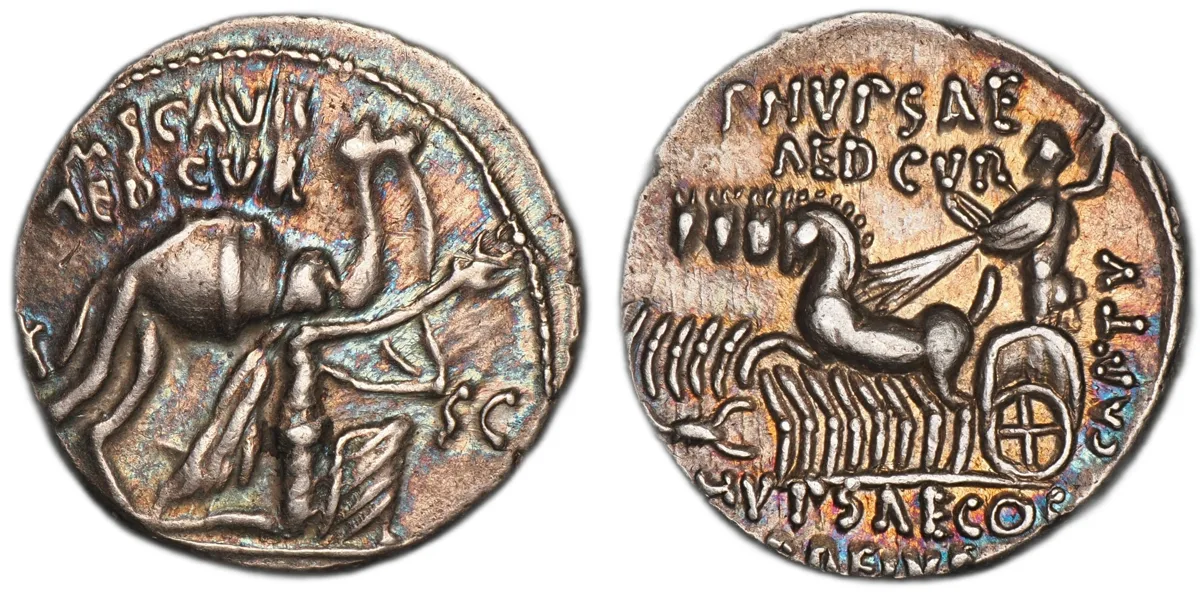
M. Aemilius Scaurus and P. Plautius Hypsaeus. Denarius, Rome, 58 BC
Lot 296 · Consigned by GreatCoinsUSA
Closed
Description
M. Aemilius Scaurus and P. Plautius Hypsaeus. Denarius, Rome, 58 BC. AR, 3.76 g, 17.4 mm, 6 h.
Obv. King Aretas of Nabataea kneeling right, holding a palm-branch in his right hand and the reins of a camel standing right behind him in his left; above, M·SCAVR / AED·CVR; on either side, EX / SC; in exergue, REX·ARETAS.
Rev. Jupiter driving quadriga left, hurling thunderbolt; below horses, scorpion right; above, P·HYPSAE / AED·CVR; to right, CAPTV upwards; in exergue, C·HYPSAE·COS / PREIVER.
Refs: Crawford 422/1b; Babelon Aemilia 8, Plautia 8; Sydenham 913.
This remarkable type is one of the very few Roman coins explicitly to name and depict a foreign king. The obverse records the capitulation of Aretas III of Nabataea, who had intervened in Judaea’s dynastic disputes. In 62 BC, Aretas besieged Jerusalem in support of Hyrcanus II against his brother Aristobulus, only to be defeated by Pompey’s forces. Later, in 58 BC, as aedile, M. Aemilius Scaurus—Pompey’s former legate in the East—struck this coin to celebrate his role in compelling Aretas’ submission, here represented kneeling beside his camel, the palm-branch symbolising peace. The inclusion of EX S C (“by decree of the Senate”) underscores the official sanction of the issue.
The reverse, struck under his colleague P. Plautius Hypsaeus, depicts Jupiter in quadriga, an emblem of divine support, while the scorpion beneath is a punning allusion to Hypsaeus’ family. The inscriptions refer to C. Hypsaeus, the consul of 139 BC, as praeiver, again linking the moneyer to illustrious ancestry. The design is thus a joint exercise in political self-promotion, with Scaurus boasting of Eastern victories and Hypsaeus of his noble lineage.
Struck in the year when Clodius’ tribunate destabilised Roman politics, this denarius vividly illustrates the use of coinage as a medium of propaganda by ambitious aediles. Its explicit naming of a living foreign monarch remains a striking rarity in the Roman series.