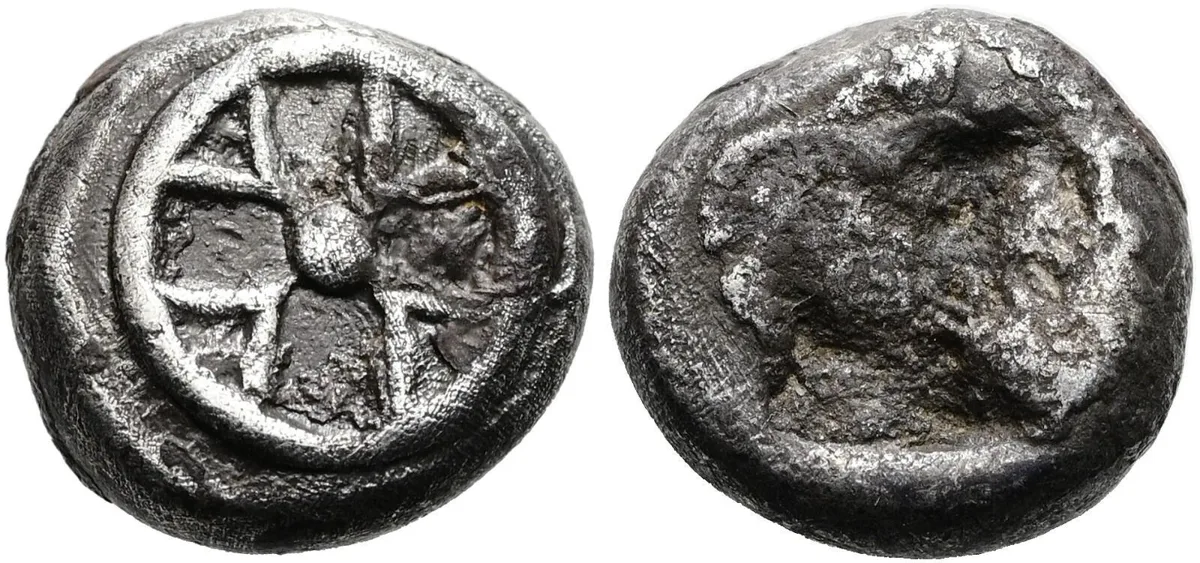
Attica, Athens. “Wappenmünzen” series. Silver obol
Lot 044 · Consigned by NumisOne
Closed
Description
Attica, Athens. “Wappenmünzen” series. Silver obol, c. 545 – 525/515 BC; 8 mm, 0.85 g. Obv. Four-spoked wheel seen from above, the rim shown in bold relief. Rev. Deep quadripartite incuse square, each quadrant bisected by a diagonal, forming an eight-point “windmill” pattern. SNG Copenhagen 8; Seltman pl. IV; Svoronos pl. I, 60 (same dies); Klein 34; SNG München 17; HGC 4, 1653. Rich dark cabinet tone with traces of horn-silver in recesses, devices bold, minor porosity as struck. Apollo to Apollo Collection.
The wheel belongs to the celebrated “badge coinage” (Wappenmünzen)—Athens’ first experiment with silver money a full generation before the famous owl tetradrachms. Each aristocratic family that dominated the young polis chose an emblem: a triskeles for the Alkmaionidai, a gorgoneion for the Philaïdai, and here a chariot wheel likely advertising the hippic prowess of the owner’s oikos. Issued in tiny obols and hemi-obols for market trade, these coins reveal a city still ruled by powerful clans yet already participating in the wider Aegean economy.
When Hippias and Hipparchos were expelled in 510 BC the new democracy abandoned heraldic types in favour of the communal owl, erasing private heraldry from public money. Surviving Wappenmünzen are consequently rare and highly prized, representing the moment Athens first translated political identity into the universal language of coinage.