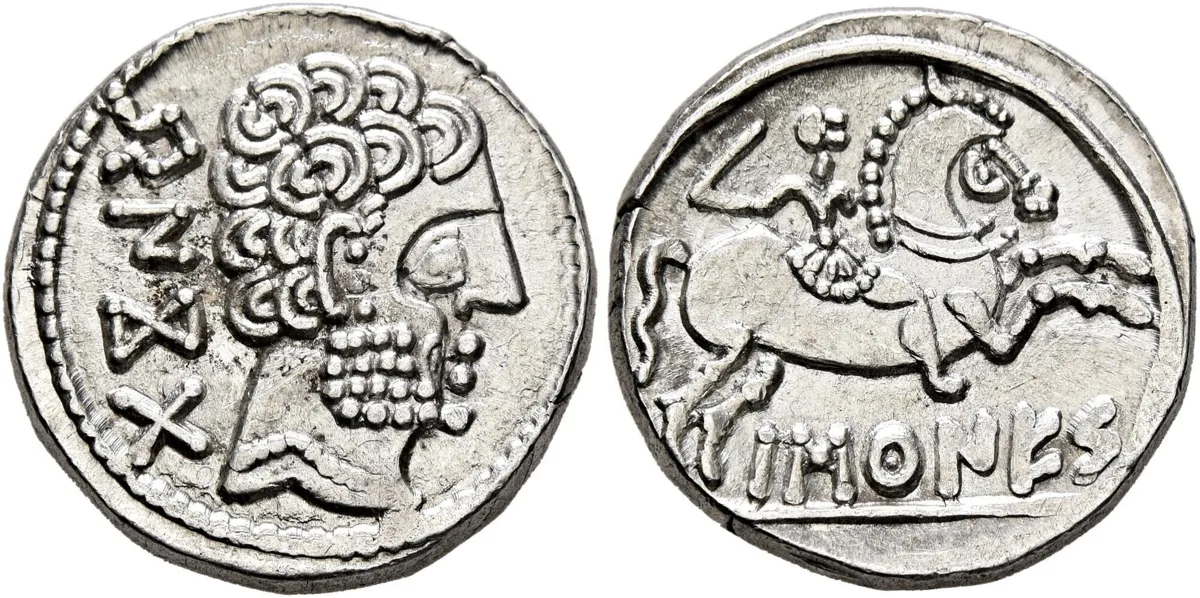
Iberia, north-eastern Spain, Barskunes (modern Pamplona region). Silver denarius
Lot 005 · Consigned by NumisOne
Closed
Description
Iberia, north-eastern Spain, Barskunes (modern Pamplona region). Silver denarius, c. 150-100 BC, 17 mm, 4.21 g, die axis 1 h. Obv. Iberian legend ΒΕΝΚΟΤΑ (‘Benkota’, local magistrate or tribal gentilicium) around the bearded head of a warrior right, his hair in tight curls and wearing a pearl necklace; plain border. Rev. Iberian legend ΒΑΡΣΚVNES (‘Barskunes’) in exergue; horseman galloping right, brandishing a long falcata-style sword above his head, reins looped round his left arm; linear ground-line and border. ACIP 1633; CNH p. 250, 10; SNG BM Spain 904-907. Light hair-line scratches on obverse, otherwise sharply struck with brilliant surfaces and full legends
Struck by the Vasconic tribe of the Barskunes, this denarius belongs to the dynamic century in which Iberian mints absorbed Roman weight standards yet retained fiercely local iconography. The obverse portrait – curly-haired, heavy-bearded, adorned with a torque-like necklace – advertises both tribal nobility and Celtic stylistic influence flowing south across the Pyrenees. On the reverse the charging rider wields the distinctive curved falcata, symbolising resistance to Carthaginian and later Roman encroachment; the proud Iberian legend declares the coin’s provenance at a time when Latin legends were spreading elsewhere in Hispania.
Such silver issues financed the Barskunes’ defence during the Celtiberian and Sertorian wars, circulating alongside Roman denarii yet maintaining a bullion value trusted by local militias and mercenaries. Hoards found from Navarre to the upper Ebro show these coins travelling the old trans-Pyrenean trade routes that would later become the pilgrim road to Santiago. Today they stand as tangible witnesses to a people who negotiated cultural exchange and military pressure while preserving their own identity on the very frontier of the Roman world.