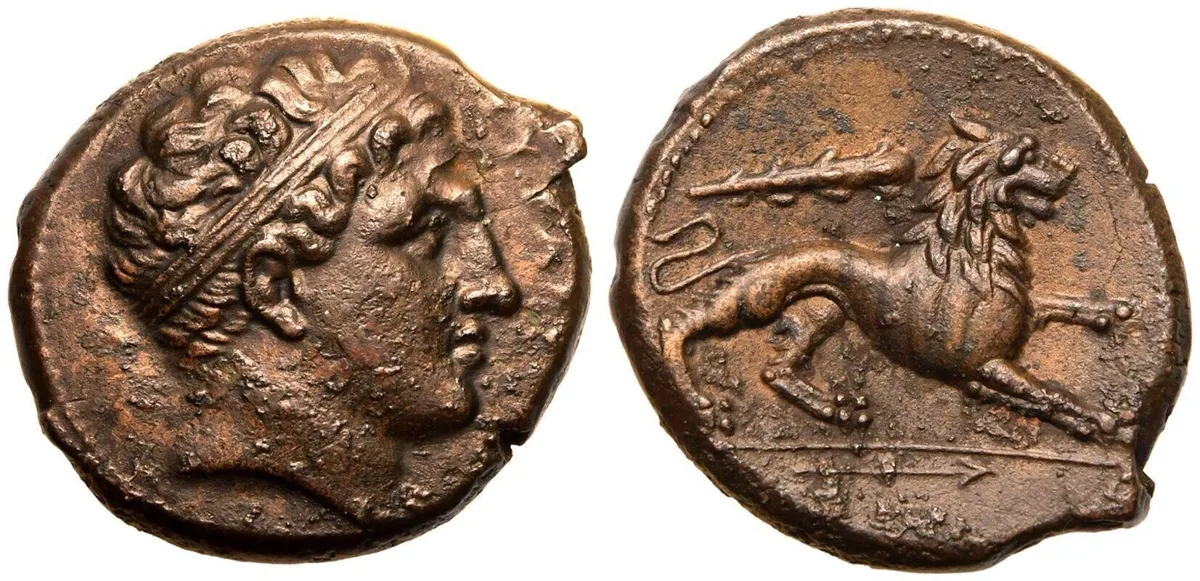
SICILY, Syracuse – Fourth Democracy c. 289-287. BC Bronze litra
Lot 032 · Consigned by NumisOne
Closed
Description
SICILY, Syracuse – Fourth Democracy (interregnum after Agathokles), c. 289-287 BC
Bronze litra; 24 mm, 8.60 g, die-axis 6 h. Obverse: ΣΥΡΑΚΟΣΙΟΝ downward before; youthful head of Herakles right, wearing a tainia (fillet); trace of a bow behind. Reverse: Powerful lion advancing right, left fore-paw raised in mid-stride; club above the animal, thin spear line in exergue. CNS II 151 (as Agathokles issue); SNG ANS 740; SNG Copenhagen 767; HGC 2, 1465 (Fourth Democracy). Warm chocolate-brown patina with lighter reddish undertones; obverse softly struck at the highest curls, reverse exceptionally bold and detailed. Seldom encountered this sharp. Ex. KA Jacob Collection 22/06/2006
When the tyrant Agathokles died in 289 BC, Syracuse briefly reverted to republican rule—known to modern scholars as the city’s Fourth Democracy. In place of the ruler’s portrait that had appeared on bronze since 317 BC, the civic mint revived neutral Pan-Hellenic types: Herakles for virtue and strength, and the rearing lion that symbolised both the hero’s first labour and Syracuse’s own martial independence.
The small litra was the workhorse denomination of Sicilian daily commerce, roughly one-twelfth of a silver drachm. Yet the artistry remained ambitious: Herakles’ youthful features recall classical dies of the Timoleonic period, while the lion—rendered with rippling mane and tense musculature—captures the dynamism typical of late-fourth-century Greek bronze.
The club above the lion and the inconspicuous spear in the exergue are more than decorative fillers; together they form a compact military emblem underlining the city’s readiness to defend itself against Carthaginian pressure and the ambitions of Hellenistic kings on the mainland. Within two years that pressure would tell: Hicetas seized power in 287 BC, ending the democratic experiment and inaugurating the first of several short-lived tyrannies.
Well-struck examples of this brief issue are scarce, particularly with a reverse as crisp as the present piece—an evocative survivor from Syracuse’s last bid to restore the freedoms won under Timoleon a generation earlier.