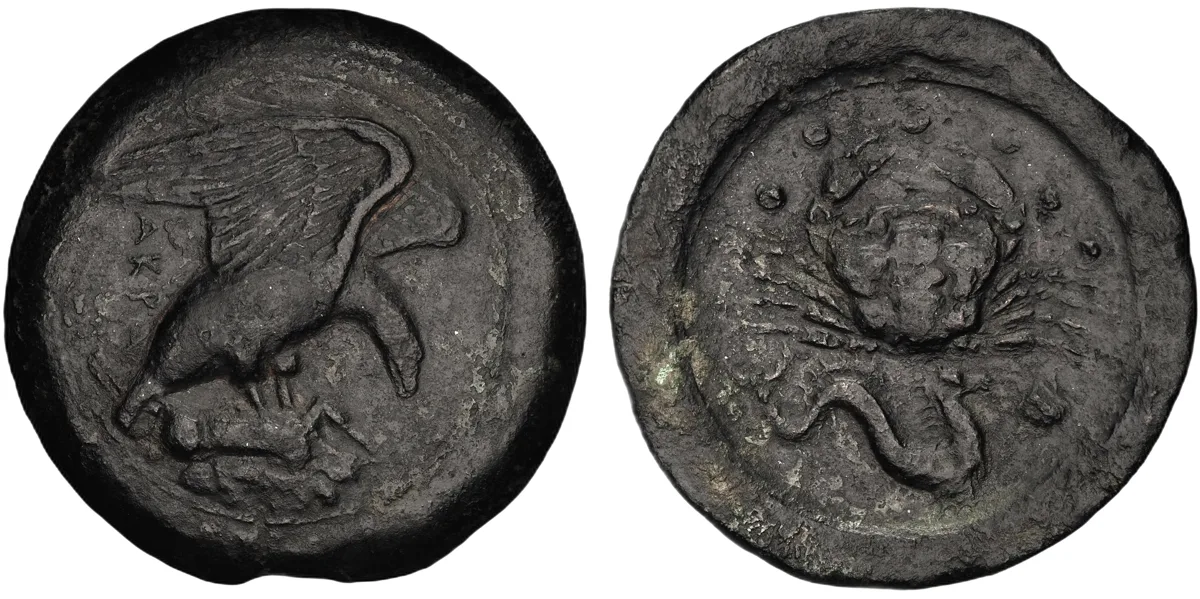
Sicily, Akragas. Circa 415-406 BC. Hemilitron
Lot 010 · Consigned by NumisOne
Closed
Description
Sicily, Akragas. Circa 415-406 BC. Hemilitron (Bronze, 31.58 mm, 20.53 g). AKPA Eagle standing right, wings spread and head lowered, clutching a dead hare in its talons; border of dots. Rev. Crab; above, six pellets as mark of value; below, hippocamp right, with scallop shell before; all within shallow incuse circle. Westermark, Akragas, Period III, Series 5, 780.4 this coin, dies 4.O3/5.R6; SNG ANS 1024 same dies; Buceti 81 same dies; Calciati CNS I, 169, 18 same reverse die; cf. HGC 2, 136. Dark brown patina, with some deposits. Near extremely fine. Very rare variety.
Ex Asta Internazionale del Titano / Aes Rude 69, 8 June 1997, 31; and Lanz 78, 25 November 1996, 112.
A substantial and unusually well-preserved example of the late bronze coinage of Akragas, issued in the tense final years before the Carthaginian destruction of the city in 406 BC. By this period Akragas was still one of the major Greek cities of Sicily, wealthy from agriculture, trade, and its commanding position on the southern coast, but it was increasingly exposed to the renewed Carthaginian advance that reshaped the island at the end of the fifth century.
The large module and ambitious design of these hemilitra reflect the sophistication of Akragantine bronze coinage in this period. They also belong to a broader Sicilian development in which bronze denominations became more visually and economically important, supplementing silver for local exchange while still carrying carefully chosen civic imagery. The six pellets identify the value, but the elaborate subsidiary symbols show that even fiduciary bronze could be treated as a serious civic medium.
Westermark’s die attribution is especially significant, since the present coin is individually cited in her corpus. The same-die links to SNG ANS 1024 and Buceti 81 confirm its place within a tightly defined and rare emission. The combination of precise publication, old 1990s provenance, broad flan, and strong preservation makes this a notably desirable example of Akragas’ final classical bronze series.