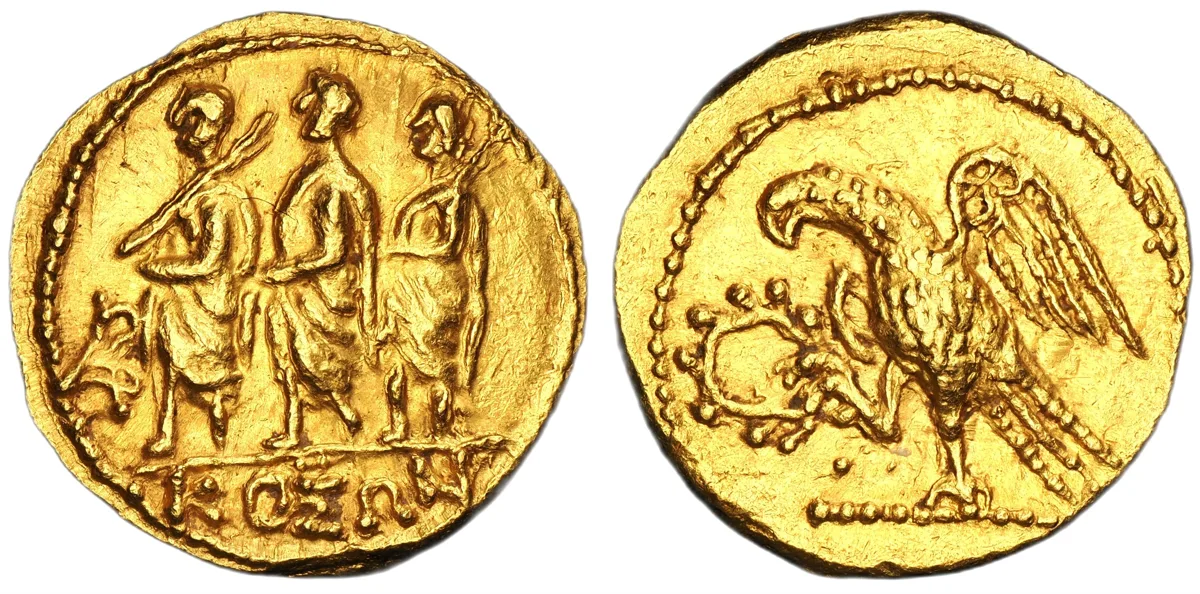
Skythia, Geto-Dacians. Koson. Mid 1st century BC. Stater
Lot 272 · Consigned by NumisOne
Closed
Description
Continental Greece. Skythia, Geto-Dacians. Koson. Mid 1st century BC. Stater (Gold, 19 mm, 8.29 g). Roman consul advancing left between two lictors; monogram to left; in exergue, ΚΟΣΩΝ. Rev. Eagle standing left on scepter, holding wreath in its talons; pellet to lower left. Iliescu 1; RPC I 1701A; HGC 3.2, 2049 corr. some examples without monogram. Superb and well centered. Good extremely fine. A particularly attractive example of the enigmatic gold staters bearing the name Koson, a series long associated with the Geto-Dacian world north of the lower Danube. These coins imitate and adapt Roman Republican imagery, but they were struck outside the normal Roman monetary system, probably in the political and military environment of the mid-first century BC, when Roman civil wars drew heavily on Balkan allies, clients, and mercenary networks. The obverse is derived from a Republican denarius type of M. Junius Brutus, showing a magistrate accompanied by lictors. On the Koson staters, the scene is transformed into a prestigious gold issue with a Greek legend, suggesting that Roman symbols of authority were being repurposed for a non-Roman audience. The reverse eagle on scepter, holding a wreath, also echoes Roman Republican models and gives the coin a strongly triumphal tone. The identity of Koson remains debated. He has often been interpreted as a local Geto-Dacian ruler, perhaps connected with the political aftermath of Burebista’s kingdom, or as a name associated with gold payments made in the region during the Roman civil wars. The monogrammed variety, as here, is especially important in this debate, since it may indicate a distinct emission or authority within the broader series. The type’s historical appeal lies in this mixture of Roman iconography, Greek lettering, and Danubian context. It is not simply a barbarous imitation of Roman coinage, but a carefully produced high-value gold issue reflecting the entangled politics of Rome and the lower Danube on the eve of the Empire. This specimen’s centering and preservation are well above average, with the full processional obverse and sharply rendered eagle reverse giving it strong visual and historical presence.