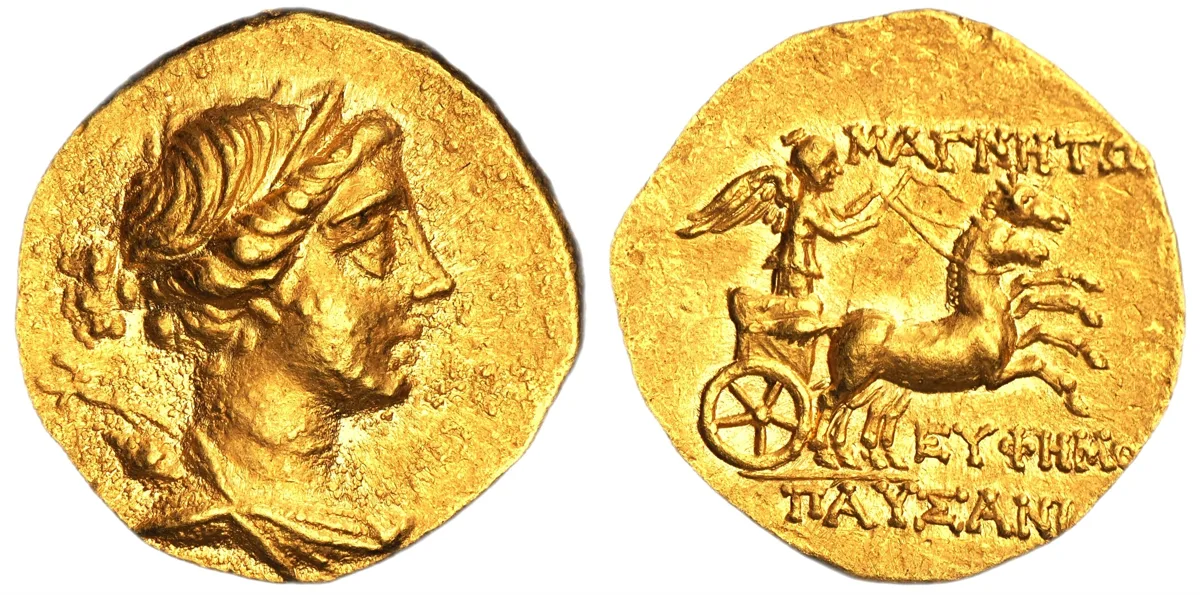
Ionia, Magnesia ad Maeandrum. Circa 130-120 BC. Stater
Lot 090 · Consigned by NumisOne
Closed
Description
Ionia, Magnesia ad Maeandrum. Circa 130-120 BC. Stater (Gold, 18 mm, 8.38 g, 12h). Magistrate Euphemos, son of Pausanias. Draped bust of Artemis right, wearing stephane and pendant earring, bow and quiver over shoulder. Rev. MAΓNHTΩN - EYΦHMOΣ / ΠAYΣANIOY Nike driving fast biga right, holding whip and reins. Ellis-Evans, Magnesia, pp. 296-304; Leu 1, 2017, 82 same dies; Leu Web Auction 18, 2021, 1143 same dies. Fresh and attractive; struck from the usual somewhat worn obverse die, otherwise good very fine. Ex Leu 11, 14 May 2022, 123; previously from a European collection formed before 2005.
A rare and important gold stater of Magnesia ad Maeandrum, belonging to the recently clarified series of Hellenistic civic gold from western Asia Minor. The issue stands apart from the city’s better-known wreathed tetradrachms, but it shares the same broader civic language: a refined image of Artemis, the principal goddess of Magnesia, paired with a dynamic reverse type and a fully named magistrate. The presence of Euphemos, son of Pausanias, gives the coin a precise civic and administrative setting, suggesting an exceptional or limited emission rather than a routine gold currency. The date in the late second century BC falls in a period when the cities of western Asia Minor operated within a complex post-Attalid political landscape. After the bequest of the Attalid kingdom to Rome in 133 BC, civic communities in the region continued to express local identity through precious metal coinage, even as Roman influence increasingly shaped regional politics. A gold issue of Magnesia in this context would have carried particular prestige, whether connected with civic payments, sanctuary finance, diplomatic expenditure, or another special occasion. The publication by Ellis-Evans is especially significant, since it helped establish the authentic corpus of Magnesian gold staters and separate them from a group of deceptive modern fabrications. The present coin belongs to the genuine group and is die-linked to published Leu examples. The familiar weakness or wear on the obverse die is therefore not a defect unique to this specimen, but a diagnostic feature of the authentic die group. With its fresh surfaces, strong reverse, pre-2005 collection history, and place within a small and closely studied series, this is a desirable example of a rare Hellenistic civic gold issue.