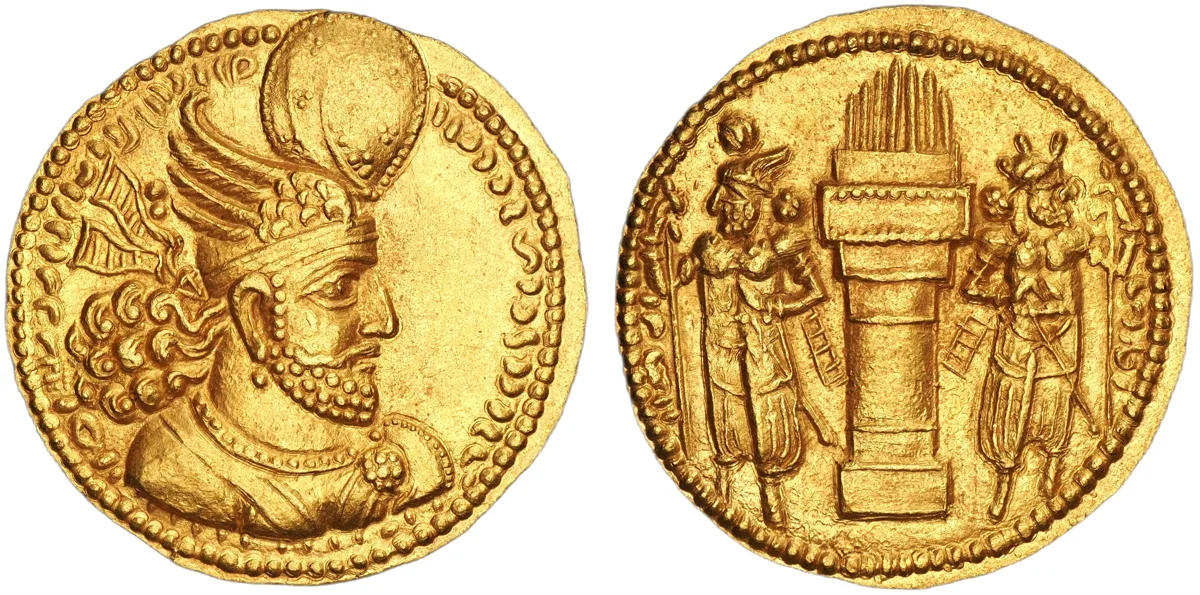
Sasanian Kings. Vahrām II, AD 276-293. Dinar
Lot 143 · Consigned by NumisOne
Closed
Description
Sasanian Kings. Vahrām II, AD 276-293. Dinar (Gold, 22 mm, 7.30 g, 3h). Style I, Phase I. 'HWPY / HRPY', probably Herat. Bust of Vahrām II right, wearing winged crown with korymbos; ribbon ties behind. Rev. Fire altar, flanked by two attendants; the figure at left wearing winged crown with korymbos, the figure at right wearing mural crown. SNS type I(1)/1(1a), Style I, unrecorded as a dinar; Saeedi –; Sunrise –; Zeno 218938 = Gorny & Mosch 261, 430 same dies; CNG 120, 604 same dies; Triton XXIII, 569 same dies; VAuctions, Pars Coins Sale 1, 209 same dies. Lightly toned, with slight marks. Extremely fine. Extremely rare.
A remarkable gold dinar of Vahrām II, apparently belonging to an exceptionally small group of same-die examples from the eastern mint conventionally read as 'HWPY / HRPY', often identified with Herat. The type is particularly important because the corresponding SNS Style I issue is not recorded there as a dinar, making this gold emission a notable extension of the published corpus. Vahrām II’s coinage is among the most iconographically varied of the early Sasanian series. His reign followed the short and unsettled rule of Vahrām I and fell during a period of pressure on several fronts, including Roman intervention in the west and instability in the east. The coinage responds to this political environment with emphatic dynastic and religious imagery, presenting the king not merely as a military ruler but as the legitimate guardian of the royal fire and the Sasanian order. The reverse is especially significant. The two attendants are not generic figures: their crowns appear to distinguish members of the royal house or court hierarchy. On issues of Vahrām II, such crowned attendants have often been interpreted as dynastic figures, sometimes connected with the king’s queen and heir, depending on the precise type. Even where the identification remains uncertain, the composition clearly expands the normal fire altar formula into a statement of dynastic legitimacy. The sacred fire stands at the center, while royal power is shown in attendance upon it. The probable Herat attribution adds further interest. Eastern Sasanian gold is far less commonly encountered than silver drachms, and the appearance of a dinar from this mint points to the importance of the empire’s northeastern regions in royal administration, prestige payments, and frontier politics. The repeated same-die citations indicate that the known corpus is very small, suggesting either a limited ceremonial or high-value emission rather than regular large-scale gold production. In extremely fine condition, with clear crowns, altar, attendants, and a strong portrait, this is a highly important early Sasanian gold coin. Its appeal rests not only in rarity, but in the combination of royal portraiture, dynastic reverse imagery, probable eastern mint attribution, and its status as a type apparently absent from the standard dinar listings.