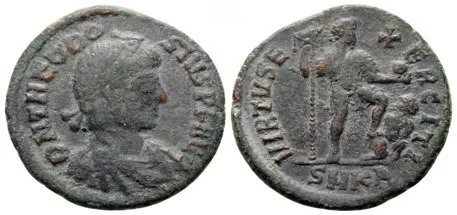
Theodosius I - A.D. 383 - 388 - AE 2 Follis - VIRTVS E-XERCITI RIC # 25b
Lot 647 · Consigned by Tacitus
Closed
Description
Theodosius I - (January 11 347- January 17 395), aka Theodosius the Great, was Roman emperor from 379 to 395. He is best known for making Christianity the state religion of the Roman Empire & great architecture projects in Constantinople. After a military career & a governorship under his father Theodosius the Elder, a comes rei militaris, he became magister equitum & was then elevated to the imperial rank of augustus by the emperor
Gratian (367-383). He replaced the latter's uncle & senior augustus Valens (364-378) who had been killed in the Battle of Adrianople. He was the 1 emperor of the Theodosian dynasty (379-457) & married into the ruling Valentinianic dynasty (364–455). On accepting his elevation, he campaigned with limited success against Goths & other barbarians who had invaded the Empire. He was not able to destroy them or drive them out, as had been Roman policy for centuries in dealing with invaders. The Gothic War ended with the Goths established as autonomous allies of the Empire, within the Empire's borders, south of the Danube. They were given lands & allowed to remain under their own leaders, not assimilated as had been normal Roman practice. He issued decrees that effectively made Nicene Christianity the official state religion of the Roman Empire, including the Edict of Thessalonica. He dissolved the order of the Vestal Virgins in Rome's Temple of Vesta. In 393, he banned the pagan rituals of the Olympic Games. His decrees made Nicene Christianity the state church of the Roman Empire & punished Roman paganism, Hellenistic religion & Arianism. He neither prevented nor punished the destruction of prominent Hellenistic temples of classical antiquity, including the Temple of Apollo in Delphi & the Serapeum in Alexandria. At his capital Constantinople he commissioned the honorific Column of Theodosius, the Theodosian Walls & the Golden Gate, among the greatest surviving works of ancient Roman architecture. His management of the empire was marked by heavy tax exactions & by a court in which"everything was for sale".