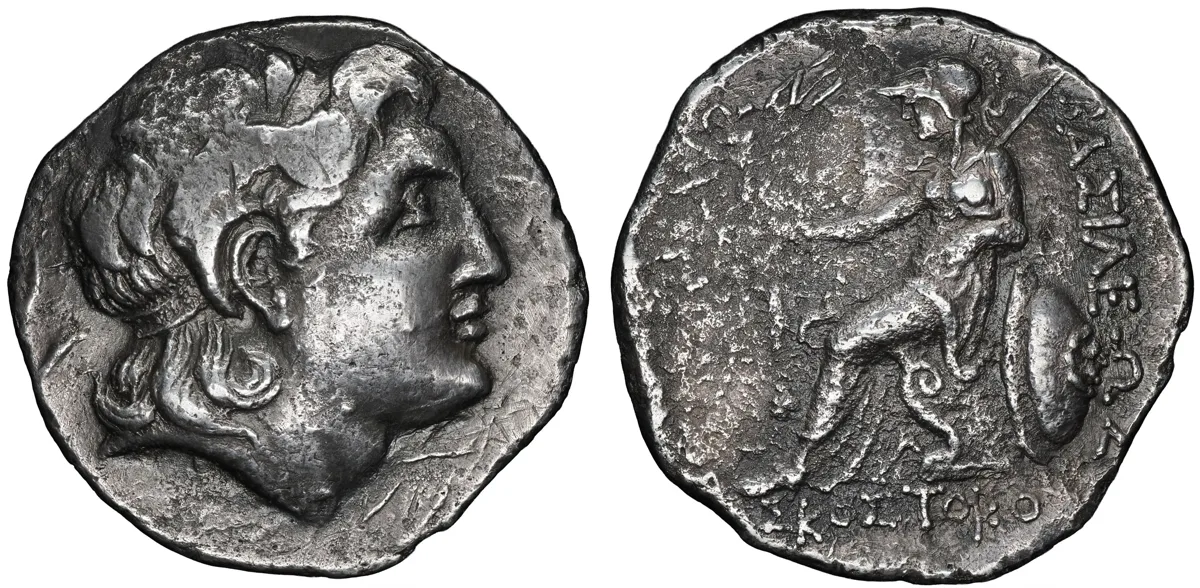
Thrace, posthumous coinage of Lysimachus, struck under Skostokos
Lot 084 · Consigned by hhf
Closed
Description
Thrace, posthumous coinage of Lysimachus, struck under the tribal dynast Skostokos, silver tetradrachm, c. 250 – 225 BC. 15.88 g, 29 mm, die axis 12 h. Obverse: diademed head of the deified Alexander the Great facing right, the ram’s horn of Ammon curling behind the ear, hair bound with a taenia. Reverse: legend ΒΑΣΙΛΕΩΣ – ΛΥΣΙΜΑΧΟΥ encircling Athena Nikephoros seated left on a high-backed throne; she holds Nike in her out-stretched right hand to crown the royal name and rests her left elbow on a shield adorned with a lion’s head; transverse spear behind; in the inner left field a slender cult-pillar; in exergue the ethnic / magistrate inscription ΣΚΟΣΤΟΚΟΥ. Müller 92; Seyrig, RN 1952, 62; SNG Copenhagen 1151; HGC 3.2, 1754. Bright silver surfaces with a pale cabinet tone; reverse devices complete though struck from a worn obverse die; fine style and clear dynast’s inscription.
After Lysimachus fell at Korupedion in 281 BC, several Thracian and Macedonian local rulers exploited his prestigious coin type to bolster their own authority. The legend ΣΚΟΣΤΟΚΟΥ (“of Skostokos”) identifies a little-known Odrysian dynast who controlled part of inland Thrace in the mid-third century BC. By retaining Alexander’s portrait and Lysimachus’s name while adding his own in the exergue, Skostokos linked himself to two iconic figures—one divine, one royal—yet signalled a degree of autonomy from the Antigonid kings then ruling coastal Macedonia. The presence of the cult-pillar beside Athena alludes to a local sanctuary, perhaps near the mint city, further localising a coin that nevertheless circulated on the wider Attic standard accepted throughout the Hellenistic Aegean.