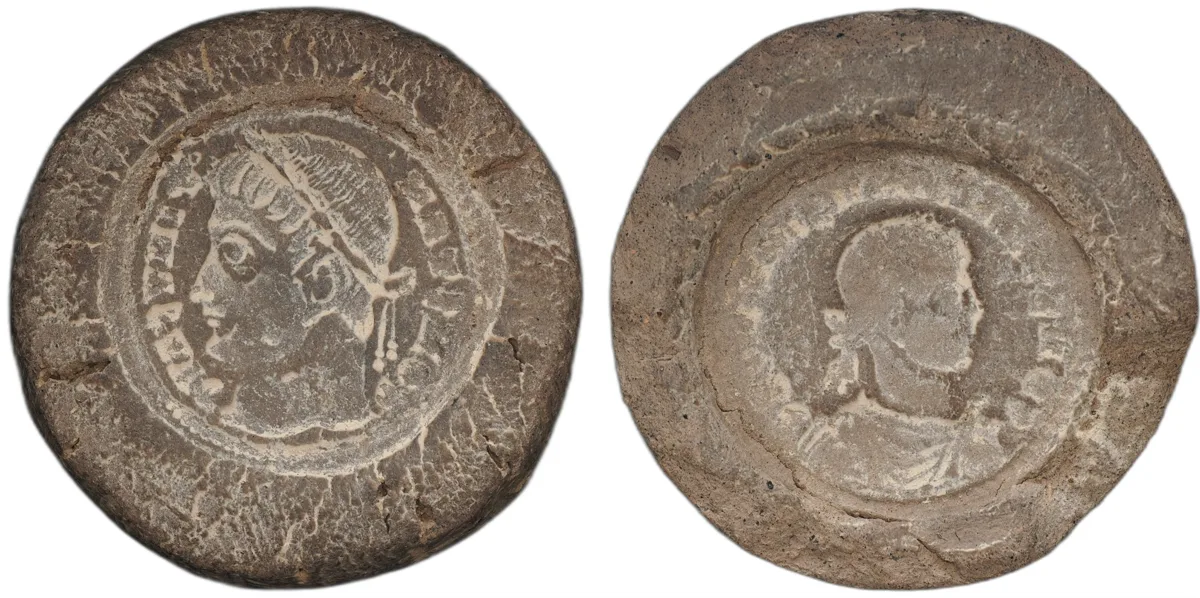
Roman bifacial terracotta forger's coin mould
Lot 614 · Consigned by hhf
Closed
Description
Constantine I (AD 306–337) and Constantine II as Caesar (AD 317–337), bifacial forger’s coin mould for AE3 bronze nummi, terracotta, prototypes c. AD 317–337; 4.88 g; 23 mm.
Roman fired-clay disc, likely North African or Egyptian manufacture, bearing two negative intaglio portrait impressions used to cast unofficial Constantinian bronzes. One face shows a laureate bust right of Constantine I with legend CONSTANTINVS AVG, in late Tetrarchic-Constantinian style. The other face carries a youthful bust right with legend CONSTANTINVS IVN NOB C for Constantine II as Caesar; this impression is more worn, with the portrait and legend partially softened. Produced for use with a paired half to cast bronze pieces by pouring metal between matched moulds; minor edge chipping and surface wear consistent with use. Unlisted in standard corpora; for prototypes compare RIC VII under Constantine I and Constantine II (e.g., Constantinian AE3 series of the 320s–330s). Terracotta coin moulds of this type are archaeologically documented in Egypt and North Africa during the early to mid-fourth century, reflecting local production of cast imitations alongside the officially struck bronze nummi of the Constantinian period. Their use indicates demand for small change in regional markets and the circulation of family-related obverse types of Constantine I and his sons; assemblages of such moulds, miscasts, and scrap from excavations corroborate the method of paired clay mould casting employed by unofficial workshops.