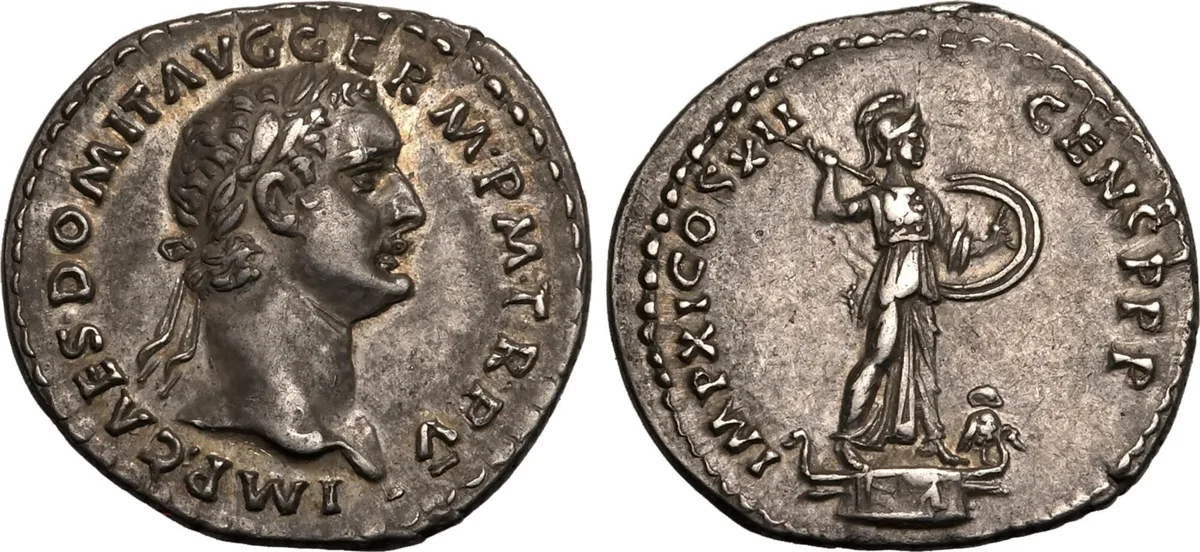
Domitian, A.D. 81-96. Denarius, Rome, late A.D. 86
Lot 178 · Consigned by NumisOne
Closed
Description
Domitian, A.D. 81-96. Denarius, Rome, late A.D. 86 (TR P V). Silver 20 mm, 3.43 g, die axis 6 h. Obv. IMP CAES DOMIT AVG GERM P M TR P V – Laureate head of Domitian right. Rev. IMP XI COS XII CENS P P P – Minerva (Type A) standing right on the capital of a rostral column, brandishing spear and holding shield; at her feet to right, owl. Ref. RIC II.1 427; RSC 196. Rare (only one specimen recorded by OCRE). Lovely pale-silver toning with golden iridescence around the devices; sharply struck on a broad flan that preserves the full dotted border.
Ex Michael Kelly Collection of Roman Silver Coins (collector’s ticket included); Spink Auction 18055 07/11/2018, Lot 111
Domitian’s denarii after A.D. 82 revolve almost obsessively around Minerva, whom the emperor claimed as his divine guardian. Of the four canonical “Minerva types,” this is Type A—the goddess advancing on the prow-like capital of a victory column, owl in attendance, spear poised to strike. The surrounding titulature fixes the coin precisely: tribunician year V, eleventh imperial acclamation, twelfth consulship. That narrow window—autumn 86—saw Domitian engaged in hard-fought campaigns on the German frontier and laying the foundations for the Dacian War that would define his later reign.
By depicting Minerva in mid-charge, the emperor fused state religion with martial propaganda: Rome’s victories were no longer the gift of Jupiter or Mars but of a personally chosen protectress whose attributes—foresight, discipline, technical skill—mirrored the qualities Domitian wished to project. The rostral column beneath her feet drives the point home, proclaiming naval and colonial successes while visually elevating the goddess (and, by proxy, the emperor) above conquered enemies. Rare in this precise combination of legends, the piece offers both an art-historical snapshot of Flavian coin design at its zenith and a miniature dossier on Domitian’s self-fashioned role as Rome’s vigilant, ever-ready commander-in-chief.