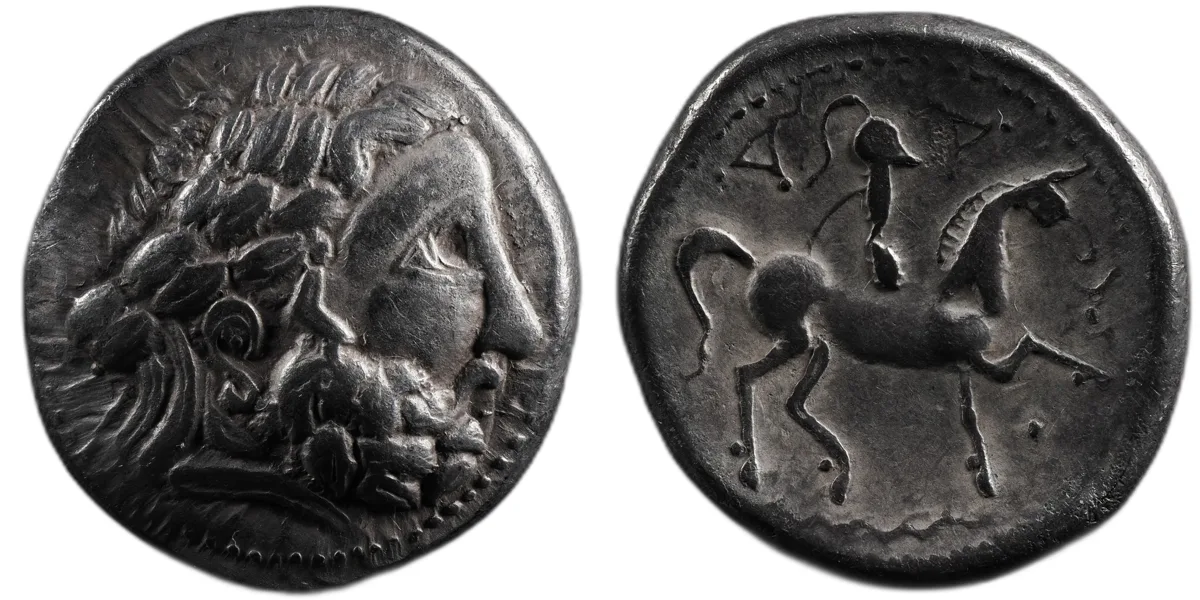
Middle Danube Celtic AR Tetradrachm, 4th c BC, Zeus/Horseman, 16.7g, 27mm
Lot 009 · Consigned by hhf
Closed
Description
Middle Danube, uncertain tribe, Tetradrachm, silver, 4th century BC, 16.7 g, 27 mm.
Anepigraphic; Celticized laureate head of Zeus right within a dotted border. Reverse anepigraphic; horseman riding right, simplified linear style, dotted border. Struck at an uncertain mint in the Middle Danube region on a compact flan; obverse slightly off-center with minor softness on the highest curls; reverse well-centered with complete type. Flesche 552; OTA 413/2. Historical significance: This imitative “tetradrachm” belongs to the earliest silver coinages of the Eastern Celts along the Middle Danube. Its Zeus/horseman types derive from Philip II of Macedon, whose coinage circulated widely in the Balkans during the late Classical period. Local engravers adapted the Greek designs into a schematic style, marking the transition from dependence on imported Macedonian currency to regional production for trade and payments. Hoard and find distributions place the series in the Morava–Danube corridor, documenting cross-border exchange between Celtic communities and the Greek world in the 4th century BC.