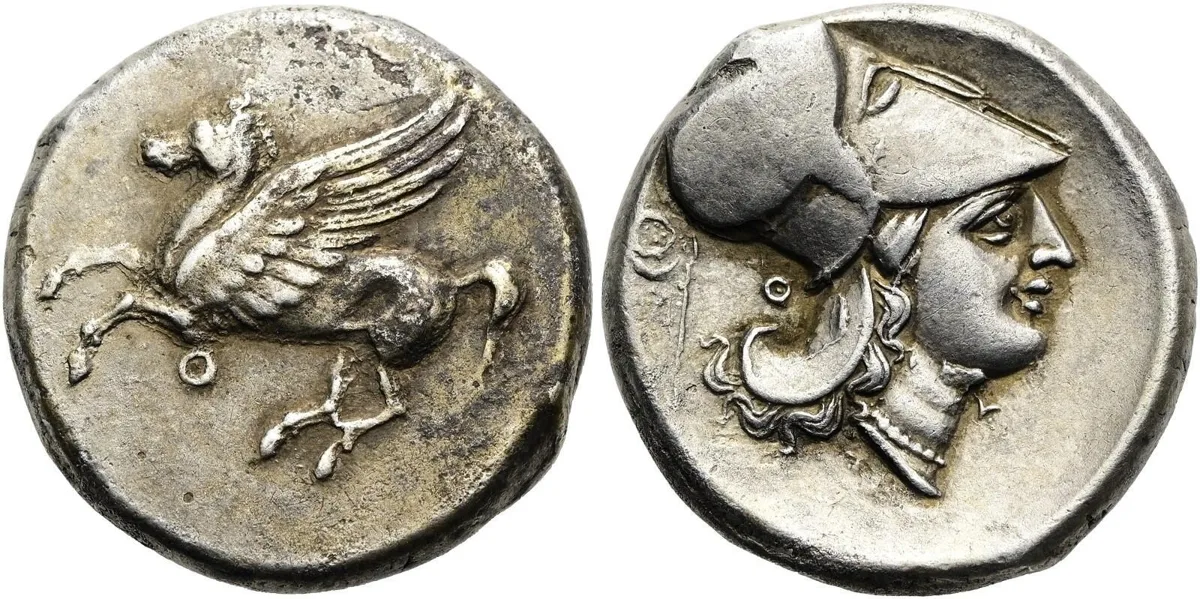
ACARNANIA, Thyrreion – Silver Stater, c. 320 – 280 BC
Lot 025 · Consigned by NumisOne
Closed
Description
ACARNANIA, Thyrreion – Silver Stater, c. 320 – 280 BC. 22 mm · 8.48 g · Attic standard. Obverse: Pegasos in mid-flight left, wings elevated; ethnic letter Θ beneath the fore-hooves. Reverse: Helmeted head of Athena right, wearing a high-crested Corinthian helmet with laurel spray; letters Λ before chin and ΛΥ beneath neck; Θ in left field and repeating as a pellet in the earring. Linear border. Calciati 8; SNG Cop 411; BCD 373.4; HGC 4, 920. Glossy steel-grey patina with warm golden iridescence; a few light pits on the obverse from a rusted die, devices otherwise sharp and attractively centred. From a Basel-region collection formed in the 1980s (collector’s ticket of M. Weder).
Nestled between the Ambracian Gulf and the Achelous River, Thyrreion joined the Acarnanian Koinon after Alexander’s death and began striking silver on the familiar Corinthian-Pegasos pattern to service the lively coastal trade routes that linked Epirus, Corcyra, and the Peloponnese.
Pegasos proclaimed monetary compatibility with Corinthian issues circulating in the western Greek world, ensuring instant credibility for local silver.
The Acarnanians personalised the reverse by adding a sequence of control letters—here Θ, Λ, ΛΥ—which likely encode the names of civic magistrates as well as the mint of Thyrreion itself.
Contemporary sources (Polybius 4.63) praise Acarnanian cavalry, and the choice of a flying horse paired with the war-goddess Athena Alkidemos symbolised both mobility and martial readiness as the Koinon negotiated alliances with the rising power of Macedon and, later, Pyrrhos of Epeiros.
Well-preserved staters from Thyrreion are markedly scarcer than those of neighbouring Leukas or Anaktorion; the present coin, with its clear sequence of control marks and pleasant toning, is an appealing representative of Acarnania’s brief silver output in the turbulent decades before Rome’s advance into western Greece.