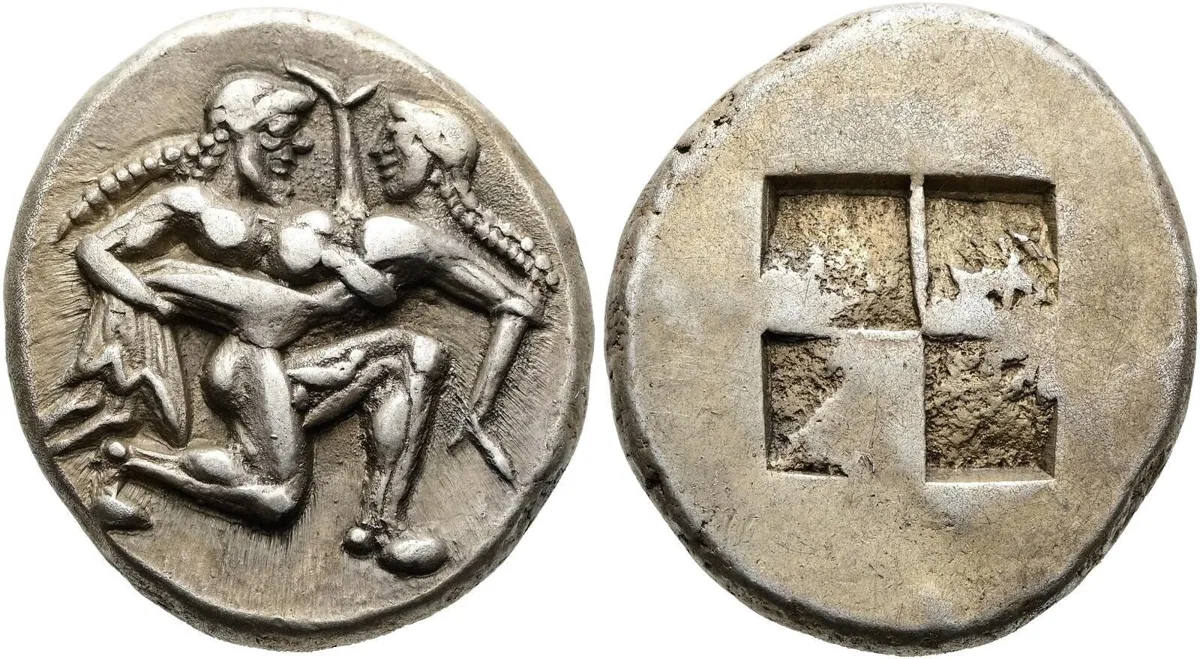
THRACE, Island of Thasos – Silver Stater, late 6th century BC
Lot 041 · Consigned by NumisOne
Closed
Description
THRACE, Island of Thasos – Silver Stater, late 6th century BC. 21 mm • 9.54 g • struck on the Persian-standard light stater. Obverse: Bearded satyr in the archaic “kneeling-run” stride to right, grasping and carrying off a nymph whose right arm is flung upward in protest; both figures rendered with long braided hair and exaggerated musculature. Reverse: Deep quadripartite incuse square (quadratum incusum). SNG Copenhagen 1011 ff.; Franke–Hirmer 435; Asyut Hoard 111. Perfectly centred, boldly struck in high relief and attractively toned; a remarkably well-preserved archaic masterpiece. Apollo to Apollo Collection (illustrated in H. B. Andersen, Apollo to Apollo – The Hunt for the Divine and Eternal Beauty, 2019); previously Numismatik Lanz Auction 151 (Munich, 5 December 2011), lot 321.
Silver flowed into Thasos after the discovery of rich veins on the mainland opposite the island around 540 BC. The Thasians used part of this newfound wealth to strike a distinctive series of staters featuring Dionysiac iconography—satyrs, nymphs, and Silenoi—that advertised their twin assets of wine and precious metal.
The satyr-and-nymph type is not merely titillating: in Greek myth Thasian wine was so potent that it drew wild nature spirits from Mount Pangaion to abduct local maidens. By placing the scene on currency, the city proclaimed both the strength of its vintage and the power of its patron god Dionysos to protect the polis.
Technically the coin exemplifies early northern-Greek practice: the obverse is engraved in bold intaglio, while the reverse is created by a single punch that forces the metal back into a deeper, four-compartment incuse. This archaic fabric would soon disappear as classical flan-preparation techniques spread from Aegina and Athens, making high-relief reverses possible.
Hoards such as Asyut (476/5 BC) and Ialysos (Rhodes) show Thasian satyrs travelling far beyond the northern Aegean, accepted across the Persian-controlled littoral alongside Samian and Milesian issues. Their artistic verve and historical importance ensure that well-centred examples like the present piece remain cornerstones of archaic collections.