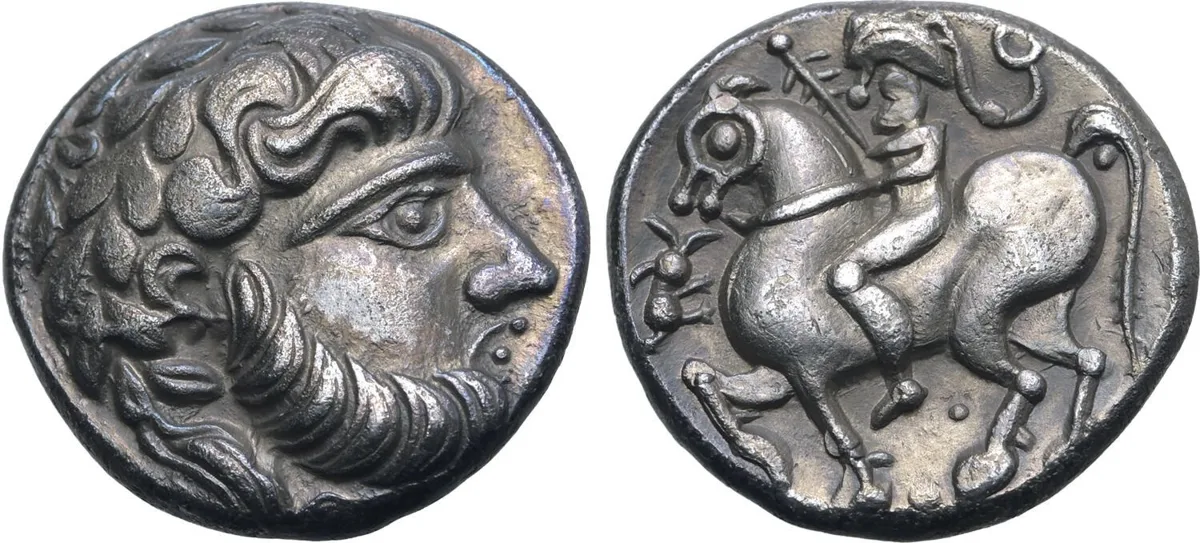
CARPATHIAN CELTS – “Baumreiter” Type. Silver tetradrachm imitating Philip II
Lot 008 · Consigned by NumisOne
Closed
Description
CARPATHIAN CELTS – “Baumreiter” Type. Silver tetradrachm imitating Philip II of Macedon, 2nd century BC. 23 mm · 13.20 g · die axis 11h. Obverse: Celticised laureate head of Zeus right, his hair rendered in bold, swirling locks. Reverse: Stylised horseman left, wearing a tall crested helmet whose S-shaped plume ends in a ring; the rider holds a branching twig in his out-stretched right hand. Ahead of the horse a tiny animal—perhaps a hound or wolf—leaps; pellet and floral device in exergue. Dembski 1085 a; Lanz 419; OTA 129/3-4; Flesche 691 var.; SLM 1268 var. Deep gray cabinet tone with golden highlights; lightly granular surfaces, details sharp. From the L.I.M.B. Collection of Celtic coinage; previously Roma Numismatics 29 (9 Nov 2023), lot 26.
“Baumreiter” (“tree-rider”) staters and tetradrachms are among the most coveted series of Celtic Balkan silver. Struck by an as-yet uncertain tribe—likely the Bastarnae or Costoboci inhabiting the northern slopes of the Carpathians—they begin as faithful imitations of Philip II’s Macedonian silver but quickly blossom into exuberant, abstract art.
The obverse still recalls Philip’s Zeus, yet the hair has been transformed into a rhythmic foliage pattern, foreshadowing the vegetal obsession that names the type.
On the reverse the original Macedonian jockey becomes a mythic horseman who seems to sprout from a living tree: his crested helmet ends in a curled vine, and he brandishes a leafy branch rather than a spear. The tiny animal before the horse may reference totemic hunting or tribal heraldry.
Metallurgical work by L. Flesche and J. Dembski shows these pieces were struck on an Attic-weight standard (≈ 14 g) but intentionally under-weight, suggesting they served as prestige gift-currency or ritual deposits rather than everyday trade coinage. Hoard contexts—from the Szilágysomlyó (Romania) find to isolated discoveries along the Upper Tisza—cluster around the mid-2nd century BC, when Celtic groups were squeezed between Dacian expansion and Roman pressure along the Danube.
Well-preserved tetradrachms of the Baumreiter series are far scarcer than their stater counterparts; this specimen, with its crisp rider and sprightly field symbols, exemplifies the Celtic talent for reshaping classical motifs into something wholly their own.