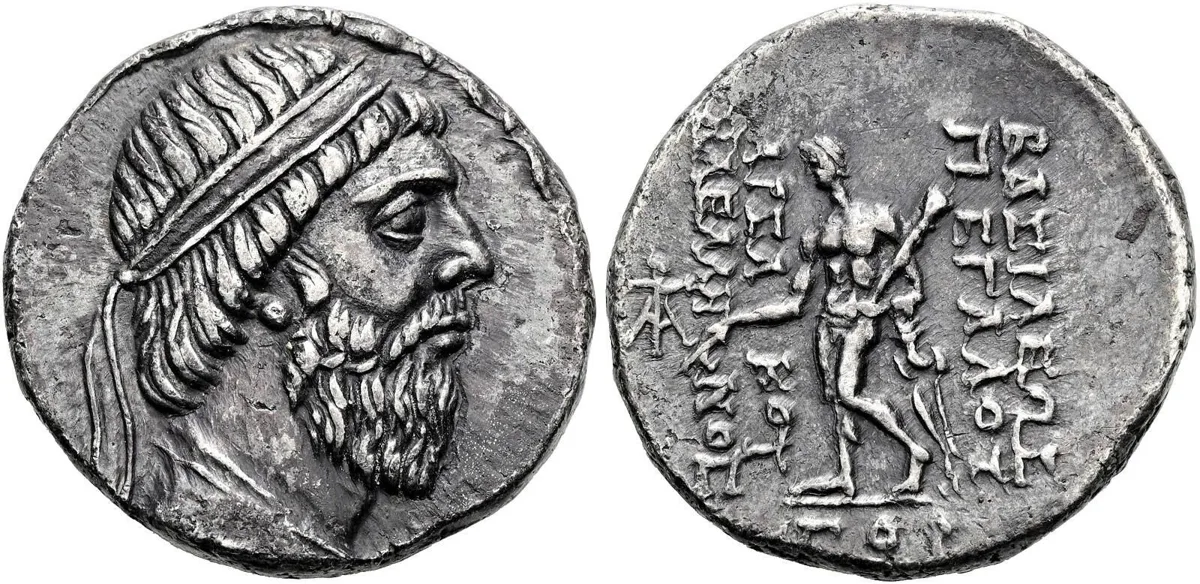
PARTHIAN KINGDOM. Arsacid Dynasty. Mithradates I “the Great,” Silver tetradrachm
Lot 290 · Consigned by NumisOne
Closed
Description
PARTHIAN KINGDOM – Arsacid Dynasty. Mithradates I “the Great,” 171/0 – 132 BC. Silver tetradrachm, Seleukeia-on-the-Tigris mint, Seleucid Era year 173 = 140/139 BC. 28 mm · 16.25 g · die-axis 12h. Obverse: Draped and diademed bust of Mithradates I right, wearing the distinctive crenellated royal tiara; finely arranged beard and hair. Reverse: Greek legend ΒΑΣΙΛΕΩΣ ΜΕΓΑΛΟΥ / ΑΡΣΑΚΟΥ ΦΙΛΕΛΛΗΝΟΣ – “of the Great King Arsaces, Friend of the Greeks.” Youthful Herakles stands left, holding a skyphos in his out-stretched right hand and resting his left arm on club and lion-skin; monogram in left field; in exergue ΓΟΡ (= 173 SE). Sellwood 13.3; Shore 36; Sunrise 261. Deep old cabinet tone; slight double-strike on obverse and reverse struck from a fatigued die, otherwise well centred. Classical Numismatic Group 123 (14 May 2023), lot 307.
When Mithradates I marched west and captured Seleukeia-on-the-Tigris in 141 BC, the Parthians instantly inherited a sophisticated Hellenistic monetary system. Rather than impose purely Iranian types, the king styled himself ΒΑΣΙΛΕΥΣ ΜΕΓΑΣ (“Great King”) in Greek and adopted the Seleucid image of Herakles to reassure the city’s Greek mercantile elite. The epithet ΦΙΛΕΛΛΗΝΟΣ (“Friend of the Greeks”)—struck here for the first generation—underlined his intention to rule, not merely conquer, the former Seleucid heartland.
The date ΓΟΡ (173 SE = 140/139 BC) places this piece in the first full year after the conquest, while the monogram at the left almost certainly identifies the newly appointed satrap or mint-master. These early Seleukeian tetradrachms became the backbone of Parthian Mesopotamian commerce, circulating alongside the final Seleucid issues of Demetrios II and Antiochos VII until Roman silver began to arrive in quantity a century later.
Scarce in higher grades, the present coin offers a well-preserved portrait of the architect of Parthia’s imperial expansion and a tangible link to the moment when Babylon and Seleukeia exchanged one Hellenistic overlord for another, Iranian one—without breaking the silver-based economy that bound the Near East together.