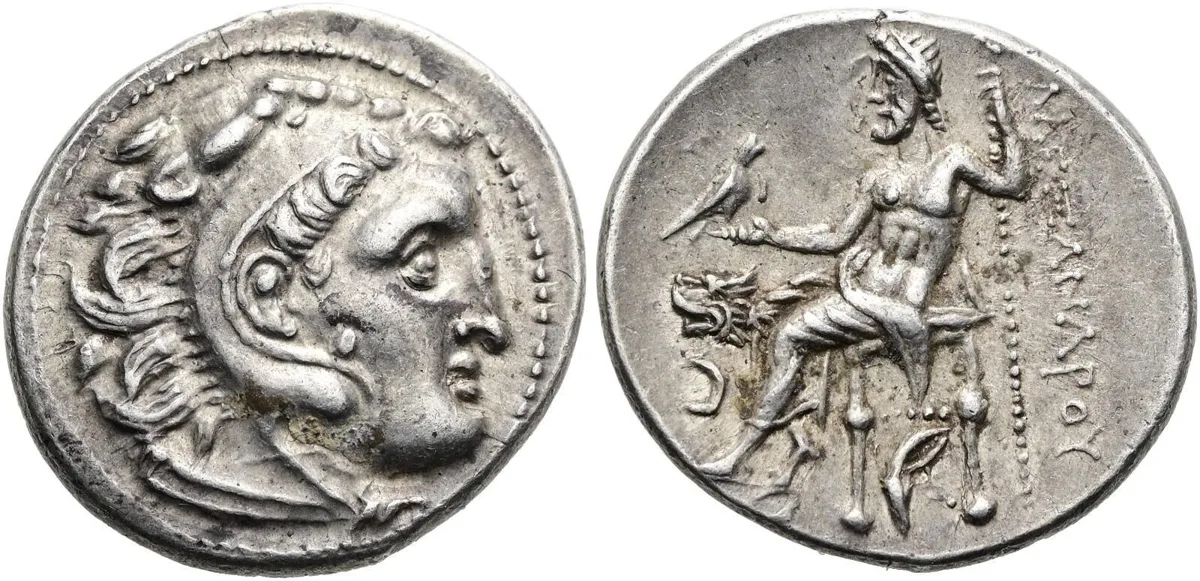
MACEDONIAN KINGDOM – Alexander III “the Great,” posthumous issue. Silver drachm
Lot 073 · Consigned by NumisOne
Closed
Description
MACEDONIAN KINGDOM – Alexander III “the Great,” posthumous issue. Silver drachm, struck at the so-called “Kolophon” mint in Ionia, c. 301 – 297 BC. 19 mm · 4.14 g · die-axis 12h. Obverse: Head of Herakles right, wearing the scalp of the Nemean lion; dotted border. Reverse: ΑΛΕΞΑΝΔΡΟΥ – Zeus Aëtophoros seated left on a backless throne, holding eagle on out-stretched right hand and long sceptre in left; in the left field lion’s head above a crescent moon; beneath the throne crab’s claw control-mark. Price 1837; Müller 340. Well-centred with delicate iridescent tone; light cabinet friction on the high points, details sharp.
This drachm belongs to the prolific “Kolophon” group—so named by Edward T. Newell for convenience, though modern die studies suggest several mobile workshops that followed Antigonos Monophthalmos and Lysimachos during the Wars of the Diadochi. The date range (301-297 BC) spans the immediate aftermath of the titanic Battle of Ipsos (301 BC), where the coalition of Lysimachos, Seleukos, and Kassandros shattered Antigonos’ bid to reunite Alexander’s empire.
The lion-head and crescent in the left field form a unique symbol pair that Price assigns to his Series 29. The emblem probably marks a short emission struck to pay Lysimachos’ Thracian and Ionian garrisons after the division of Antigonos’ Asian territory.
The tiny crab claw under Zeus’ throne is the mint-master’s personal control mark, allowing ancient auditors to track silver flows in a chaotic political landscape.
Although small in module, Alexander drachms like this travelled farther than their larger tetradrachm cousins: hoards in Egypt, the Levant, and even India attest to their role as the dollar-equivalent of the Hellenistic world. Their continued use—fully a quarter-century after Alexander’s death—speaks to the enduring trust merchants placed in the Attic-weight, Herakles-and-Zeus design, even as rival kings stamped their own names and symbols into the fields.
A choice, well-preserved example bearing a distinctive set of post-Ipsos control marks—ideal for collectors tracing the complex monetary geography of the early Successor period.