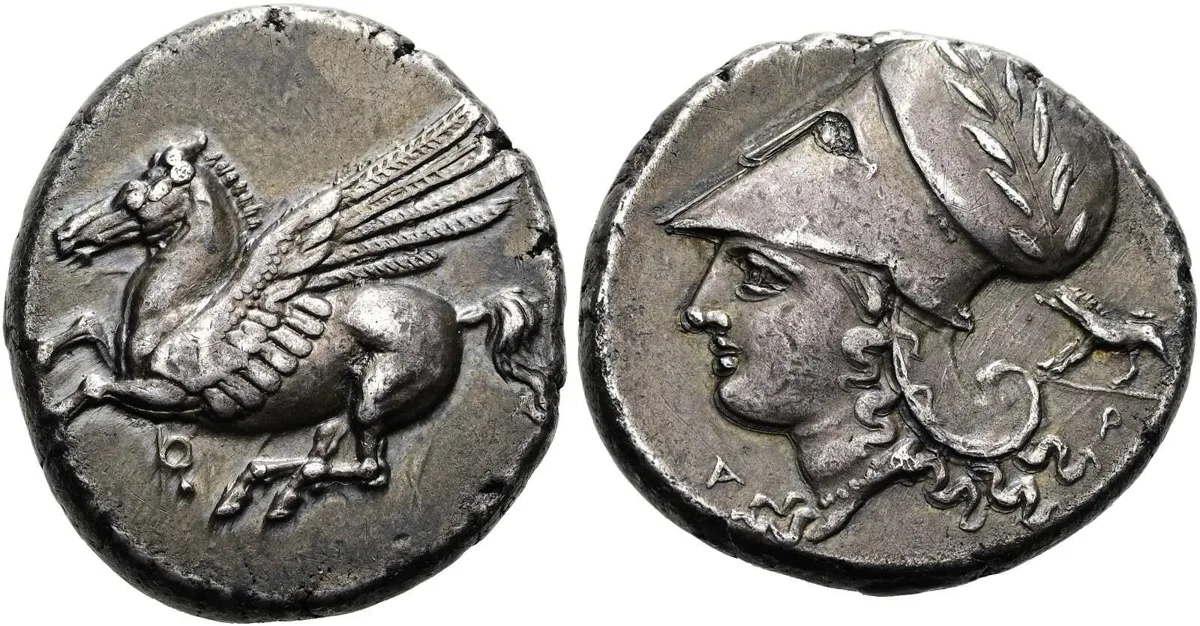
CORINTHIA, Corinth – Silver Stater, c. 345 – 307 BC
Lot 021 · Consigned by NumisOne
Closed
Description
CORINTHIA, Corinth – Silver Stater, c. 345 – 307 BC. 22mm. 8.44 g. Attic standard. Obverse – Pegasos, the winged horse, flying left; archaic koppa (Ϙ) below. Reverse – Α-Ρ (ethnic abbreviation for Arche-Corinth) to left of helmet; head of Athena left, wearing Corinthian helmet decorated with laurel spray; behind, small running boar; all within shallow circular incuse. Calciati Pegasi 435; Ravel 1017; HGC 4, 1848. Attractive 100 year old deep cabinet toning, sharply detailed.
Münzhandlung Herbert Grün (Heidelberg) Auction 12, 29 November 1994, lot 220.
A. Riechmann & Co., Halle (Saale), Auction XXX, “Greek Coins – Duplicates from the Berlin State Coin Cabinet”, 11 December 1924, lot 603
Corinth’s iconic Pegasos–Athena staters were the hard currency of the Greek West for nearly three centuries, accepted from Sicily to the Black Sea thanks to the city’s commanding role in maritime trade. By the mid-fourth century BC, however, political upheaval forced Corinthian die-engravers to innovate if they were to preserve that prestige in the shadow of Macedonian expansion.
Two details on this late-Classical issue illustrate the subtle re-branding:
The tiny boar behind Athena’s helmet is the mint-mark of an otherwise anonymous engraver whose issues cluster just before the battle of Chaeronea (338 BC). Scholars link the emblem to the mythic Calydonian boar-hunt, perhaps signalling Corinth’s bid for pan-Hellenic unity against Philip II.
The retention of the archaic koppa (Ϙ) under Pegasos kept faith with centuries of earlier staters while providing an instant safeguard against forgery in an age when imitations from across the Adriatic were rife.
Hoards such as the Alessandria del Carretto (1989) and the Bouthrotos deposit (1995) confirm that these later Pegasi still dominated western commerce until Alexander’s successors flooded the market with Alexandrine tetradrachms after 300 BC. Well-centred, richly toned examples—particularly with a clear boar control-mark—remain keenly sought by collectors for the elegance of their late-Classical style and for the window they offer onto Corinth’s last independent flourish.