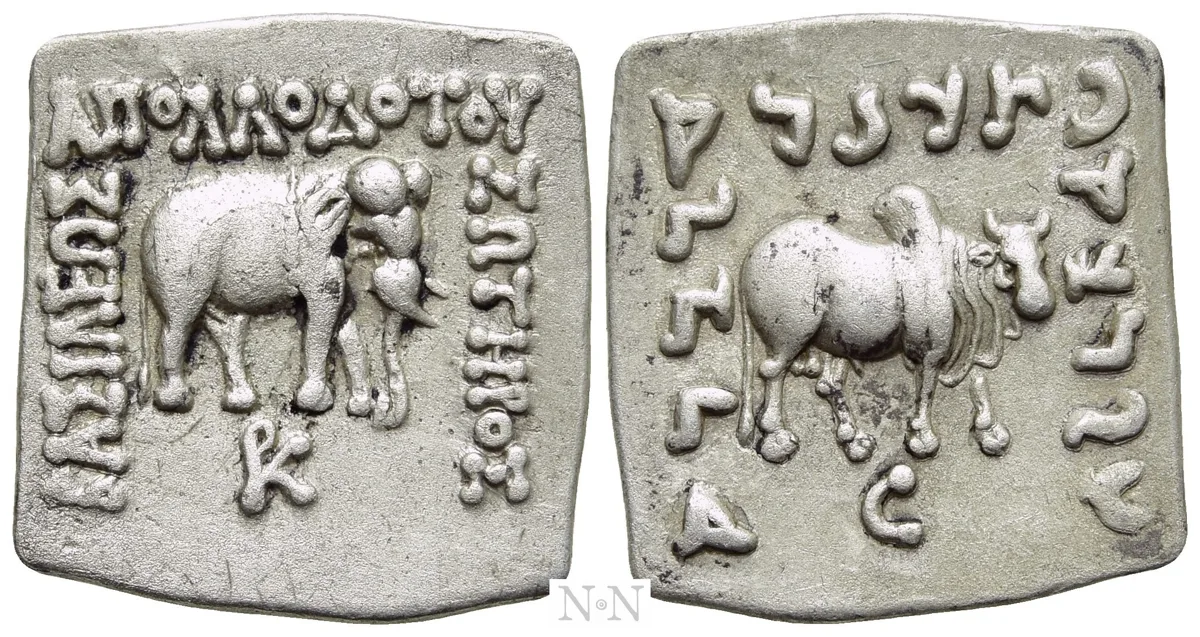
KINGS OF BACTRIA – Apollodotos I Soter, c. 180-160 BC Silver drachm
Lot 124 · Consigned by NumisOne
Closed
Description
KINGS OF BACTRIA – Apollodotos I Soter, c. 180-160 BC. Silver drachm, Indian square standard. 20 mm, 2.42 g. Obverse: Greek legend ΒΑΣΙΛΕΩΣ ΑΠΟΛΛΟΔΟΤΟΥ ΣΩΤΗΡΟΣ “of King Apollodotos the Saviour.” Elephant striding right, raised trunk; monogram beneath fore-feet. Reverse: Kharoshthi legend 𐨨𐨱𐨪𐨌𐨧𐨯 𐨀𐨿𐨤𐨫𐨡𐨯 𐨭𐨿𐨟𐨪𐨯 (Maharajasa Apaladatasa Sotarasa) around a humped zebu bull standing right; letter “C” below. Bopearachchi Série 4 D; HGC 12, 119. Attractive light cabinet tone; minor flan roughness, devices sharp and well-centred.
Apollodotos I is the first Indo-Greek ruler whose bilingual coinage appears in both Greek and Kharoshthi, signalling the permanent presence of Hellenistic power south of the Hindu Kush. Struck on the lighter Indian standard and in the local square shape, his drachms were tailored to everyday commerce in the Punjab and Sindh, while retaining Greek artistry to reassure mercenaries and traders from Bactria.
The elephant—icon of royal might and of the Buddha’s birth legend—announces Apollodotos as Soter (“Saviour”) of his new subjects, while the zebu bull evokes Vedic ritual and the agrarian prosperity of the Indus plain. By pairing the two sacred animals, the king projected an image of benevolent overlord bridging Hellenic and Indian worlds.
Boepearachchi dates this Série 4 to the middle of Apollodotos’ reign, after he had expelled the last Mauryan satraps from the northwest yet before Eucratides overturned the Greco-Bactrian heartland. Finds from Taxila and Charsadda show the type in heavy circulation alongside the punch-marked silver of local janapadas, illustrating how rapidly the Indo-Greek drachm became the new lingua franca of trade from the Khyber to the lower Indus.
An evocative, well-preserved specimen that marks the dawn of Hellenism in India and the birth of one of antiquity’s most colourful hybrid cultures.