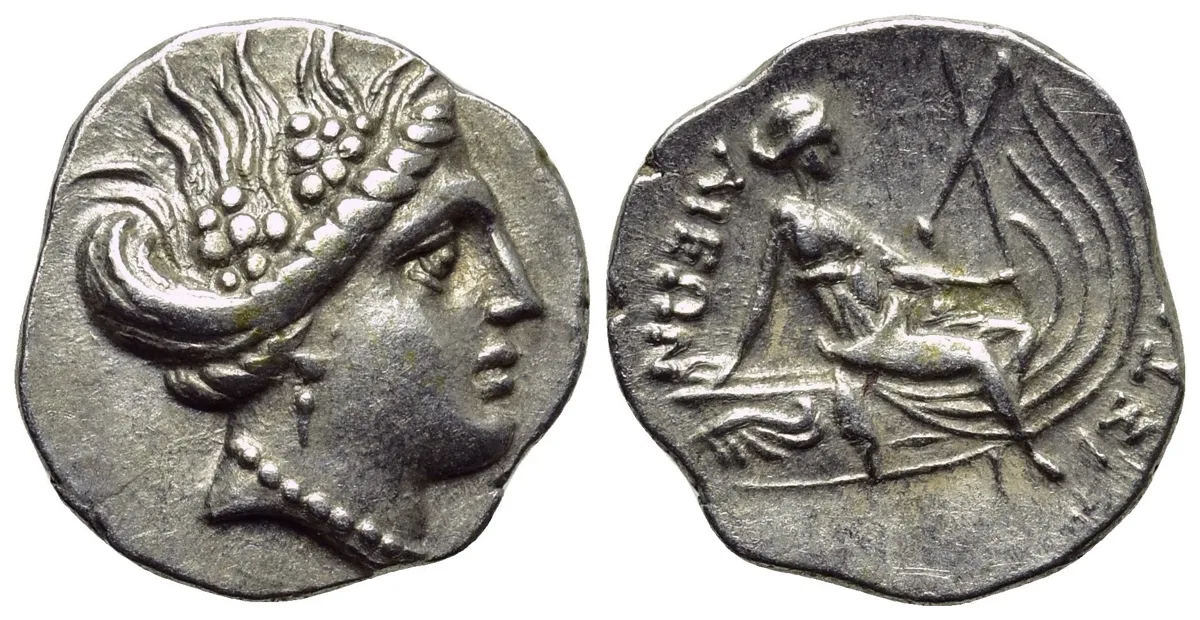
EUBOEA, Histiaia. Silver Tetrobol, 3rd–2nd centuries BC
Lot 049 · Consigned by NumisOne
Closed
Description
EUBOEA, Histiaia. Silver Tetrobol, 3rd–2nd centuries BC. 14 mm · 1.39 g · Attic/Euboean standard Obverse: Wreathed head of the nymph Histiaia right, her hair swept up and bound with a plain stephane; single-drop earring and beaded necklace visible. Reverse: ΙΣΤΙΑΙΕΩΝ — Nymph seated right on the stern of a galley, holding ship’s mast and yard; spiral wing ornament on the prow, stylised waves beneath. BCD Euboia 387 ff.; HGC 4, 1524.
The little silver tetrobols of Histiaia rank among the most charming minor coinages of the Hellenistic Aegean. After the Athenians expelled the original population of Histiaia in 445 BC and refounded the city as Oreus, the native name survived chiefly on its money. By the third century the old nymph Histiaia—personification of the town’s fertile plain at the northern tip of Euboea—reclaimed pride of place on the obverse, wearing a radiant crown that evokes both grain ears and flickering flame (ἑστία, “hearth-fire”).
The galley reverse alludes to Histiaia’s strategic harbour on the Oreos Channel, commanding the sea-lane that connected Chalkis and the northern Sporades. The nymph perched on the stern (with a decorative wing on the prow) symbolises the city’s maritime livelihood, while the diminutive denomination itself—worth one-sixth of an Athenian drachm—suited day-to-day coastal trade in olives, dried fish, and timber.
Hoards from Thasos to Aitolia show that these tetrobols travelled widely, circulating alongside the ubiquitous Macedonian bronzes and the silver fractions of Chios and Rhodes. Their fine style and light weight made them a favourite pocket piece for Hellenistic sailors and soldiers, and they remained in production until Rome consolidated control of Euboea after 146 BC.
A delightful, high-grade specimen that distils the commercial energy of a small but well-placed Greek polis.