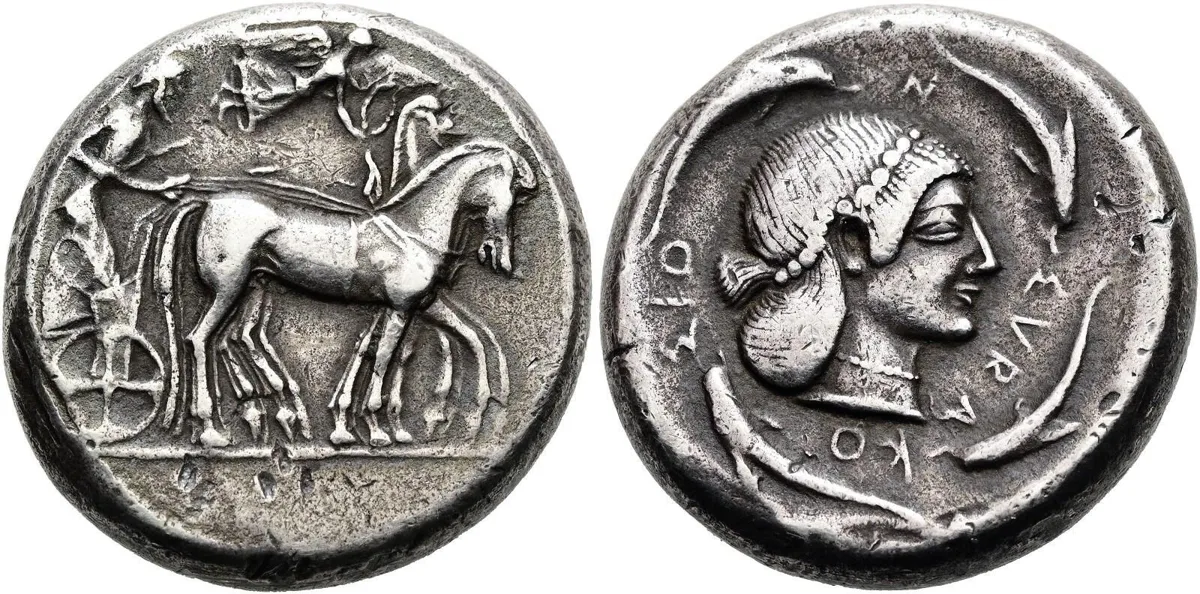
Sicily, Syracuse. Reign of the Deinomenids, 485-466 BC. Silver tetradrachm
Lot 030 · Consigned by NumisOne
Closed
Description
Sicily, Syracuse. Reign of the Deinomenids, 485-466 BC. Silver tetradrachm. Obverse: Charioteer, holding a goad and the reins, drives a racing quadriga right; Nike hovers above, crowning the horses with a wreath; exergual line. Reverse: ΣΥΡΑ-ΚΟ-ΣΙΟ-Ν — head of the fountain-nymph Arethusa right, her hair bound in a beaded sakkos and net, wearing single-drop earring and necklace; four dolphins swim clockwise around. Boehringer 228 (dies V102/R154); Randazzo 384 (same dies); HGC 2, 1306. Beautiful old cabinet toning; light, even wear but full detail on the finely modelled quadriga and Arethusa’s archaic profile.
This dramatic early tetradrachm was struck during the reign of the tyrant Gelon (485-478 BC) and his brother Hieron I (478-466 BC), the so-called Deinomenids who transformed Syracuse into the dominant naval power of the western Greek world.
Quadriga & Nike — Gelon won the four-horse chariot race at Olympia in 488 BC; the obverse commemorates that victory while proclaiming the city’s military horsepower. Nike’s tiny, energetic figure is among the earliest representations of the goddess on a coin.
Arethusa & the dolphins — Arethusa, whose sacred spring bubbles on the islet of Ortygia, served both as a civic emblem and a guarantee of the coin’s fine Attic-standard silver. The encircling dolphins allude to Syracuse’s superb natural harbour and its sea-borne prosperity.
These archaic-to-early-classical dies precede the famous Demareteion and the signed masterpieces of Kimon and Euainetos by half a century, yet already display the bold relief and dynamic composition that would make Syracusan coinage the benchmark for Greek art in miniature. Hoard evidence (e.g. the 1960s Randazzo find) shows that such pieces circulated widely across Sicily and southern Italy, fuelling the mercenary armies that repelled the Carthaginian invasion at Himera in 480 BC.
An attractive, well-preserved example from the formative phase of Sicilian numismatics, distinguished by its full, almost sculptural engraving and its pleasing toning.