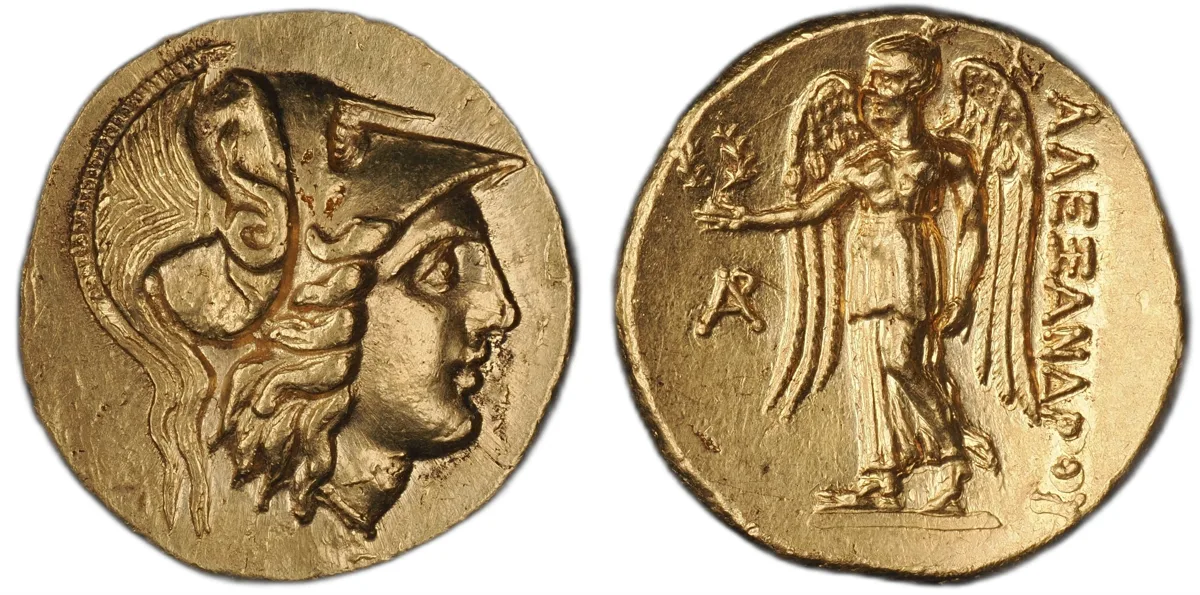
MACEDONIAN KINGDOM. Alexander III the Great (336-323 BC). AV stater
Lot 087 · Consigned by NumisOne
Closed
Description
MACEDONIAN KINGDOM. Alexander III the Great (336-323 BC). AV stater (17mm, 8.61 gm, 1h). Late lifetime-early posthumous issue of Aradus, under Menes, ca. 325/4-324/3 BC. Head of Athena right, hair flowing loose in long waves, and upswept at temple, wearing triple-crested Corinthian helmet pushed back on head, short parallel crest ends, bowl decorated with coiled serpent right / AΛEΞANΔPOY, Nike advancing left, wreath in outstretched right hand, stylis cradled in left arm; AP monogram in outer left field. Price 3423 (Byblus). Nicely centered with sharp detailing and brilliant protected surfaces.
Struck at the Phoenician port of Aradus under the satrap Menes, this gold stater belongs to the late lifetime to early posthumous issues of Alexander III the Great, dating to circa 325/4–324/3 BC, a time when Alexander’s empire stretched from Greece to India. The obverse portrait of Athena, with her flowing hair and finely detailed Corinthian helmet, reflects Alexander’s deliberate use of Greek iconography to unify his diverse subjects under a shared Hellenic visual language. Athena goddess of wisdom and war embodied both the strategic brilliance and martial prowess Alexander sought to project. The choice of Aradus, a key naval ally and maritime hub on the Levantine coast, underscores the strategic importance of controlling Phoenician ports in securing sea lanes and facilitating the movement of troops, goods, and wealth throughout the eastern Mediterranean.
The reverse image of Nike advancing with wreath and stylis encapsulates Alexander’s self-presentation as a divinely favored conqueror and master of the seas. The stylis, a ship’s mast with a crossarm, alludes to naval supremacy—critical for maintaining dominance over the Aegean and eastern Mediterranean after the defeat of the Persian fleet. The AP monogram identifies a specific magistrate or issuing authority, tying this coin to a particular administrative phase within the Aradian mint. Gold staters such as this were not merely high-value trade currency; they also served as political instruments, rewarding loyalty among officers and allies while broadcasting Alexander’s legitimacy across a vast multicultural empire. As a well-preserved example with sharp detail, it offers both numismatic and historical insight into the final years of Alexander’s reign and the immediate transition toward the successor period.