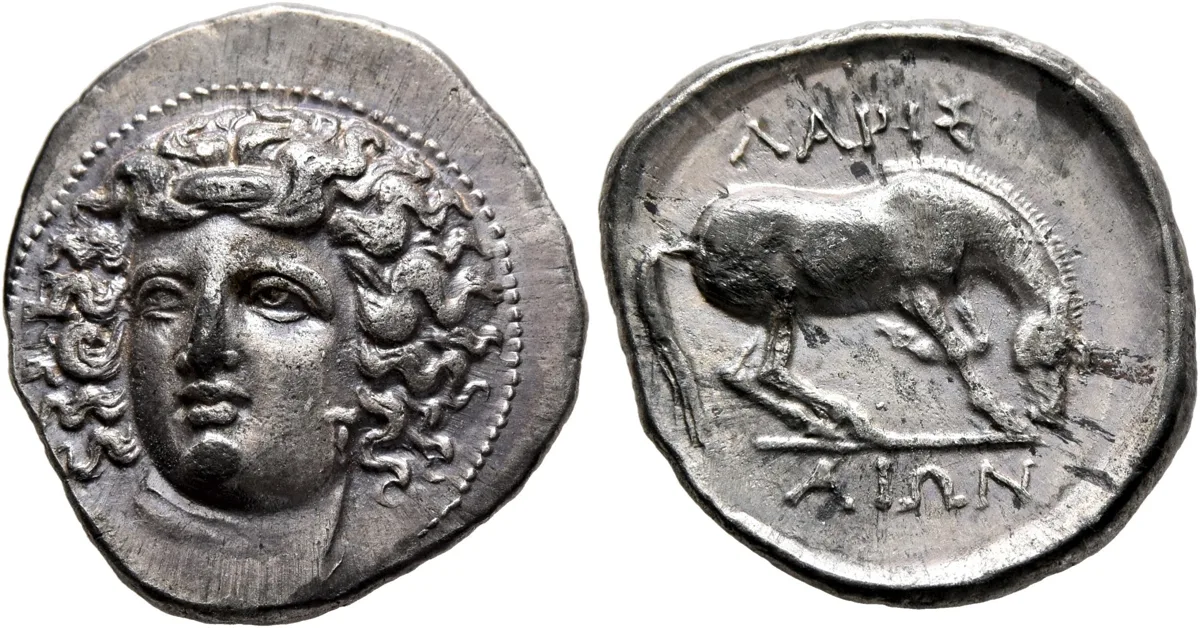
THESSALY. Larissa. Circa 356-342 BC. Drachm (Silver, 18 mm, 6.01 g, 7 h).
Lot 043 · Consigned by NumisOne
Closed
Description
THESSALY, Larissa. Silver drachm, c. 356 – 342 BC. 18 mm · 6.01 g · die axis 7h. Obverse: Head of the nymph Larissa three-quarter facing left, her luxuriant hair held by a plain ampyx; wearing pendant earring and bead-and-drop necklace; dotted border. Rev. ΛΑΡΙΣ-ΑΙΩΝ Horse standing right with head turned under its belly, fore-legs bent as it gathers itself to roll on the ground; exergual line. BCD Thessaly I 1155; BCD Thessaly II 318; HGC 4, 454. Pale silver with hints of amber toning, light surface granularity; portrait boldly struck although off-centre.
Larissa’s facing portraits, introduced just after 370 BC, are among the most celebrated works of late-Classical die-engraving. The nymph personifies the city’s life-giving waters: the Peneios river that curls round the polis and the springs that irrigated Thessaly’s fertile plain. By turning the head a quarter left, the master engraver conveyed an almost weightless grace—an artistic leap beyond the stiff Archaic kore-types still current a generation earlier.
The reverse shows a Thessalian war-horse moments before it drops to roll in the dust—an image unique to Larissa’s coinage. Xenophon, writing in the same period (Peri Hippikēs 9.6), describes the manoeuvre as part of a cavalryman’s drill: a trained mount would drop and rise at a signal, making the rider a smaller target and calming the horse on campaign. In daily life the scene evoked Thessaly’s reputation as the “horse-breeding land” (ἱπποφαής Θεσσαλία).
Economically, these compact drachms replaced the heavier fifth-century staters, better suiting the brisk regional trade in grain and livestock. Hoard evidence from the Velestino and Coinachi finds shows them circulating beside Macedonian issues until Philip II absorbed Thessaly in 344 BC.
A handsome example of the type—its softly modelled portrait and dynamic reverse encapsulate the artistic confidence of northern Greece on the eve of Macedon’s rise.