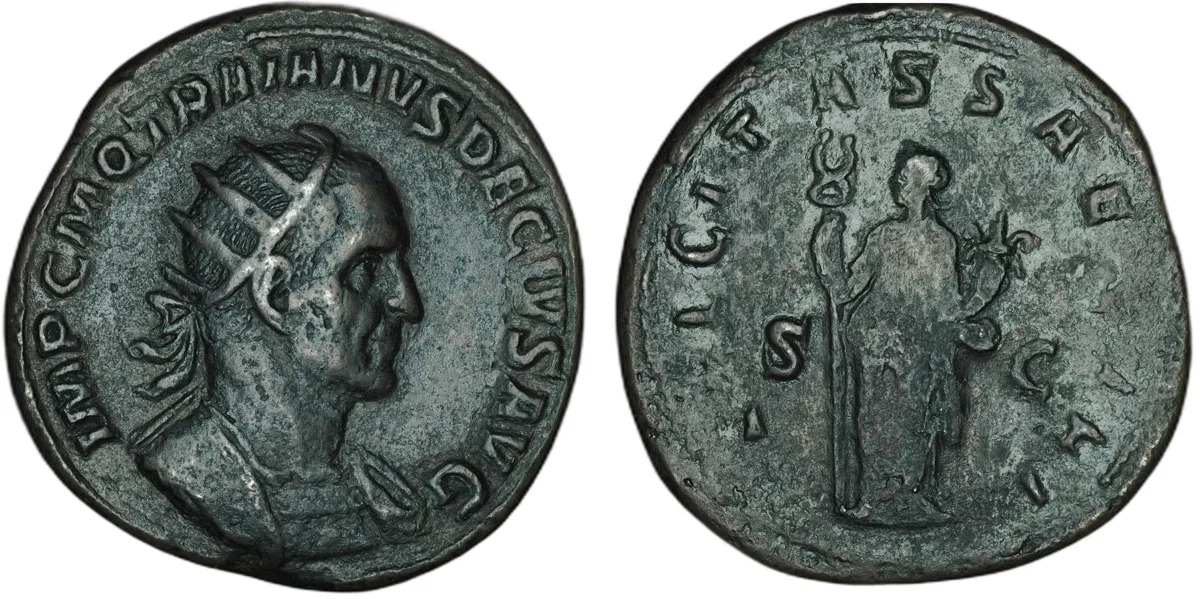
Trajan Decius. AE Medallion of 2 Sestertii. Millitary issue.
Lot 511 · Consigned by NumisOne
Closed
Description
Trajan Decius, 249-251. Double Sestertius (Bronze, 37mm, 41.23g, 12h), Rome, early-mid 250. IMP C M Q TRAIANVS DECIVS AVG, radiate and cuirassed bust of Trajan Decius to right. Rev. FELICITAS SAECVLI / S - C, Felicitas standing to left, holding caduceus in her right hand and cornucopia with her left. Banti 9. Cohen 39. RIC 115a. Struck on a hefty flan with pleasant dark-green patina; striking flatness on reverse, otherwise nearly very fine. ex. R.G. collection, Brian Holland collection (Classical Numismatic Group e526, 2 November 2022, Lot 567), Pegasi Auction XXI (24 November 2009), lot 562, and from the old stock of Spink & Sons.
The reign of Trajan Decius (AD 249–251) was short but intensely turbulent, marked by both external threats and internal crises that tested the stability of the Roman Empire. Elevated by the army on the Danube and soon confirmed by the Senate, Decius styled himself deliberately in continuity with Rome’s great soldier-emperors, adopting the name Trajanus to evoke the memory of the revered conqueror of Dacia. His coinage, abundant and varied, reflects this effort to project legitimacy and a sense of renewal during a time of uncertainty.
The double sestertius itself is a coinage innovation. Originally introduced by Trajan Decius in the early 250s, the denomination was conceived as a larger fiduciary bronze issue to replace the declining sestertius. At over 40 grams and nearly 40 mm across, these massive bronzes carried strong visual impact, but their large size and thin flans made them vulnerable to striking weakness—something seen in this example’s soft reverse. Despite such flaws, these pieces remain among the most impressive bronze coins of the mid-3rd century, often cherished for their scale and artistry.
The reverse type, FELICITAS SAECVLI, proclaims the “Happiness of the Age,” with Felicitas shown holding a caduceus and cornucopia, symbols of prosperity, trade, and abundance. It is a poignant propaganda message, attempting to reassure the Roman populace of stability and divine favor in the face of a fractured empire, ongoing Gothic incursions, and the shadow of the plague that would later ravage the Roman world. In reality, Decius’ reign was consumed by military campaigns and religious tensions, most famously his empire-wide edict requiring sacrifice to the Roman gods—a policy that directly led to the first organized persecution of Christians.
From a historical perspective, coins like this double sestertius embody the contradictions of Decius’ rule: grand in design and ambition, yet minted in an era of deepening crisis. Their survival allows us to glimpse both the propaganda the emperor wished to broadcast and the material fragility of Rome’s mid-third-century economy. Today, these pieces command interest not only for their imposing fabric but also for the insight they provide into a moment when Rome stood precariously between its past glories and the instability of the age to come.