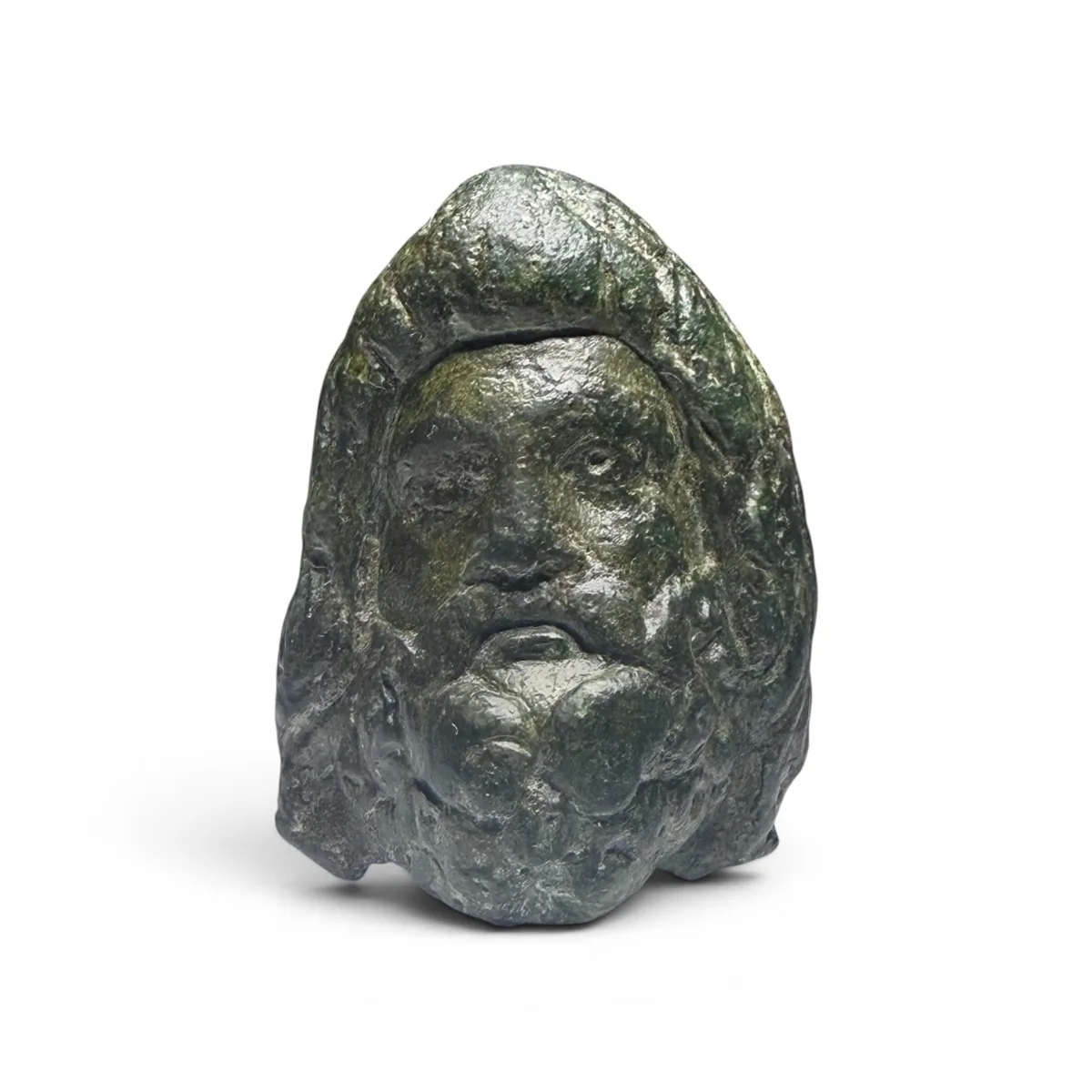
Bronze Steelyard Weight (Aequipondium) in the Form of the Bust of Asklepios.
Lot 346 · Consigned by Classiccoins.inc
Hammer price $300.00
Description
ROMAN EMPIRE. Bronze Steelyard Weight (Aequipondium) in the Form of the Bust of Asklepios. Circa 1st-2nd Century AD.
Description: A finely modeled hollow-cast bronze bust depicting Asklepios (Asclepius), the god of medicine and healing. The god is shown as a mature bearded male with centrally parted long wavy hair, full mustache and thick curled beard with two prominent locks beneath the chin. Almond-shaped eyes, heavy brow. The bust is truncated at the shoulders with a flat base allowing it to stand.
Manufactured as a counterweight for a Roman steelyard balance (statera). The interior is filled with a massive ancient lead core to adjust the piece to the official weight standard. The lead is visible at the broken suspension area on the crown and openly exposed at the base, with typical ancient lead oxide / carbonate corrosion products (off-white / brownish granular surface).
Dimensions: Height: 40 mm (4.0 cm). Weight: 144 grams.
Weight Standard: Approximately 5 unciae. 1 Roman uncia = ca. 27.3g, 5 unciae = 136.5g, plus patina and encrustation. This small module was used for precise weighing of high-value goods such as spices, medicines, and silver coinage.
Condition: Good Very Fine. Dark olive-green to blackish patina with lighter green encrustation, typical of long burial. Face remains well-detailed and easily recognizable. Original integral suspension loop at the top now missing / worn through, exposing lead core at the apex - common for this type. Bottom open, lead filling exposed and stable. No modern cleaning or repair.
Dating & Type: Roman Imperial, 1st-2nd century AD. Cf. Bolla, M., Le misure dei Romani, Verona, 2017; Allason-Jones & Miket, Catalogue of Small Finds from South Shields Roman Fort; Christie's and Bonhams examples of lead-filled bust weights.
Provenance: Ex old European private collection, acquired before 2000.
A rare small-size Asklepios weight, highly desirable for collections of ancient metrology, medicine, and Roman bronzes. An authentic, untouched example with clear evidence of ancient manufacture.
Ref: Asklepios / Aesculapius weights are the most popular deity type after Minerva and Mercury, serving both as a functional weight and as a protective, good-luck emblem for the shop