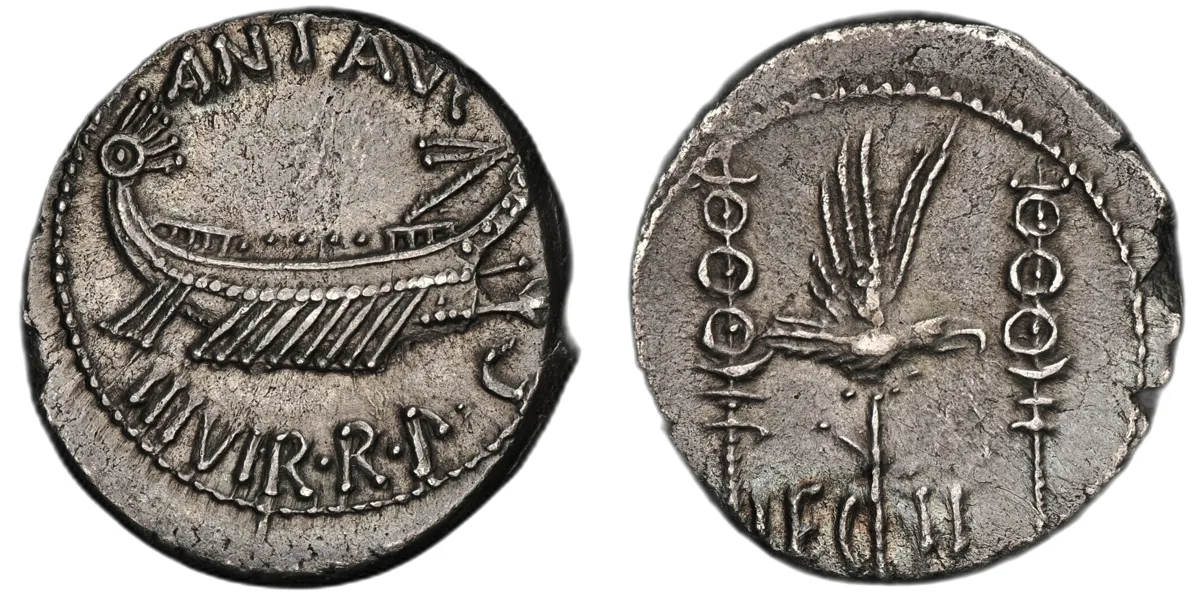
Marcus Antonius. Autumn 32-spring 31 BC. Denarius
Lot 275 · Consigned by NumisOne
Closed
Description
Marcus Antonius. Autumn 32-spring 31 BC. Denarius (Silver, 17 mm, 3.62 g). Legionary mint moving in Greece, perhaps at Aegae or Patrae. ANT AVG / III VIR R P C Praetorian galley right, with filleted scepter on prow. Rev. LEG II Legionary eagle between two standards. Crawford 544/14; Babelon Antonia 105; Sydenham 1216. Cabinet toned.
A well-toned example of Antony’s famous legionary denarii, struck on the eve of the final war against Octavian. These coins were produced in enormous quantities to pay Antony’s army and fleet in Greece, shortly before the campaign that culminated at Actium in 31 BC. Their design is direct military propaganda: the galley on the obverse refers to Antony’s naval power, while the legionary eagle and standards on the reverse identify the specific unit whose loyalty and service the issue honored.
The obverse legend expands to Antonius augur, triumvir rei publicae constituendae, “Antony, augur and triumvir for the restoration of the Republic.” That title is politically charged. By 32-31 BC, the triumviral settlement had effectively collapsed, but Antony still presented himself in constitutional language, not as a monarch or eastern dynast. The religious title augur also reinforced his legitimacy within Roman public tradition.
The reverse names Legio II, one of the legions in Antony’s eastern army. These numbered legionary issues created a powerful visual catalogue of his forces, each coin proclaiming the identity of a military unit at a moment when loyalty was decisive. After Actium, many of these denarii continued to circulate for decades, often becoming heavily worn. A cabinet-toned example with clear galley, standards, and legion number remains desirable, even though the type itself is common, because it is one of the most historically recognizable coinages of the Roman civil wars.