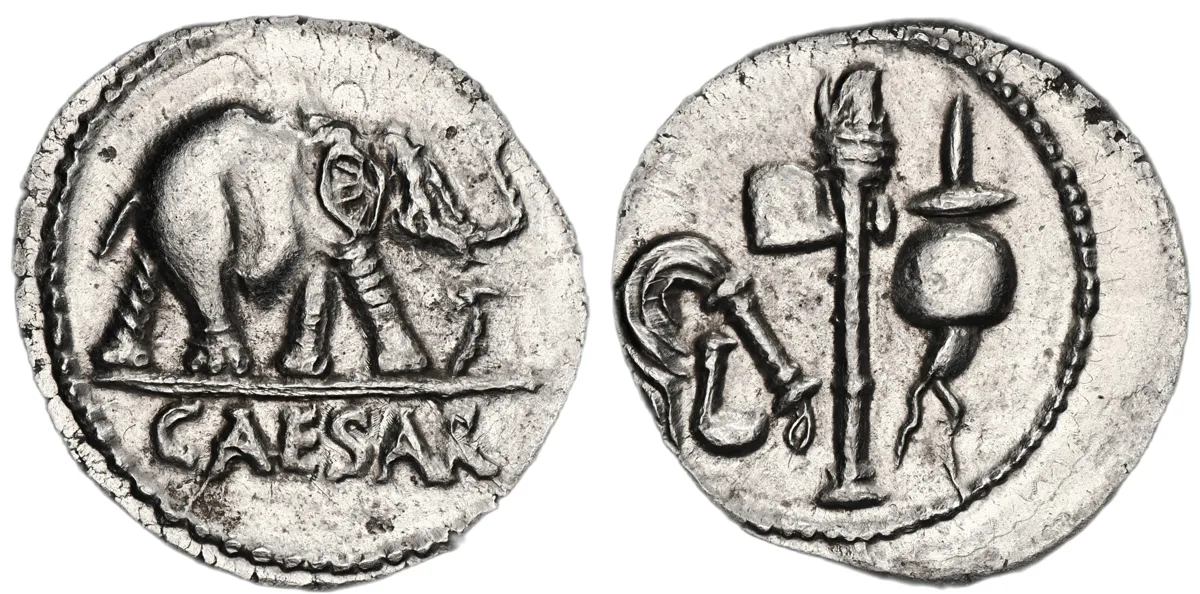
C. Julius Caesar. April-August 49 BC. Denarius
Lot 265 · Consigned by NumisOne
Closed
Description
C. Julius Caesar. April-August 49 BC. Denarius (Silver, 18.37 mm, 3.84 g). Military mint moving with Caesar in Gaul or Spain. CAESAR Elephant advancing right, trampling serpent or dragon. Rev. Pontifical implements: simpulum, aspergillum, axe surmounted by wolf’s head, and apex. Crawford 443/1; Babelon Julia 9; Sydenham 1006; BMC Gaul 27-30. Nicely toned. An attractive example of Caesar’s first major military denarius, struck at the opening of the Civil War after his crossing of the Rubicon in January 49 BC. The issue was produced by a mobile military mint to finance Caesar’s armies as he moved rapidly through Italy, Gaul, and Spain against the Pompeian forces. Its scale of production was enormous, but its message was unusually personal: the obverse gives only CAESAR, without office or magistrate, presenting his name itself as the authority behind the coinage. The reverse emphasizes Caesar’s religious office as pontifex maximus, which he had held since 63 BC. The sacrificial implements frame him not merely as a general in revolt, but as Rome’s chief priest, a man acting under the sanction of Roman tradition and divine order. This was especially important in 49 BC, when both sides claimed to be defending the Republic. The elephant type has been much debated. It may allude to Caesar’s name through an ancient etymology connecting caesar with an elephant, or it may symbolize overwhelming force crushing an enemy represented by the serpent or dragon. Either reading is useful to Caesar’s propaganda: the coin turns a civil-war emergency issue into a statement of legitimacy, victory, and personal command. Although common as a type, well-preserved examples with good centering, full reverse implements, and pleasing tone remain highly desirable.