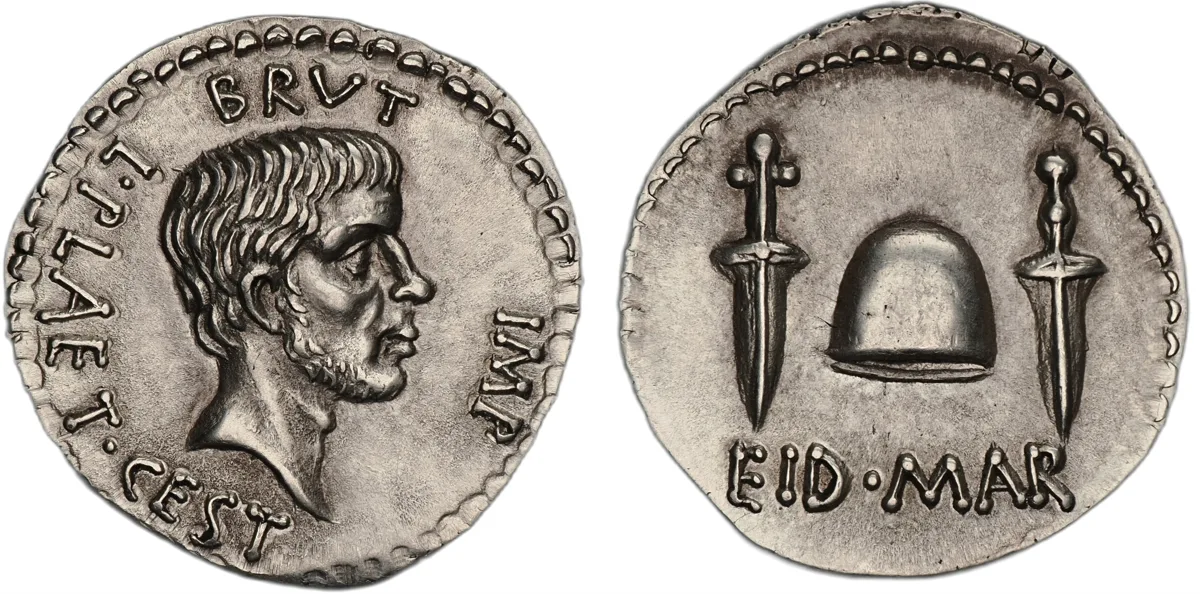
Marcus Junius Brutus and L. Plaetorius Cestianus. Transfer-die replica denarius
Lot 270 · Consigned by NumisOne
Closed
Description
Marcus Junius Brutus and L. Plaetorius Cestianus. Transfer-die replica denarius, after an issue of Northern Greece, 43-42 BC. AR 19 mm, 3.82 g. BRVT IMP L·PLAET·CEST Bare head of Brutus right. Rev. EID·MAR Pileus between two daggers. Babelon Junia 52 and Plaetoria 13; Crawford 508/3; Sydenham 1301; Sear Imperators 216; Cahn, “EIDibus MARtiis,” QT 18, 1989, 11b; Campana, Eidibus Martiis, 37; Kent-Hirmer pl. 27, 98; RBW –. An exact transfer-die replica of the most celebrated of all Roman Republican coin types. The piece preserves the full visual force of the original issue, with a finely rendered portrait of Brutus, excellent metal, a broad flan, and a sharp, well-centered strike. No coin of antiquity is more directly tied to a single political act than the EID MAR denarius. Its reverse names the Ides of March and places the pileus, the cap of liberty, between two daggers, transforming the assassination of Julius Caesar into a concise Republican manifesto. The type was so pointed and so unusual that it attracted comment even in antiquity, most notably from Cassius Dio, who recognized the extraordinary nature of a coin openly commemorating a murder as an act of liberation. The imagery is deliberately simple. The daggers refer to the weapons used against Caesar, but also to the two principal leaders of the anti-Caesarian cause, Brutus and Cassius. The pileus proclaims the professed aim of the conspirators: the liberation of the Roman people from tyranny. By reducing the event to date, weapons, and symbol, the reverse presents the assassination not as a crime, but as a constitutional restoration. The obverse is scarcely less important. Brutus appears named as imperator, an exceptional title for a man who claimed to be defending the Republic from autocracy. Secure portraits of Brutus are rare, and the inscribed coin portraits remain the principal basis for identifying his likeness in other media. The EID MAR denarii of Plaetorius Cestianus, together with the aurei of Casca and Costa, form the core evidence for Brutus’ portraiture. The style of the portrait has been the subject of considerable study. Nodelman distinguished the Brutus portraits into several artistic modes, describing the Plaetorius Cestianus denarii as the most sober and precise of the group. Unlike the more elevated or idealized versions on certain aurei, the EID MAR portrait tends toward a restrained realism, likely derived from a sculptural prototype and adapted into a compact, highly legible numismatic image. Although the present piece is a transfer-die replica rather than an ancient striking, it reproduces one of the most historically charged types ever produced: a coin on which Brutus publicly justified Caesar’s assassination and claimed the language of liberty for the Republican cause.