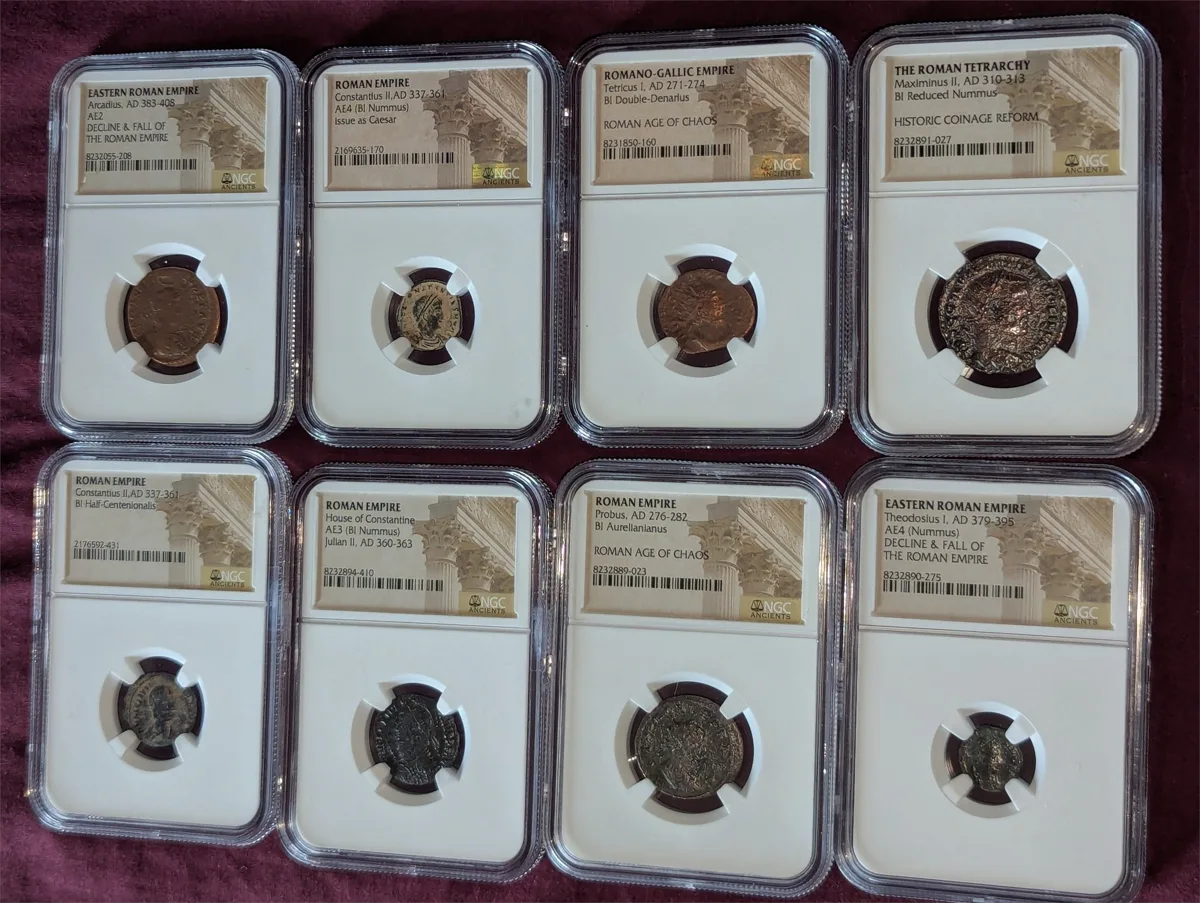
Lot of 8 NGC certified Roman Imperial AD 271-408
Lot 728 · Consigned by Corona55
Hammer price $359.00
Description
For sale are eight NGC-certified ancient Roman bronze coins (primarily AE or billon nummi and related denominations). These specimens span the late 3rd to early 5th centuries AD and illustrate key periods of Roman imperial coinage, including the reforms of Diocletian, the Constantinian era, the Tetrarchy, and the subsequent decline of the Western and Eastern Roman Empires.
The coins are categorized as follows based on their NGC slab labels and historical context:
Constantius II (AD 337-361): Two examples —one a billon AE3/4 nummus from the House of Constantine series (often featuring military or religious reverse types) and another referenced in the Constantinian context. These are mid-4th-century bronzes struck during the rule of Constantine the Great's sons, typically depicting diademed busts and reverse motifs such as soldiers, standards, or Victory figures.
Arcadius (AD 383-408): One AE4 nummus from the Eastern Roman Empire, representing the late 4th/early 5th-century "decline and fall" phase, with small-module designs common in the Theodosian period (often showing crosses, wreaths, or simple imperial portraits).
Julian II (AD 360-363): One AE3/4 nummus from the House of Constantine (as Augustus), issued during the brief pagan revival under "the Apostate." These coins frequently feature helmeted or bearded portraits and reverses emphasizing military virtue or pagan symbolism.
Probus (AD 276-282): One billon antoninianus (double denarius) from the Roman Age of Chaos (Crisis of the Third Century), characterized by radiate-crowned portraits and reverses often depicting the emperor with military or solar deities. Probus's issues helped stabilize the empire prior to Diocletian's reforms.
Roman Age of Chaos (Probus or related, AD 276-282): Another specimen, likely an antoninianus or early nummus, reflecting the turbulent period of rapid imperial turnover and debasement.
Romano-Gallic Empire (AD 271-274): One double denarius (antoninianus) from the breakaway Gallic Empire (Tetricus I or similar), featuring local mint issues with radiate crowns and reverses focused on victory or piety.
Eastern Roman Empire – Theodosius I (AD 379-395): One AE4 nummus marking the decline and fall of the Western Empire, with small bronzes typical of late 4th-century Eastern issues (often minimalistic designs amid economic contraction).
Roman Tetrarchy – Maximianus (AD 286-310, as Augustus or in reduced form): One reduced nummus or historic coinage reform issue from the First Tetrarchy (Diocletian and Maximian), part of the major monetary overhaul that introduced the large follis/nummus with Genius reverse types. This represents the transition from the Crisis of the Third Century to stabilized (though debased) bronze coinage.
Thanks for looking!