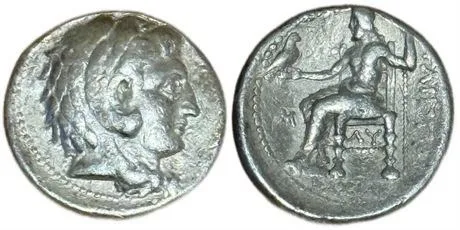
Babylonian Diadochi (Archon, Dokimos, or Selukos I?) Alexander III the Great AR
Lot 176 · Consigned by hzaa3100
Closed
Description
This posthumous tetradrachm is a product of the chaos that ensued after Alexander's death. His empire, the fruit of his labor, was broken apart into pieces. From Anatolia, to Egypt, to Bactria, Alexander's generals all took a piece of his lands and formed their own dynasties. Thus began the Hellenistic era.
This coin can be attributed to three different diadochi, or the rival generals/companions of Alexander. The first two contenders, Archon and Dokimos, are the most obscure figures. Archon was appointed as satrap of Babylonia directly after Alexander's death. What we do know of him is from a limestone memorial in Delphi that was discovered in 1938 (Link). He was an athlete, having won horse races in the Isthmian and Pythian Games. He also oversaw the naval transport in the Battle of the Hydaspes, (fought in modern-day Jhelum, Pakistan) against Porus. Archon was killed by the forces of Dokimos, our next contender.
Dokimos, on the other hand, was intially aligned with the Macedonian command structure in Asia. Dokimos then killed Archon and seized control of Babylonia, but his hold on the region proved ultimately short-lived. During the settlement of the empire at the Partition of Triparadisus, Dokimos was reassigned to govern parts of Asia Minor, likely in Phrygia. There, he became entangled in the power struggle between Antigonus I Monophthalmus and his rivals. Dokimos ultimately sided against Antigonus, a decision that led to his defeat and capture.
Our last option, Seleucus I Nicator emerged as one of the most successful of the diadochi. Initially serving as a general under Alexander the Great, Seleucus was appointed satrap of Babylonia but was briefly driven out during the early struggles among Alexander’s successors. He later reclaimed the region in 312 BCE, an event often taken as the foundation of the Seleucid Empire. His progeny ruled much of the eastern territories, from Mesopotamia to parts of Iran and beyond for over 3 centuries!
These coins are so handsome. Note the young Heracles, wearing his headdress of the lion's mane. The reverse depicts his father, the mighty Zeus Aëtophoros. Aëtophoros, or "eagle-bearer," is a term used for this version of Zeus that appeared in these tetradrachms. The eagle that Zeus is carrying represents his role as the messenger of victory.