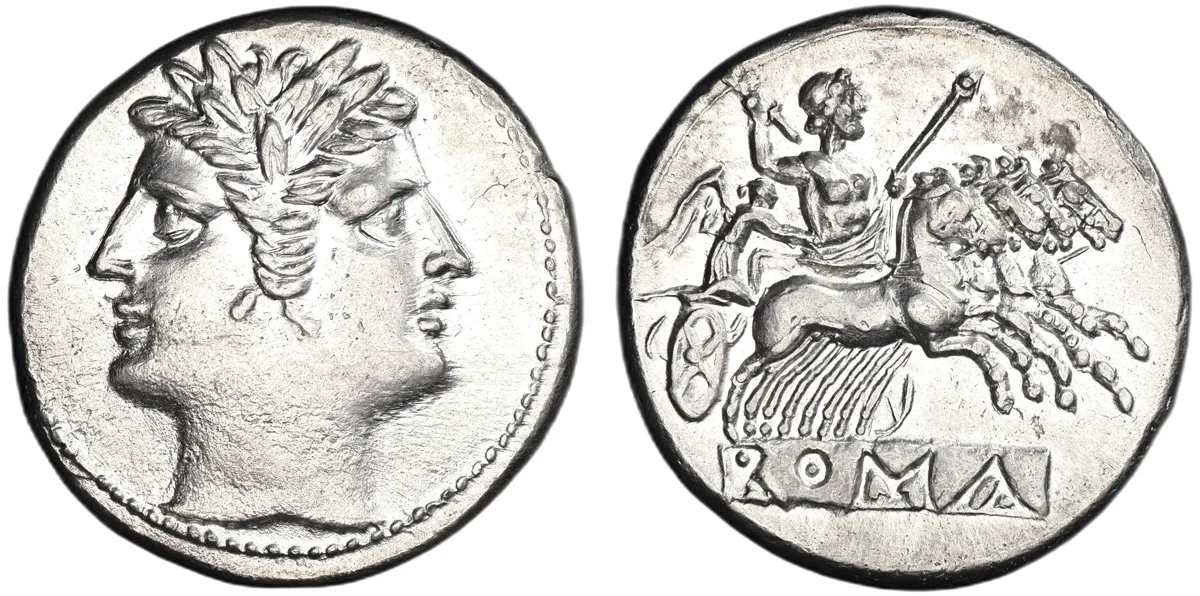
Rome. Anonymous. Circa 225–214 BC. AR Quadrigatus
Lot 309 · Consigned by GreatCoinsUSA
Closed
Description
Rome. Anonymous. Circa 225–214 BC. AR Quadrigatus (Didrachm) (21 mm, 6.69 g, 6 h). Uncertain mint. Obv. Laureate head of Janus. Rev. ROMA (incuse on raised tablet), Jupiter driving a fast quadriga right, hurling thunderbolt with his right hand and holding sceptre in his left; Victory standing beside him as charioteer. Crawford 30/1; Sydenham 64b. Good extremely fine. Provenance: From the collection of Dr. Günter Olf; ex Bertolami E-Auction 92 (2 October 2020), lot 594.
This quadrigatus belongs to the earliest phase of Rome’s heavy silver coinage, struck during the decades surrounding the outbreak of the Second Punic War. The denomination, conventionally termed a didrachm, reflects strong Greek influence in both weight standard and iconography, particularly in southern Italy and Sicily, where Roman silver was intended to circulate alongside Greek issues. The obverse head of Janus, shown laureate and bifrons, is among the most distinctive and enduring images of early Roman coinage. Janus, a deity associated with beginnings, transitions, and guardianship, was particularly appropriate for a period marked by military crisis and territorial expansion. The reverse presents Jupiter in a quadriga, accompanied by Victory, a type derived from Hellenistic models but adapted to Roman religious and political ideology. The incuse ROMA on a raised tablet serves as an emphatic assertion of civic authority and identity at a time when Rome was consolidating its power in the western Mediterranean. Quadrigati were produced in substantial numbers and formed the backbone of Roman silver currency until the introduction of the denarius system in the late third century BC. Despite surface disturbances from cleaning, this example preserves strong detail and illustrates clearly the types and fabric characteristic of Rome’s earliest large scale silver issues.