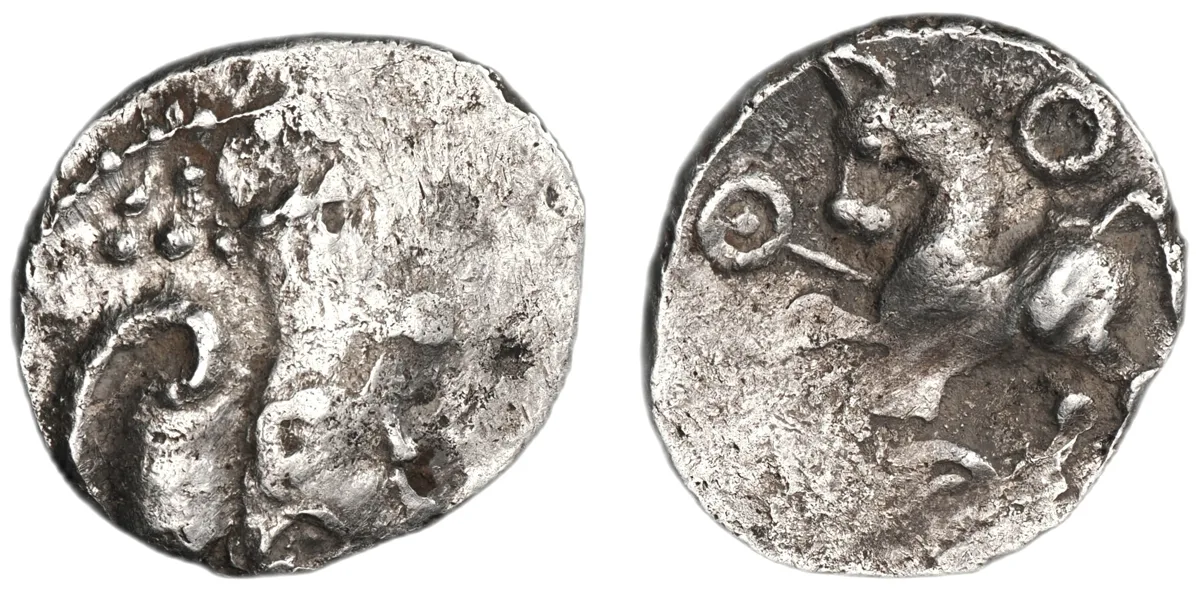
Gaul, Sequani. AR Denarius. Circa 27 BC–AD 14.
Lot 008 · Consigned by hhf
Closed
Description
Gaul, Sequani. AR Denarius. Circa 27 BC–AD 14. Obv. Celticized head of Roma left, wearing crested helmet; garbled legend SEQVANOIOTVOS around. Rev. Horse galloping left. 18 mm. LT 5351; DT 3243; ABT 419; RIG 260. Light grey tone with scattered darker highlights. Broad flan, well centered. Very fine. Issued by the Sequani, a prominent Gallic tribe occupying the upper valley of the Doubs River near Vesontio (modern Besançon), this denarius represents one of the final expressions of native Celtic coinage before complete monetary Romanization. Though superficially imitative of the Roman denarius standard, the type retains strong regional character through its bold linear engraving and simplified forms. The obverse, featuring a stylized head of Roma, is a distinctly Celtic reinterpretation of Roman prototypes, rendered with geometric abstraction and characteristic disregard for strict realism. The reverse, showing a horse galloping left, is a long-lived Celtic symbol of vitality and martial prowess, commonly associated with tribal aristocracy and the elite cavalry culture of eastern Gaul. Struck during the transitional period following Caesar’s conquest of Gaul and prior to the full integration of the region into the Roman Empire, these denarii served both as instruments of local commerce and as a means of expressing cultural autonomy. Their circulation across Sequanian territory and into neighboring regions underscores the complex economic and artistic exchange between the Gallic tribes and the advancing Roman state. A historically important and evocative issue, standing at the intersection of indigenous Celtic artistry and the expanding monetary system of Rome.