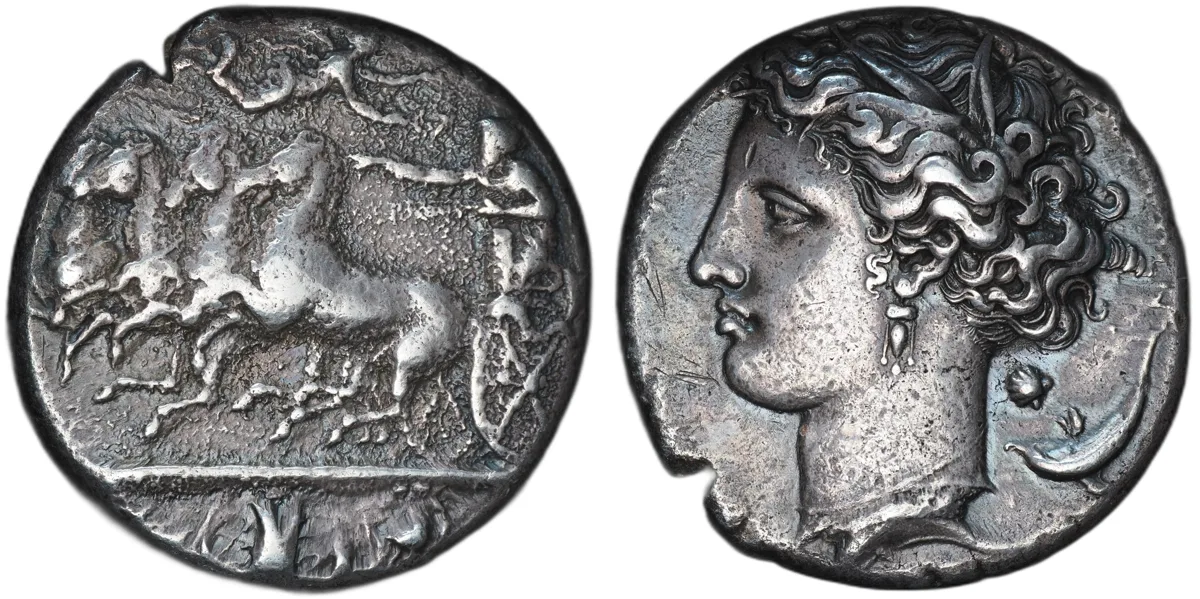
Sicily, Syracuse. Euainetos Decadrachm. Circa 400 BC.
Lot 023 · Consigned by GreatCoinsUSA
Closed
Description
Sicily, Syracuse. Decadrachm. Circa 400 BC. Unsigned dies by the engraver Euainetos. Obv. ΣΥΡΑΚΟΣΙΩΝ, quadriga galloping left, the charioteer holding reins and kentron; above, Nike flies right to crown the driver; in exergue, panoply consisting of cuirass, greaves, shield, and helmet. Rev. Head of Arethusa left, wearing earring and necklace, her hair crowned with a wreath of grain leaves; four dolphins swim around, a shell behind the neck. 42.88 g. Gallatin O.VIII–R.F.I; SNG Copenhagen 692 var.; Dewing 907 ff. Obverse struck from a lightly rusted die, reverse of high relief with minor marks. Attractive tone. Very rare.
From the duplicate collection of the Museum of Fine Arts, Boston (inv. 1984.807), donated by Cornelius C. Vermeule III on 19 December 1984. Gemini VI, 10-01-2010, Lot 795. This coin originates from the duplicate collection of the Museum of Fine Arts, Boston (inventory no. 1984.807), a piece once belonging to the distinguished curator and numismatist Cornelius C. Vermeule III, who donated it to the museum on 19 December 1984. Vermeule, a central figure in twentieth-century classical scholarship and a connoisseur of ancient art, was instrumental in building the MFA’s world-class holdings of Greek and Roman coins. The specimen later appeared in the sale of Gemini VI (New York, 10 January 2010), lot 795, where it was recognized for both its scholarly provenance and its artistic importance. Its passage from a major institutional collection into the numismatic market marks it as a coin of particular historical and academic interest, embodying the rigorous standards of acquisition and connoisseurship that characterized Vermeule’s curatorial legacy.
Among the most celebrated coin types of the ancient world, the Syracusan decadrachms engraved by Euainetos and his circle represent the highest refinement of classical numismatic art. Struck shortly after the defeat of the Carthaginians at Himera and the political consolidation of Syracuse under Dionysios I, these magnificent issues commemorate both military triumph and civic prosperity. The obverse, with its racing quadriga and crowning Nike, symbolizes victory and divine favor. The careful rendering of the horses in full gallop, the delicately poised charioteer, and the balanced rhythm of the composition attest to the technical mastery of the engraver. The panoply in the exergue alludes to the military valor of Syracuse, while the dynamic upward movement of the scene evokes the tension and exhilaration of the games that celebrated the city’s success. The reverse portrait, one of the most influential images of Greek art, depicts the nymph Arethusa—or possibly Persephone, as suggested by the grain wreath—surrounded by four dolphins representing the sea that frames her myth. The soft modeling of her face, the complex arrangement of hair, and the interplay of ideal beauty with human realism mark the transition from the classical to the early Hellenistic aesthetic. No ancient coinage exerted a more enduring influence on later art and medallic design than the Syracusan decadrachms of Euainetos. Their composition inspired numerous imitations in Sicily, Magna Graecia, and even among Carthaginian engravers, whose own coin portraits of goddesses echo the serene power of this masterpiece. A coin of outstanding historical and artistic importance, combining technical brilliance, mythological depth, and political symbolism. The decadrachms of Euainetos stand as enduring monuments to the cultural supremacy of Syracuse at the height of the Greek classical age.