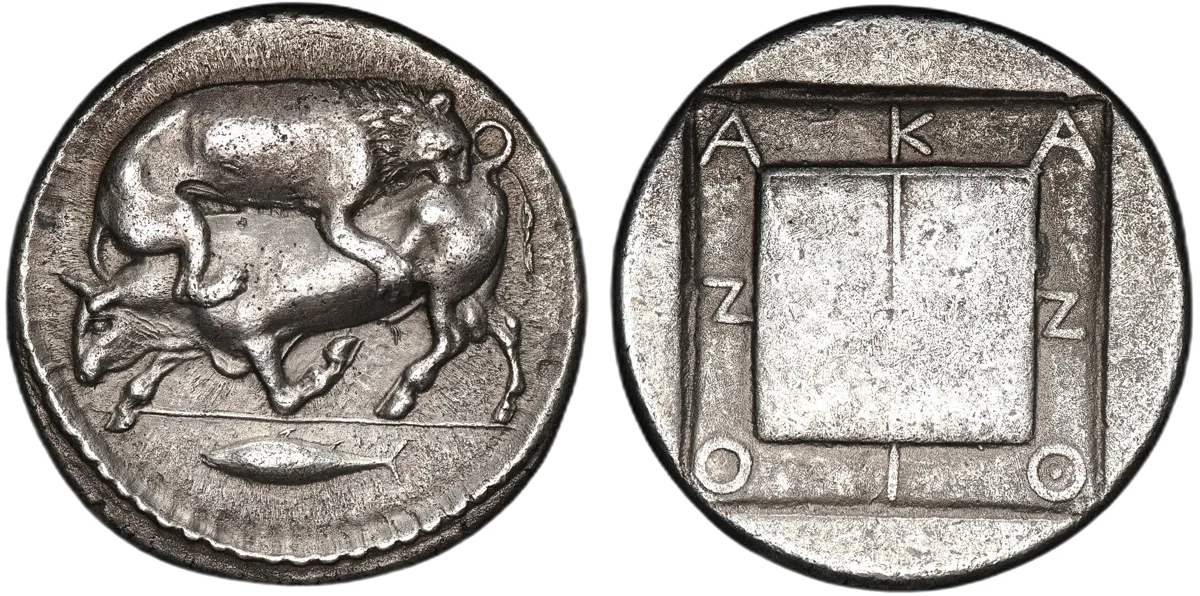
Macedonia, Akanthos. Tetradrachm. Circa 470–430 BC.
Lot 034 · Consigned by GreatCoinsUSA
Closed
Description
Macedonia, Akanthos. Tetradrachm. Circa 470–430 BC. Obv. Lioness attacking a bull kneeling left, grasping him by the back; in exergue, fish swimming left. Rev. ΑΚΑΝΘΙΟΝ, within quadripartite incuse square formed by raised cross. 16.83 g. Desneux –; AMNG –; SNG ANS –; HGC 3, 385. Compare to Numismatica Ars Classica Auction 92, Lot 149. Ex Leu Numismatik 7 (2020), lot 1161.
The vigorous scene of a lioness attacking a bull is one of the most dynamic and enduring images of the archaic and early classical coinage of northern Greece. Its origins lie in the ancient art of the Near East, where similar compositions appear on cylinder seals and reliefs from the third millennium BC. Transmitted through centuries of artistic exchange, the motif came to symbolize the primal struggle of strength and vitality, embodying both natural ferocity and divine power. At Akanthos, this image became the city’s defining emblem. The rendering is bold and sculptural, the lioness crouched low as she brings down her prey, the muscular bull collapsing under her assault. The addition of the small fish in the exergue, a recurring local symbol, may allude to the city’s coastal situation on the Strymonian Gulf and its maritime prosperity. The reverse design, a quadripartite incuse square divided by raised lines, preserves the archaic minting tradition that persisted in northern Greece into the fifth century BC. Its geometric simplicity contrasts strikingly with the naturalism of the obverse, illustrating the artistic transition from the archaic to the classical style. Animal combat scenes of this type were particularly favored across the Chalkidike, appearing also on the coinage of nearby Stageira, where the lion’s role is sometimes replaced by a boar. These shared motifs reflect both regional artistic identity and a wider cultural fascination with the representation of strength, struggle, and divine order in nature. A piece of remarkable sculptural quality and fine preservation, representing one of the most iconic and symbolically rich coin types of early classical Macedonia.