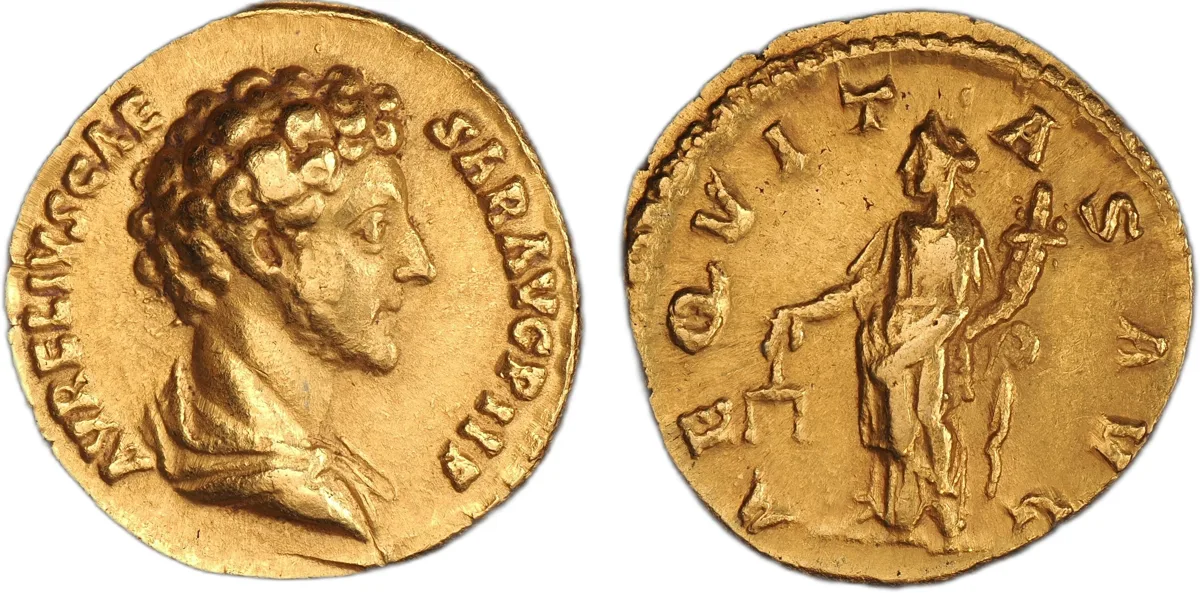
Marcus Aurelius, as Caesar, 161-180, Aureus
Lot 376 · Consigned by hhf
Closed
Description
Marcus Aurelius (as Caesar). Aureus. Rome, under Antoninus Pius, AD 148–149.
Obv. AVRELIVS CAESAR AVG PII F, bare head of Marcus Aurelius right.
Rev. AEQVITAS AVG, Aequitas standing left, holding scales and cornucopia.
7.21 g. 19 mm. Struck at Rome. Unpublished and apparently unique.
A superb and entirely unpublished aureus of Marcus Aurelius as Caesar, struck at Rome during the reign of Antoninus Pius, at the height of the empire’s stability and administrative refinement. The obverse die, displaying the distinctive flat truncation of the shoulder and finely engraved portrait, is consistent with the TR POT III issue of AD 148–149, a period when the young heir’s image was frequently updated to reflect his increasing maturity and prominence in public life. The delicate modeling of the features, the sharply defined hair curls, and the classical proportions of the legend all point to the masterful workmanship characteristic of Rome’s finest engravers of the Antonine period.
The reverse type, AEQVITAS AVG, is of particular iconographic significance. Aequitas, holding scales and cornucopia, personifies moral and fiscal balance, the equitable administration of justice and the fair distribution of wealth and resources across the provinces. The theme is fully consonant with the values cultivated under Antoninus Pius and with Marcus’s own emerging reputation as a philosophic prince committed to moderation, virtue, and rational governance. Its presence on a gold issue of the Caesar reflects the ideological continuity between emperor and heir, projecting an image of harmony and shared purpose within the ruling house.
The ideological pairing of AVRELIVS CAESAR AVG PII F and AEQVITAS AVG is appropriate for a donative or special ceremonial issue, particularly one celebrating the stability of the Antonine succession or the Caesar’s assumption of new public duties. It is precisely within such limited, high-level contexts that exceptional reverse types appear on the gold coinage, intended less for mass circulation than for presentation to members of the Senate, military officers, or distinguished provincial administrators.
An extraordinary survival of the Antonine age, this aureus unites technical perfection, refined artistry, and profound symbolic resonance. It embodies the high ideals of the Antonine court—justice, balance, and continuity—and stands as an important addition to the corpus of Roman imperial gold coinage.