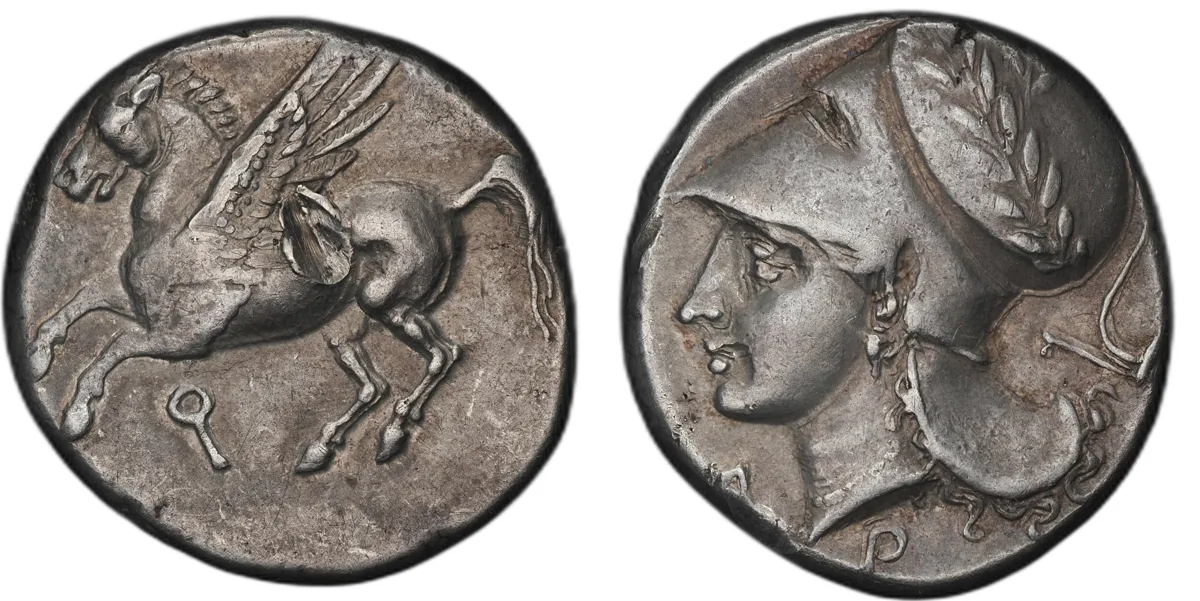
Corinthia. Corinth. Circa 375–300 BC. AR Stater
Lot 086 · Consigned by NumisOne
Closed
Description
Corinthia. Corinth. Circa 375–300 BC. AR Stater (21 mm, 8.63 g, 1 h).
Obv. Pegasos flying left; below, Ϙ (koppa), the archaic civic badge of Corinth.
Rev. Head of Athena left, wearing laureate Corinthian helmet; below chin and neck truncation, A–P; behind neck-guard, plough.
Refs. BCD Corinth 107; Calciati Pegasi 439–441; HGC 4, 1848; Ravel 1021–1024.
A classic Pegasos–Athena stater of Corinth, struck on the city’s widely accepted trade standard in the later 4th century BC. The winged horse, paired with the archaic koppa beneath, served as an unmistakable guarantee of Corinthian silver across Aegean and Adriatic markets. On the reverse, Athena appears in a particularly attractive variant: a laureate Corinthian helmet, an elegant flourish within the otherwise conservative type, signalling both martial prowess and divine favour.
The control system on this issue is especially instructive. The A–P beneath the bust (a magistrate/issue pairing) together with the plough behind the neck-guard precisely locates the coin within the long series catalogued by Ravel and Calciati. The plough—an emblem with deep resonance in Corinth’s agrarian hinterland—adds a civic note to a coinage otherwise calibrated for international exchange. Such rotating letters and symbols allowed the authorities to track emissions over decades while keeping the iconic designs constant for merchants and soldiers who relied on Corinthian staters as a de facto international currency.
Well within the main late Classical / early Hellenistic production, this stater encapsulates the formula that made Corinth’s silver so successful: instantly legible types, meticulous fabric, and neat administrative marks for die-study. A desirable entry for a Pegasos cabinet, combining the laureate helmet variety with the clear A–P / plough controls and the proud Ϙ signature of the mother-city.