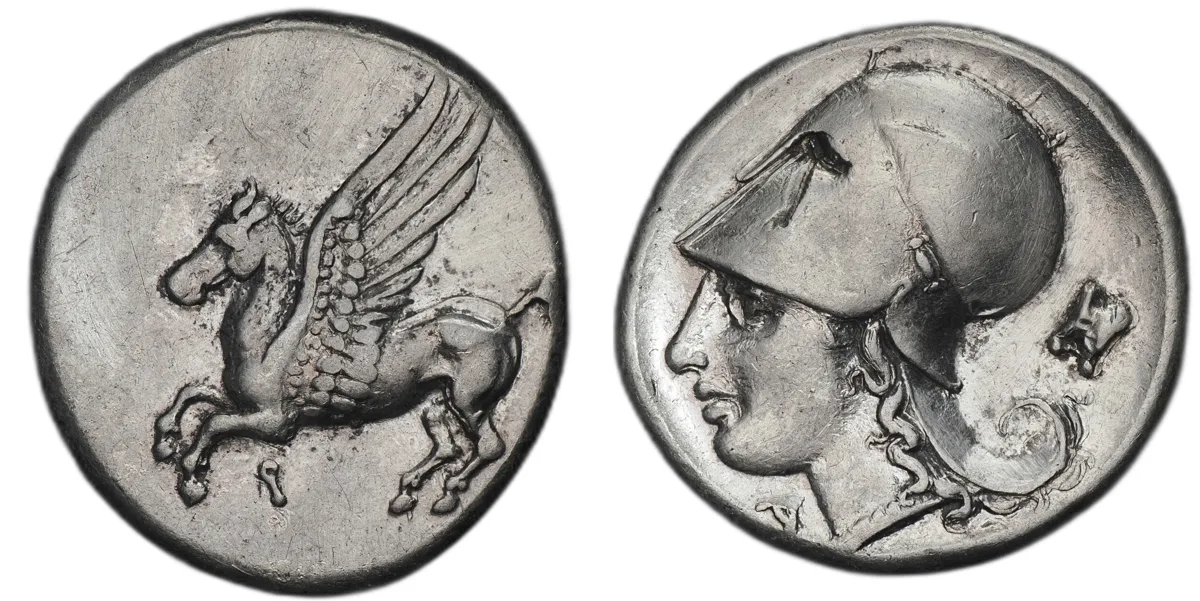
Corinthia. Corinth. Circa 375–300 BC. AR Stater
Lot 085 · Consigned by NumisOne
Closed
Description
Corinthia. Corinth. Circa 375–300 BC. AR Stater (21 mm, 8.57 g, 9 h).
Obv. Pegasos flying left; below, Ϙ (koppa).
Rev. Head of Athena left, wearing crested Corinthian helmet; below chin, A; behind neck-guard, astragalos (knucklebone).
Refs. Calciati Pegasi 400; Ravel 1039; BCD Corinth –.
A classic Corinthian Pegasos stater from the late Classical to early Hellenistic horizon, struck on the city’s widely recognised trade fabric. The winged horse—marked beneath by the archaic koppa (Ϙ), the old civic sign of Corinth—advertised trustworthy silver from one of the Mediterranean’s premier commercial hubs. The reverse bears the serene martial profile of Athena, her helmet crisply crested; the subsidiary controls (A beneath the chin and an astragalos behind the neck-guard) link this coin to a specific emission within the sprawling Pegasos series, the astragalos being a favoured Corinthian symbol with playful agonistic overtones.
Between about 375 and 300 BC Corinth’s staters formed a de facto international currency, circulating from the Aegean to the Adriatic and into Magna Graecia. Their conservative iconography ensured instant recognition in markets and ports, while the rotating control marks allowed local authorities to track issues and magistracies across a long-running programme. This example neatly encapsulates the blend of pan-Hellenic types (Pegasos and Athena) with Corinth’s own epigraphic signature (Ϙ), producing a coin that is at once familiar to traders and firmly rooted in its civic origin.