KINGS OF PONTOS. Mithradates VI Eupator
Lot 119 · Consigned by NumisOne
Closed
Description
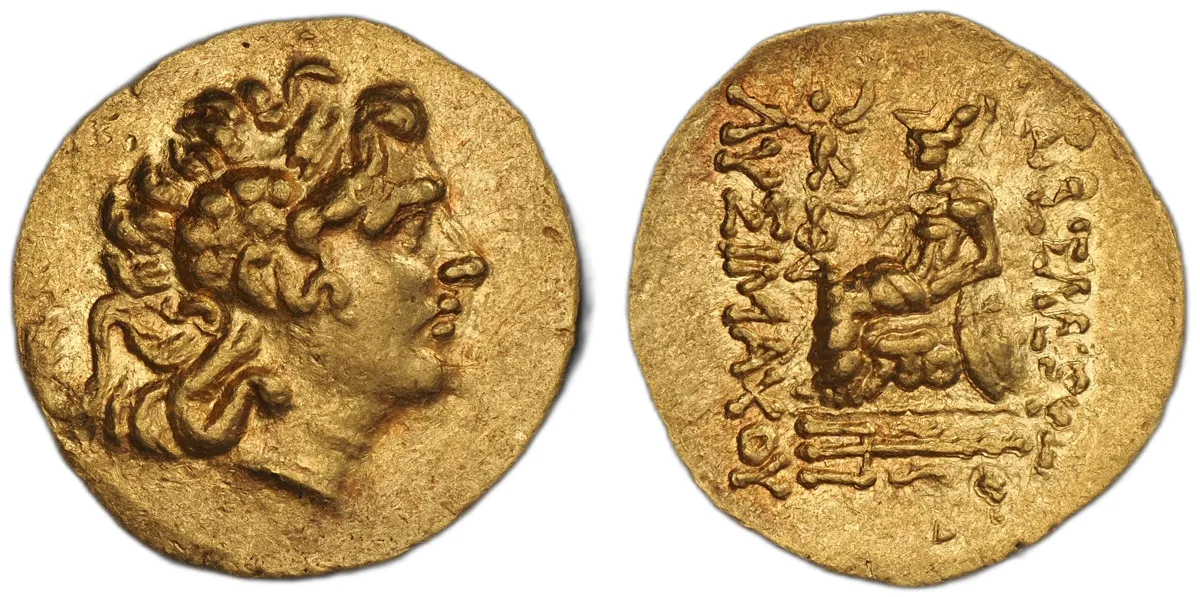
KINGS OF PONTOS. Mithradates VI Eupator, circa 120–63 BC. AV Stater (20 mm, 8.20 g, 12 h). Tomis, circa 88–86 BC.
Obv. Diademed head of Alexander the Great to right, with the horn of Ammon over his ear.
Rev. ΒΑΣΙΛΕΩΣ ΛΥΣΙΜΑΧΟΥ. Athena Nikephoros seated left, holding Nike in her right hand, crowning the king’s name, and resting her left arm on a shield; transverse spear behind; in inner left field, monogram; beneath throne, TO; in exergue, ornate trident left.
Refs. AMNG 2485; De Callataÿ p. 142, D7/R1; SNG Tübingen 203 (same dies).
Struck during the First Mithradatic War (88–86 BC), this handsome gold stater belongs to Mithradates VI’s extraordinary revival of Hellenistic royal types, issued at the coastal mint of Tomis on the western Black Sea. Though bearing the name of Lysimachos of Thrace, these coins were struck under Mithradates’ direct authority, consciously evoking the golden age of Alexander and his successors. Their imagery—particularly the divine head of Alexander with the horn of Ammon—served as a deliberate statement of legitimacy and continuity: the Pontic king presenting himself not as a barbarian potentate, but as the rightful heir to Alexander’s universal empire.
The obverse portrait, one of the finest survivals of this late classical ideal, blends the serene strength of Alexander’s deified likeness with the subtle realism typical of Mithradatic issues. Its deep cutting and confident modelling suggest the hand of an engraver trained in the Greek tradition of Asia Minor, perhaps influenced by Lysimachean prototypes from the mints of Thrace or Pergamon. On the reverse, Athena Nikephoros—the protectress of kingship and civilisation—extends a miniature Victory toward the name of Basileus Lysimachou, an ancient echo of divine sanction repurposed to legitimise Mithradates’ rule during his war against Rome.
The monogram and trident below the throne identify Tomis as the place of striking, a strategic Pontic outpost controlling trade and communications along the western Euxine littoral. Here Mithradates’ forces minted quantities of gold and silver coinage to pay troops, secure allegiance, and advertise Pontic authority across the Black Sea basin. Despite being a “pseudo-Lysimachean” issue, the artistry of this piece rises well above most contemporaries—its style crisp, its devices fully struck, and its surface radiant with the distinctive brilliance of Pontic gold.
More than a simple imitative coin, the stater stands as a manifesto in metal: a declaration that the line of Alexander had not perished with the Diadochi, but endured in the east through Mithradates Eupator, basileus megistos, “the Great King.”
Condition: Well struck and of unusually fine style for the issue, with lustrous surfaces and light traces of die polish. Extremely Fine.