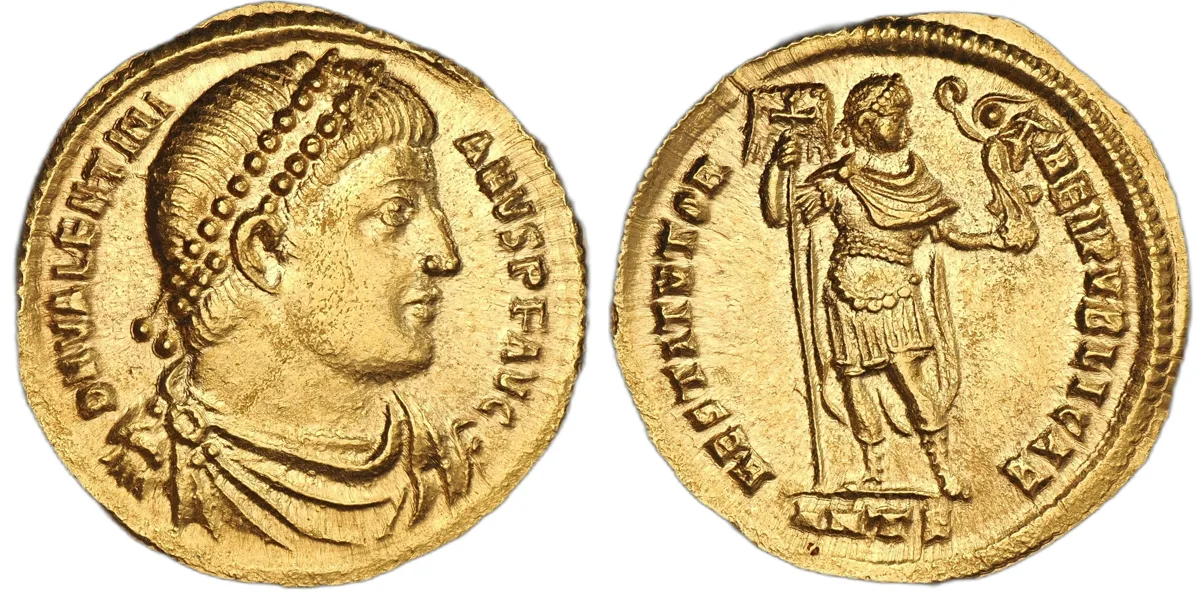
Valentinian I, AD 364–375. AV Solidus
Lot 599 · Consigned by NumisOne
Closed
Description
Valentinian I, AD 364–375. AV Solidus (22 mm, 4.47 g, 12 h). Antioch mint, AD 367. Obv. D N VALENTINI-ANVS P F AVG. Pearl-diademed, draped, and cuirassed bust of Valentinian I right. Rev. RESTITVTOR REI PVBLICAE. Valentinian standing facing, head right, in military dress, holding labarum surmounted by a cross in his right hand and Victory on globe in his left; in exergue, ANTB. Refs. Depeyrot 30/1; RIC IX Antioch 2(a).i.2.
Struck at Antioch in AD 367, this handsome solidus reflects the confident early years of the reign of Valentinian I, founder of the Valentinian dynasty and one of the last emperors to embody the traditional Roman ideal of the soldier-ruler. The obverse shows a sharply modelled and expressive portrait, the emperor’s gaze firm and commanding beneath the pearl diadem, his military cloak and armour rendered with precision. The image projects the strength, dignity, and stoic discipline that defined Valentinian’s public persona. The reverse legend, Restitutor Rei Publicae (“Restorer of the Republic”), evokes a central theme of Valentinian’s propaganda: the restoration of order and moral authority following the turbulence of the mid-fourth century. The emperor appears standing, in the full splendour of martial regalia, grasping the labarum—the standard of Christian imperial victory—topped with a cross, while in his other hand he presents a Victory on globe, symbolising divine sanction and universal dominion. Together, these attributes merge the classical Roman and Christian conceptions of imperial power: earthly strength guided by divine providence. The Antioch mint, one of the great metropolitan workshops of the Late Empire, maintained an exceptionally high level of craftsmanship during this period. Coins such as this were struck from carefully engraved dies and distributed across the eastern provinces as both salary for officials and soldiers and as instruments of imperial prestige. The Restitutor Rei Publicae type appears across several eastern mints and reflects a deliberate campaign of image-making—one that cast Valentinian as both reformer and protector of the state at a time when barbarian incursions, administrative corruption, and religious division threatened imperial stability. Valentinian’s reign was marked by military vigilance on the Rhine and Danube frontiers, where he repelled Alamannic and Quadi invasions, and by his strict enforcement of imperial law. Yet beneath his stern authority lay a deep commitment to the defence of the Roman world as a moral and political order. In this light, the type’s inscription and imagery gain their fullest meaning: not merely a claim to military victory, but a promise of restoration—of empire, of justice, and of faith. Condition: Struck from slightly worn dies and with very minor porosity on the obverse, otherwise lustrous and well-centred with a finely engraved portrait. Extremely Fine.