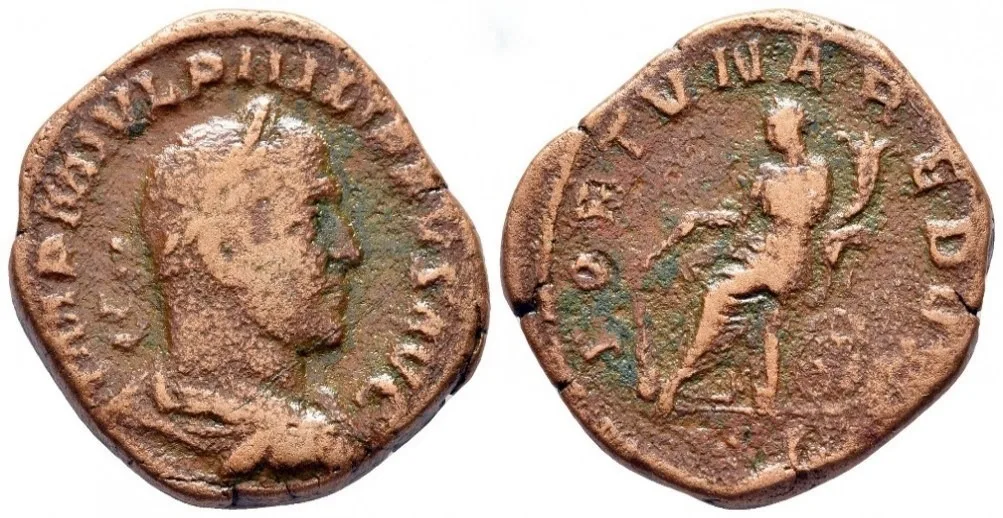
Philip I the Arab Sestertius Æ RIC IV # 174A - FORTVNA REDVX S C - A.D. 244-249
Lot 472 · Consigned by Tacitus
Closed
Description
This coin is a well-known commemorative issue struck for the Ludi Saeculares (Secular Games), celebrating the 1000th Anniversary of Rome in A.D. 248.
Philip I, known as 'The Arab' (A.D. 244-249), was an emperor from the Roman province of Arabia (modern-day Syria). His ascent to power followed the death of his predecessor, Gordian III, possibly by his own hand. Philip's reign, though short, is one of the most historically significant, marked by the celebration of the Millennium of Rome in A.D. 248.
The Significance of Fortuna Redux: The reverse type, FORTVNA REDVX (Returning Fortune), was highly propagandistic. It was struck following Philip's successful return to Rome in A.D. 244 after his peace treaty with the Sassanian Empire in the East. By featuring Fortuna Redux (the goddess who safely guides travelers on their journey and brings them home), Philip assured the Senate and the Roman people that his reign, and by extension, the good fortune of the Empire, was securely returned to the capital. This coin proclaimed stability and divine protection at the start of what was to be a massive celebration of the city's 1000th birthday.
The Sestertius in A.D. 248: By the mid-3rd century, the Sestertius was less common than the silver/billon Antoninianus, but still held symbolic importance, especially for commemorative issues like this one. Its large size allowed for impressive imperial portraits and detailed reverse scenes, such as the bold Fortuna on this piece.
A Monument to Rome's Millennium: This large, evocative Bronze Sestertius of Philip I ‘the Arab’ was struck during one of the most remarkable periods in the Empire’s history: the celebration of Rome's 1000th birthday in A.D. 248. Philip spared no expense, hosting legendary Ludi Saeculares (Secular Games) that filled the city with exotic animals and spectacle. This coin is a tangible link to those historic festivities.
Condition & Eye-Appeal: This Sestertius is presented with a fantastic dark-brown, stable patina, offering superb contrast and great tactile feel. The reverse is particularly strong and well-centered, clearly showcasing Fortuna with all her attributes. Graded Fine+ (F+) to Near Very Fine (nVF) range, it exhibits the authentic, even wear expected of a coin that circulated in the tumultuous life of the 3rd Century. A wonderful large-format bronze from a watershed moment in Roman history.
Mint: Rome
Denomination: Bronze Sestertius
Reverse (FORTVNA REDVX S C): The powerful goddess Fortuna Redux (Returning Fortune) stands, holding the rudder on a globe (symbolizing her control over the fate of the world) and a cornucopiae (representing prosperity). This type was a crucial propaganda tool, proclaiming to the Roman people that the good fortune and stability of the Empire had returned safely with the Emperor.