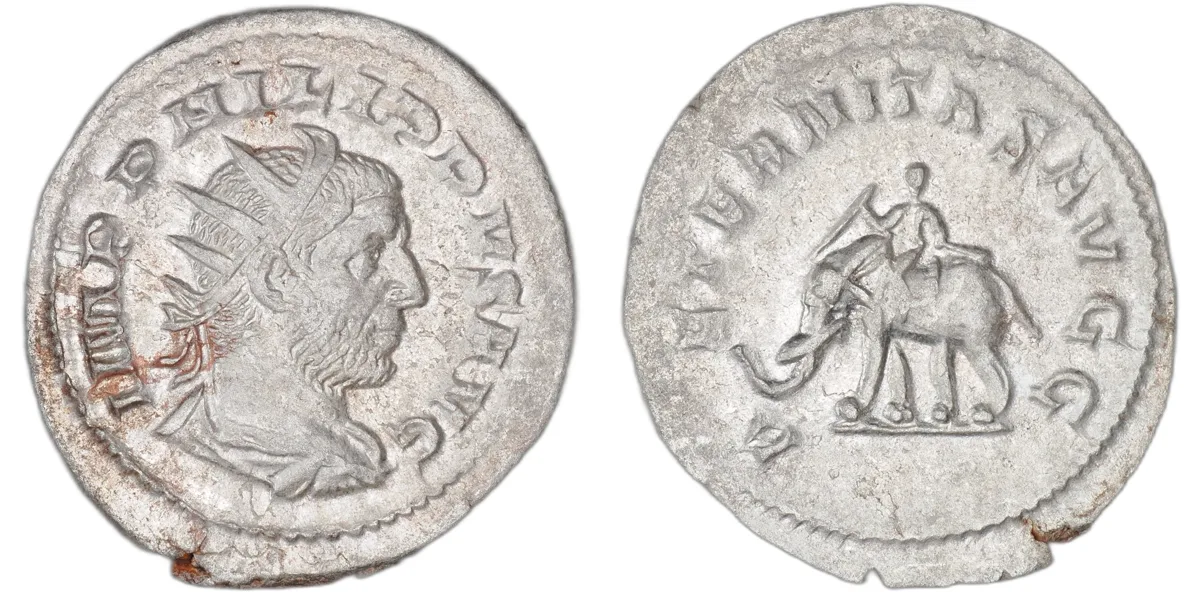
Philip I “the Arab,” A.D. 244-249. Antoninianus
Lot 268 · Consigned by NumisOne
Closed
Description
Philip I “the Arab,” A.D. 244-249. Antoninianus, Rome mint, struck for the Saecular Games, A.D. 248 Silver (AR) 24 mm, 3.97 g, die axis 12 h. Obv. IMP PHILIPPVS AVG – Radiate, draped and cuirassed bust of Philip I right, seen from behind. Rev. AETERNITAS AVGG – Elephant caparisoned and walking left, guided by mahout (cornac) seated atop; he holds a goad in his right hand and a wand in his left. RIC IV.III 58. Formerly encapsulated, NGC AU (Strike 4/5, Surface 4/5) 6291049-011
Brilliant silver with delicate champagne iridescence; sharply struck portrait and an unusually crisp rendering of the elephant’s skin and harness. A lustrous and eye-catching specimen of this sought-after Saecular Games type.
To celebrate Roma’s millennium (21 April A.D. 248), Philip I revived the ancient Ludi Saeculares (“Saecular Games”), an extravagant festival first staged by Augustus in 17 B.C. The programme lasted three days and nights, combining solemn religious rites with lavish spectacles: gladiatorial bouts, theatrical performances, wild-beast hunts, and staged animal processions designed to dazzle Rome’s populace.
The reverse of this antoninianus advertises those celebrations. The elephant—exotic, colossal, and closely associated with triumph—had featured in Augustus’ inaugural Saecular Games and re-appears here as a living emblem of Aeternitas, the promise that Rome would endure for another thousand years under the benevolent rule (AVGG, “of the two Augusti,” i.e., Philip and his son). Contemporary writers report that entire herds of wild beasts, including rhinos, hippos, giraffes, and elephants, were displayed and slain in the arena; the coin’s image immortalises that spectacular pledge of imperial munificence.
Numismatically, the Saecular Games issues form a highly collectable subset within Philip’s coinage, distinguished by their themed reverses (lion, elk, antelope, elephant, etc.) and relatively fine silver for the period. Well-preserved pieces such as the present example offer a vivid, miniature window onto one of the last great pagan festivals before the political crises of the later third century began to erode Rome’s confidence in its own eternity.