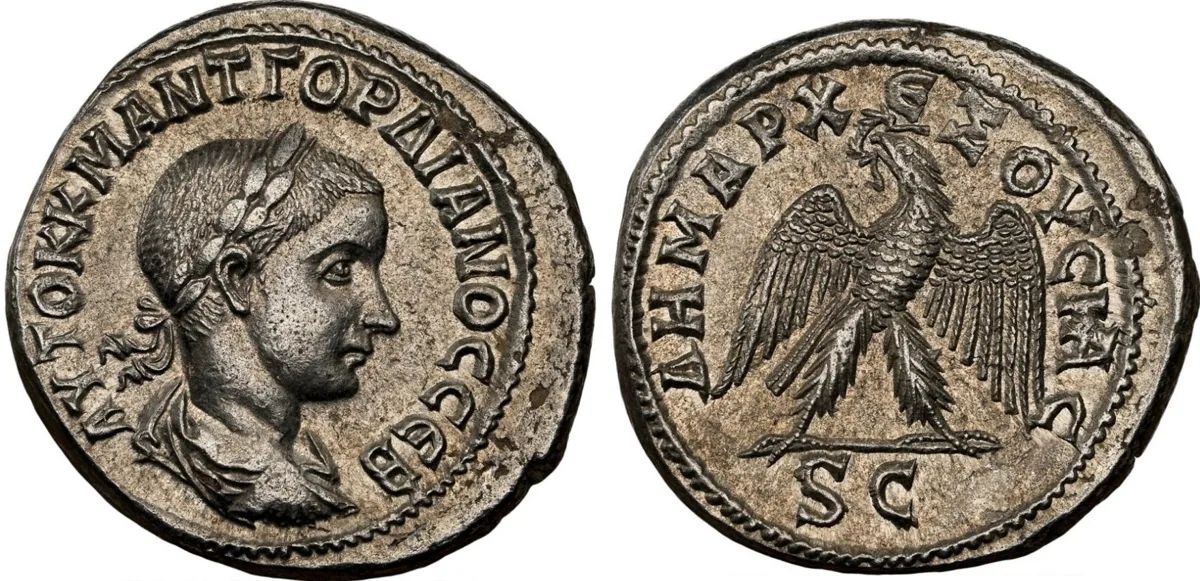
Gordian III, A.D. 238-244. Billon Tetradrachm, Antioch (Syria), A.D. 240
Lot 266 · Consigned by NumisOne
Closed
Description
Gordian III, A.D. 238-244. Billon Tetradrachm, Antioch (Syria), A.D. 240. 27 mm. Obv. AYTOK K M ANT ΓOPΔIANOC CЄB – Laureate, draped and cuirassed bust of Gordian III right, seen from behind. Rev. ΔHMAPX-ЄΞOYCIAC – Eagle standing facing, head and tail left, wings spread, holding wreath in beak; in exergue, SC. Ref. Prieur 282; McAlee 860; RPC VII.2, 3488. NGC graded Choice AU #6836537-035, removed from encapsulation. Glints of olive-gold toning over sharply preserved, satiny surfaces; a bold, almost medallic portrait and fully struck reverse details make this an exceptional survivor of Antioch’s prolific Severan mint.
Tetradrachms of Antioch were the lifeblood of imperial payrolls in the East, struck in a debased but still respectable silver alloy (billon) whose weight standard hovered around 13–14 grams. By A.D. 240, the teenage Gordian III had just assumed full tribunician power (Δημαρχικὴ ἐξουσία), a milestone proudly proclaimed on the reverse legend. The eagle clutching a victory wreath echoes both Roman legionary standards and the Hellenistic iconography long familiar in Syria, advertising the emperor’s protection of the Eastern provinces at a moment when Sasanian Persia was re-emerging as a threat.
The enigmatic letters SC (Senatus Consulto) at the exergue nod to the formal authority of Rome’s Senate, a token gesture meant to placate traditionalists even as real power lay with the Praetorian Guard and frontier armies. High-grade pieces such as this, with the full titulature crisply preserved, help anchor the complex dating sequence of Antiochene tetradrachms and stand as tangible proof of Gordian III’s brief but eventful reign.